
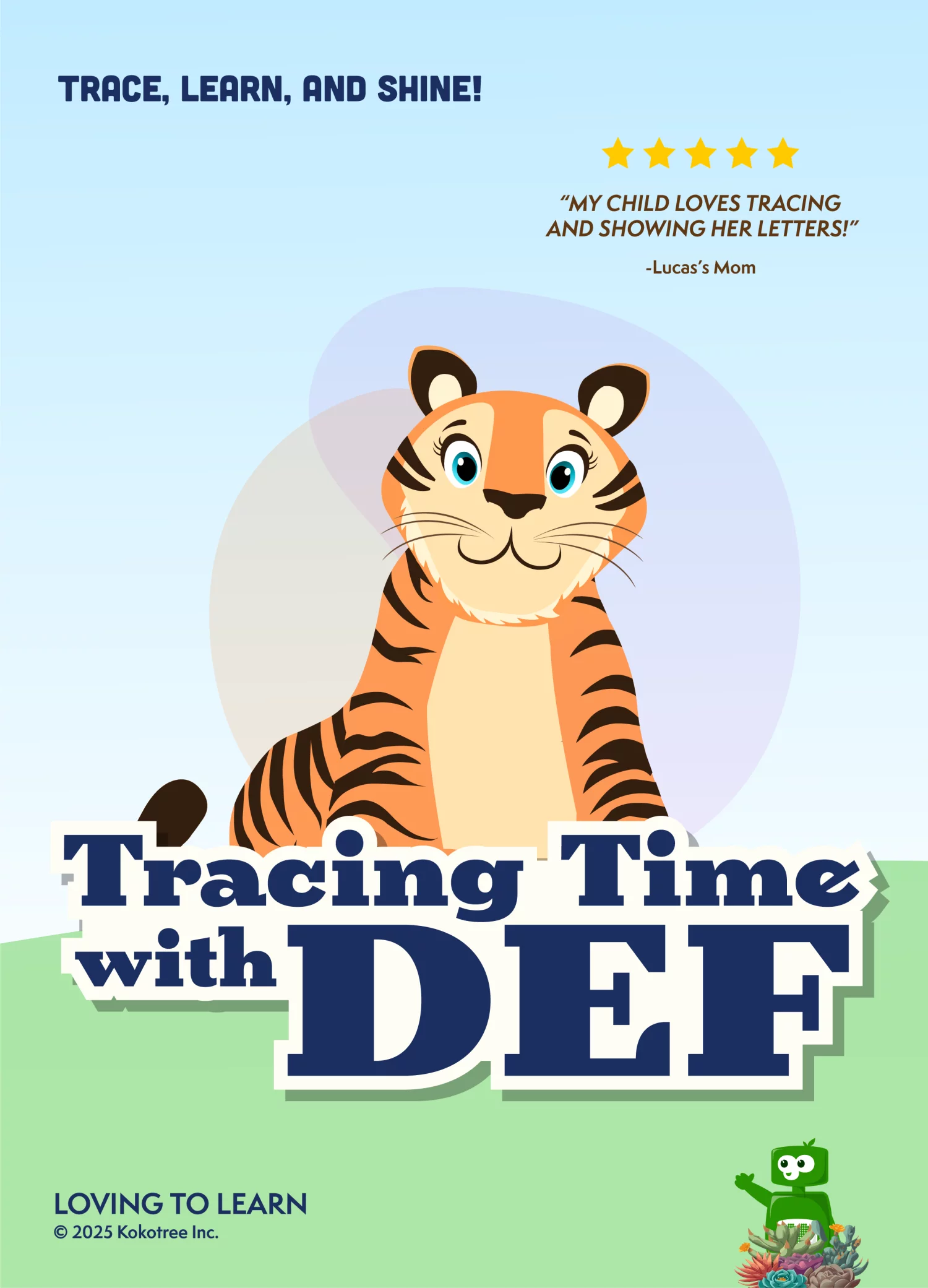
What's Tracing Time with D, E, & F About?
Your little one follows along with Miss Meera to trace uppercase and lowercase D, E, and F using fun, memorable instructions like "standing lines" and "sleeping lines." After watching, they'll be ready to practice writing these letters on their own!
6 minutes
Ages 3-5
Skill: Letter Formation & Handwriting Basics
Your kid watches Miss Meera demonstrate letter strokes step-by-step. You get 6 minutes to enjoy your coffee while it's still warm.
Miss Meera guides the Kokotree class through each letter twice, using kid-friendly language like "standing lines" for vertical strokes and "sleeping lines" for horizontal ones. The friendly animal students ask questions and cheer each other on, making your child feel like part of the classroom.
What your child learns:
This video builds essential pre-writing skills by breaking down each letter into simple, repeatable strokes. Your child learns to distinguish between uppercase ("Mother") and lowercase ("Baby") letters while developing the muscle memory needed for handwriting.
- Proper stroke order for uppercase and lowercase D, E, and F
- Understanding of writing guidelines (topline, midline, baseline)
- Distinction between uppercase and lowercase letter forms
- Fine motor control through curved and straight line practice
- Letter-object associations (D looks like a Door!)
They'll use these skills when:
- Writing their name if it contains D, E, or F
- Labeling their artwork or drawings at preschool
- Recognizing these letters on signs, books, and food packaging
- Playing letter games with friends or siblings
The Story (what keeps them watching)
Miss Meera welcomes her eager Kokotree class for a special tracing lesson. She introduces each letter like a friend—showing how uppercase D looks just like a door! Bobby asks for extra demonstrations, and Maddy chimes in about "Baby E," keeping the energy playful. Each letter gets two full practice rounds, so kids can trace along without feeling rushed. By the end, the whole class celebrates their new writing skills, and Miss Meera promises more fun lessons ahead.
How We Teach It (the clever part)
- First 2 minutes: Miss Meera introduces uppercase and lowercase D, using the "standing line" and "curve" technique. She connects D to a door for instant recognition.
- Minutes 2-4: The class tackles uppercase and lowercase E, learning about "sleeping lines" and the single-stroke lowercase e. Bobby and Maddy's questions model curiosity.
- Final 2 minutes: Uppercase and lowercase F wrap up the lesson, reinforcing the standing line foundation while adding the hook curve for lowercase f.
Teaching trick: Miss Meera uses consistent vocabulary ("standing line," "sleeping line," "midline") so kids build a mental toolkit they can apply to ANY letter—not just D, E, and F.
After Watching: Quick Wins to Reinforce Learning
- Mealtime activity: "Can you trace a D in the air before we eat?" Have your child use their finger to draw the letter while you name the strokes together. Builds muscle memory without any mess.
- Car/travel activity: "Let's find the letter E on signs!" Point out EXIT signs or store names. Ask if it's uppercase or lowercase to reinforce the difference.
- Bedtime activity: "Trace an F on my back and I'll guess the letter!" Take turns drawing letters on each other's backs. Sneaky handwriting practice disguised as a game.
- Anytime activity: "What has a door shape like the letter D?" Hunt around your home for curved shapes that match—refrigerator handles, rounded furniture, even sliced bread!
When Kids Get Stuck. And How to Help.
"My child keeps mixing up lowercase d and b." This is incredibly common and totally normal! Focus on the circle position: for d, the circle comes first (like "d starts with a belly"). Practice one letter at a time before comparing.
"They can trace but can't write independently yet." Tracing builds the neural pathways—independent writing comes next. Try dotted letters they can connect, then gradually fade the dots over several weeks.
"The lowercase e seems too complicated for my 3-year-old." Start with just the uppercase letters for younger kids. Lowercase e's single curved stroke is actually advanced—celebrate any attempt that's roughly circular!
What Your Child Will Learn
Prerequisites and Building Blocks
Children benefit most from this video if they can hold a crayon or pencil with a basic grip and have practiced simple strokes like vertical and horizontal lines. This lesson builds on earlier Kokotree videos covering letters A, B, and C, continuing the alphabetical progression. Understanding of "top," "middle," and "bottom" spatial concepts helps children follow Miss Meera's guideline references.
Cognitive Development and Teaching Methodology
The video uses explicit instruction with immediate repetition—each letter is demonstrated twice consecutively, supporting working memory in young learners. Miss Meera's consistent vocabulary ("standing line," "sleeping line") creates predictable patterns that reduce cognitive load. Visual demonstration paired with verbal narration addresses both visual and auditory learners, while the invitation to trace along engages kinesthetic processing.
Alignment with Educational Standards
This content aligns with Common Core Kindergarten standards for print concepts (RF.K.1) and letter formation expectations. The uppercase/lowercase distinction supports NAEYC literacy benchmarks for ages 4-5. Proper stroke order and baseline awareness reflect handwriting readiness indicators used in kindergarten screening assessments nationwide.
Extended Learning Opportunities
Pair this video with Kokotree's printable D, E, F tracing worksheets for tactile practice. The app's Letter Sandbox game lets children practice these letters with finger tracing on screen. Extend learning with playdough letter formation or sand tray writing. Follow up with the "D, E, F Phonics" video to connect letter shapes to their sounds.
Transcript Highlights
- "First, make a standing line. Then go back to the top, slide right and make a curve till the bottom of the standing line." (Clear sequential instruction for uppercase D)
- "Draw a circle below the middle line. Then, go back to the top line and draw a standing line just touching the circle till the bottom line." (Precise spatial language for lowercase d)
- "We use just one stroke to write the lowercase 'e'. So watch carefully." (Alerting children to increased complexity)
- "Start below the top line and make a curve back touching the top line, pull it straight down to the baseline." (Breaking down the tricky lowercase f hook)
Character Development and Story Arc
Miss Meera models patient, encouraging teaching—repeating demonstrations without frustration and celebrating every attempt. Bobby demonstrates that asking for help ("Can you show us again?") is welcomed and valued, normalizing the learning process. Maddy shows enthusiasm for vocabulary ("Baby E"), modeling curiosity about language. The collective "Yay!" responses from the Kokotree class create a supportive peer environment that encourages participation.
Letter Formation and Fine Motor Development Deep Dive
Letter formation is far more than memorizing shapes—it's a complex integration of visual perception, motor planning, and spatial awareness. When children learn to write D, E, and F, they're developing crucial pre-writing skills that form the foundation for all future handwriting.
The letters in this video strategically combine different stroke types. Uppercase D introduces the challenging curve-to-line connection, building the motor control needed for letters like B, P, and R. Uppercase E and F share a structural foundation (the standing line with horizontal branches), teaching children to recognize letter "families" and transfer skills efficiently.
Lowercase letters present unique challenges. The lowercase d requires starting with a circle then adding a line—the opposite direction from uppercase D. This distinction builds cognitive flexibility. Lowercase e's single continuous stroke develops the fluid motion needed for cursive readiness. Lowercase f introduces the "hook" curve starting below the topline, one of the more complex movements in the lowercase alphabet.
Miss Meera's use of guideline terminology (topline, midline, baseline) isn't arbitrary—it builds spatial vocabulary children will use throughout their school years. Understanding these reference points helps children size letters consistently and maintain proper proportions, key indicators of handwriting maturity that kindergarten teachers specifically assess.
The repetition strategy (showing each letter twice) leverages spaced repetition principles. The brief pause between demonstrations allows neural consolidation while the immediate second viewing reinforces correct motor patterns before incorrect habits form. This approach is particularly effective for procedural learning like letter formation.