
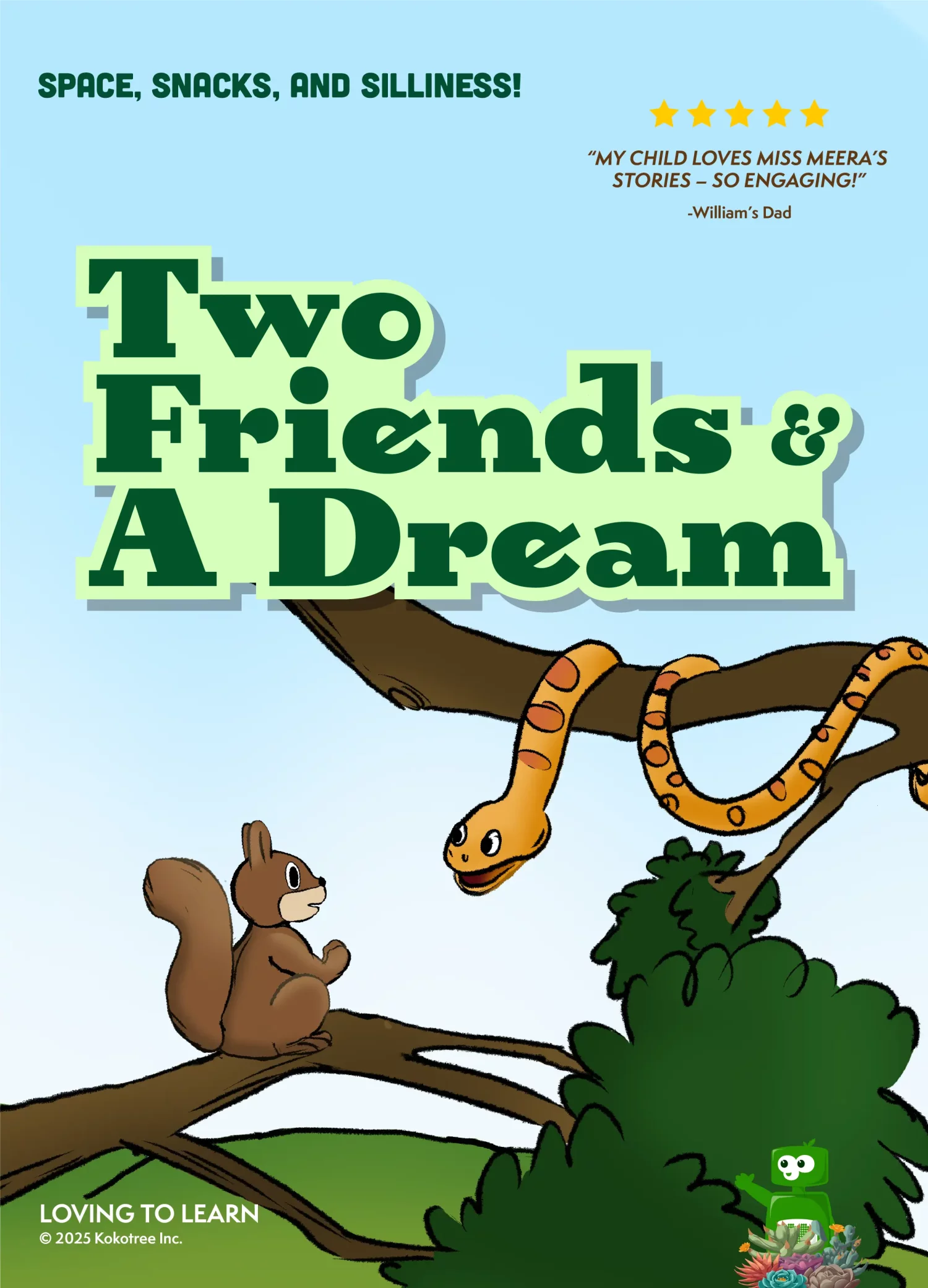
What's Two Friends And A Dream About?
Watch your little one discover the magic of the letter S through an imaginative story about two animal friends building a space shuttle! They'll hear dozens of S-words while learning that big dreams require teamwork, planning, and a good sense of humor.
3 minutes
Ages 3-6
Skill: Letter S recognition and phonics awareness
Your kid watches two friends dream big and build together. You get 3 minutes to enjoy your coffee in peace.
Snoopy Snake and Sammy Squirrel decide to build a space shuttle to visit Saturn and see the stars up close. They gather supplies, spend a week building, pack snacks, and discover they forgot something important—the engine! Instead of getting upset, they laugh together and plan for next Sunday.
What your child learns:
This story immerses children in the S sound through natural, repeated exposure. Every key word—from snake to space shuttle to strawberry shakes—reinforces letter recognition while the narrative teaches valuable lessons about planning, persistence, and friendship.
- Recognizes the letter S sound in multiple word positions
- Identifies S-words like snake, squirrel, space, stars, Saturn, and Sunday
- Understands basic problem-solving when things don't go as planned
- Learns that mistakes can be funny, not frustrating
- Practices listening comprehension through storytelling
They'll use these skills when:
- Spotting S-words on cereal boxes, signs, and books during everyday routines
- Sounding out new words that start with S while learning to read
- Building block towers or craft projects and problem-solving when something goes wrong
- Playing with friends and learning to laugh off silly mistakes together
The Story (what keeps them watching)
Snoopy Snake and Sammy Squirrel are best friends who dream of visiting space to see Saturn and the stars. They buy supplies—six wheels, two seats, screws, and silvery sheets—and spend seven days building their shuttle. When launch day arrives, they pack spinach sandwiches and strawberry shakes, climb aboard in their spacesuits, and... nothing happens! They forgot the engine! Instead of tears, there's laughter. They'll try again next Sunday, but today? Snacks under a sandalwood tree with a best friend sounds pretty perfect too.
How We Teach It (the clever part)
- First 1 minute: Introduces Snoopy Snake and Sammy Squirrel in a sandalwood forest, establishing the S-sound pattern through character names, setting, and the word "Summer Saturday."
- Minutes 1-2: Builds S-word exposure through action—space shuttle, stars, Saturn, store, six, seats, screws, silvery sheets, seven, Sunday, spacesuits.
- Final 1 minute: Reinforces learning with snack words (spinach sandwiches, strawberry shakes) and the gentle lesson that setbacks lead to smiles, not sadness.
Teaching trick: The story uses alliteration naturally—nearly every noun, verb, and descriptor starts with S. Children absorb the sound pattern without realizing they're in a phonics lesson because they're too busy wondering if the shuttle will launch!
After Watching: Quick Wins to Reinforce Learning
- Snack time activity: "Can you find something that starts with S on your plate?" (Practices identifying the S sound in real objects—strawberries, string cheese, sandwich, soup)
- Car/travel activity: "Let's spot things that start with S—signs, stores, the sun, the sky!" (Reinforces S recognition in the environment while keeping little ones engaged)
- Bedtime activity: "What would YOU pack for a space trip that starts with S?" (Encourages creative thinking while practicing the S sound—stars, stuffed animals, snacks, sleeping bag)
- Anytime activity: "Let's build something together like Snoopy and Sammy! What do we need?" (Connects the story to hands-on play while discussing supplies, steps, and solving problems)
When Kids Get Stuck. And How to Help.
- "My child doesn't notice all the S-words." - That's completely normal! The brain absorbs patterns even without conscious recognition. After a few viewings, casually ask "Did you hear how many words started with Ssssss?" and watch their eyes light up.
- "They got sad when the shuttle didn't work." - This is actually great! It means they're emotionally invested in the story. Use it as a conversation starter: "Snoopy and Sammy laughed—what would you do?" This builds resilience thinking.
- "The story seems too simple for my child." - Challenge them to count all the S-words they hear, or ask them to retell the story using as many S-words as they can remember. Same video, leveled-up learning!
What Your Child Will Learn
Prerequisites and Building Blocks
Children watching this video benefit from basic story-listening skills and familiarity with the alphabet. This episode builds on foundational letter awareness and connects to other phonics content in the Budding Sprouts program. It's ideal for children who recognize some letters and are ready to connect letters with their sounds. The narrative structure supports children transitioning from letter identification to phonemic awareness—the crucial skill of hearing sounds within words.
Cognitive Development and Teaching Methodology
This video leverages the power of alliterative storytelling, a research-backed approach for phonemic awareness development. Preschoolers learn best through repetition embedded in meaningful context—not isolated drills. The narrative engages auditory learners through the rhythmic S-sounds, visual learners through the animated story, and kinesthetic processors who naturally want to "build" after watching. The problem-solving element activates higher-order thinking while maintaining age-appropriate simplicity.
Alignment with Educational Standards
This content aligns with Common Core Foundational Skills for Reading (RF.K.2, RF.K.3) focusing on phonological awareness and phonics. It supports kindergarten readiness indicators for letter-sound correspondence and listening comprehension. The narrative structure addresses language standards for vocabulary acquisition through context. Teachers expect entering kindergarteners to recognize common letter sounds—this video provides exactly that exposure in an engaging, memorable format.
Extended Learning Opportunities
Pair this video with letter S tracing worksheets or sensory activities like drawing S in sand or salt. Explore related Kokotree content featuring other letter sounds to build a complete phonics foundation. Extend learning with a simple building activity using household items—blocks, boxes, cushions—while narrating with S-words. Create a "Space Snack" together using S-foods: strawberries, sunflower seeds, or star-shaped crackers.
Transcript Highlights
- "Snoopy snake and Sammy squirrel were swinging down from the sandalwood tree" — Dense alliteration introduces the S-sound naturally
- "They bought six wheels, two seats, some screws and a few silvery sheets" — Combines S-sound practice with counting and material identification
- "They packed some spinach sandwiches and strawberry shakes for the trip" — Connects phonics to familiar food vocabulary
- "So even though they didn't get to go to space yet, they could still make each other smile" — Models positive response to setbacks
Character Development and Story Arc
Snoopy Snake and Sammy Squirrel model ideal learning behaviors throughout this story. They demonstrate curiosity (wondering about space), collaboration (building together), and resilience (laughing at their mistake rather than giving up). When their shuttle fails to launch, they don't cry or blame each other—they identify the problem, make a plan, and enjoy the present moment. This growth mindset modeling teaches children that setbacks are temporary and friendship matters more than perfect outcomes.
Phonemic Awareness and Alliterative Storytelling Deep Dive
Phonemic awareness—the ability to hear, identify, and manipulate individual sounds in spoken words—is the single strongest predictor of early reading success. This video employs alliterative storytelling, a technique where nearly every significant word shares an initial sound, creating an immersive phonics environment.
The S-sound is particularly valuable for early learners because it's a continuant consonant—you can stretch it ("Ssssssnake") without distorting it, unlike stop consonants like B or T. This stretchability helps children isolate and identify the sound more easily.
The story contains over 40 S-words across just three minutes, including: Snoopy, Snake, Sammy, Squirrel, southern, sandalwood, Summer, Saturday, sun, shining, swinging, suddenly, space, shuttle, stars, Saturn, soon, store, stuff, six, seats, screws, silvery, sheets, seven, Sunday, spinach, sandwiches, strawberry, shakes, spacesuits, sat, start, something, silliness, shall, snacks, smile.
This density creates what linguists call "phonological priming"—the brain becomes sensitized to the target sound and begins recognizing it automatically. Children don't need to consciously count S-words; their auditory processing systems naturally attune to the pattern.
The narrative context is crucial. Research shows that sounds learned in meaningful stories transfer to reading more effectively than sounds learned in isolation. When children later encounter "snake" or "space" in print, they'll have rich mental associations to support decoding.
The story also introduces the concept that S can appear in different word positions—beginning (snake), middle (missing), and end (goodness)—though the emphasis remains on initial sounds appropriate for this developmental stage.