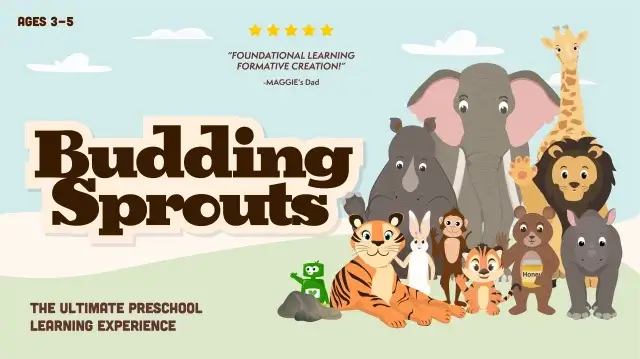

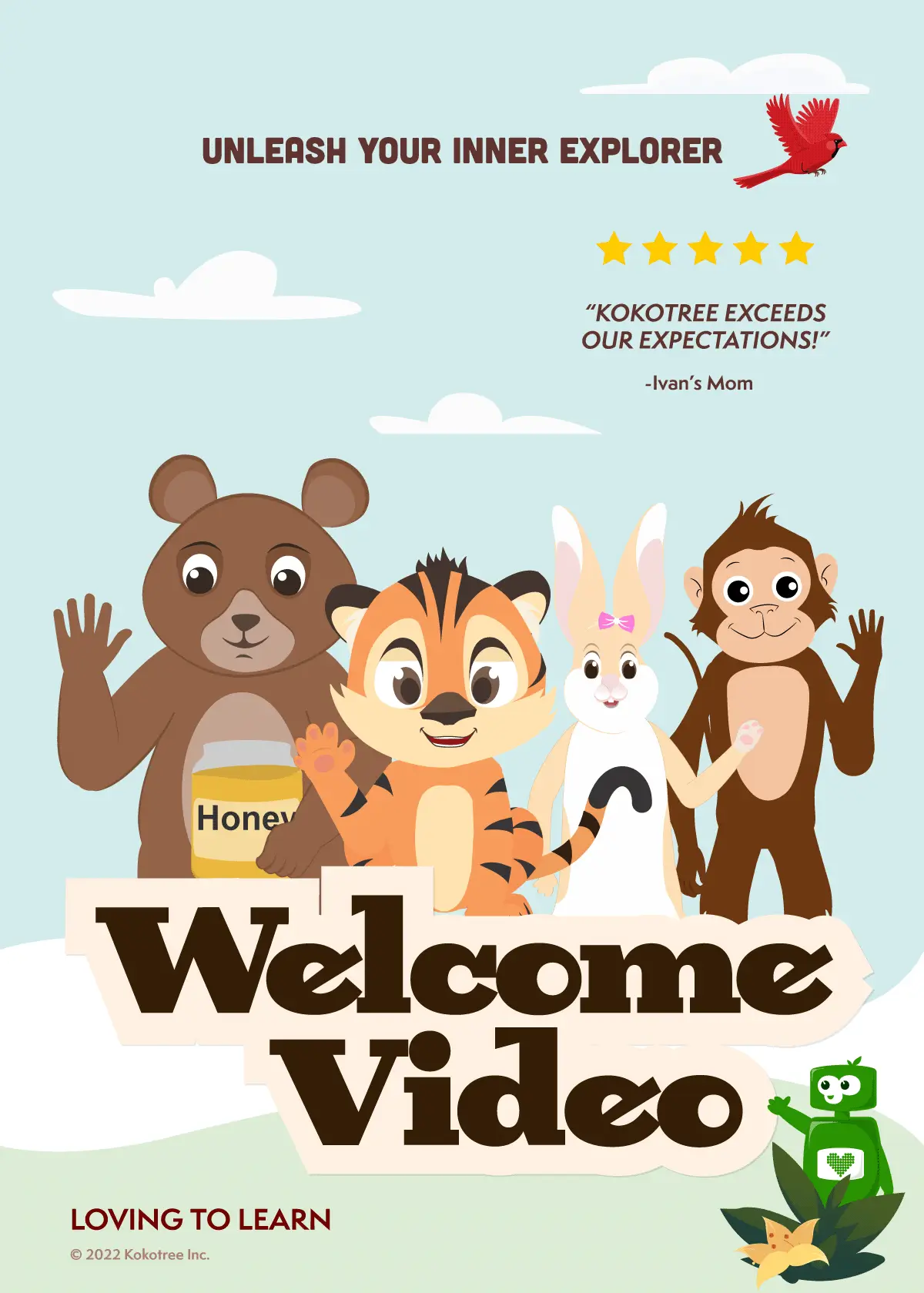
What's Welcome to Budding Sprouts About?
Your child meets their new animal teachers and classmates in the Kokotree jungle! They'll learn about different habitats, discover jungle animals, and get excited about the learning adventures ahead in letters, numbers, and science.
6.5 minutes
Ages 1-6
Skill: Social introduction and habitat awareness
Your kid watches friendly animals introduce themselves in a jungle. You get 6 minutes to finish that cup of coffee.
Elizabeth the Elephant welcomes your child to the Kokotree jungle, pointing out animals like zebras, hippos, and monkeys near the river. Then each teacher—Looka the Lion (science), Meera the Tiger (English), and Rocko the Rhino (math)—introduces themselves and what they'll teach. Finally, six young animal classmates come out from hiding spots to say hello.
What your child learns:
This video builds foundational social skills and introduces key concepts your child will explore throughout the Kokotree program. They'll hear about different environments and get familiar with the characters who will guide their learning journey.
- Identifies jungle animals by name (alligators, hippos, zebras, monkeys, giraffes)
- Recognizes different habitats (jungle, city, mountains, ocean)
- Associates teachers with subjects (lion teaches science, tiger teaches English, rhino teaches math)
- Practices counting along with Rocko (1, 2, 3)
- Hears the alphabet song (A through G)
They'll use these skills when:
- Spotting animals at the zoo and naming them confidently
- Pointing out different places in picture books ("That's the ocean!")
- Getting excited about learning letters and numbers in future videos
- Meeting new friends and understanding that everyone has different interests
The Story (what keeps them watching)
Elizabeth the Elephant takes your child on a gentle tour of the Kokotree jungle, pointing out hippos splashing in the river and monkeys swinging through trees. Then it's time to meet the teachers! Looka the Lion gives a friendly roar before explaining he'll teach science. Meera the Tiger sings a bit of the alphabet song, and Rocko the Rhino counts to three. The best part? Six young animal classmates—including shy little Tiki Tiger—come out from their hiding spots behind bushes and trees to introduce themselves. By the end, your child has a whole crew of new friends ready to learn alongside them.
How We Teach It (the clever part)
- First 2 minutes: Elizabeth introduces the jungle setting, naming animals and where they live (trees, ground, water). This builds vocabulary through visual association.
- Minutes 2-5: Each teacher introduces themselves and previews their subject—Looka mentions animals and plants, Meera sings ABCs, Rocko counts. This creates anticipation for future lessons.
- Final 1.5 minutes: Child characters emerge one by one from hiding spots, modeling friendly introductions and showing different personalities.
Teaching trick: The video uses a "reveal" technique—animals hiding behind trees and bushes, then popping out to introduce themselves. This peek-a-boo style keeps toddlers engaged and models that new friends are exciting, not scary.
After Watching: Quick Wins to Reinforce Learning
- Mealtime activity: "Can you roar like Looka the Lion?" Have your child make animal sounds from the video while eating. (Reinforces animal names and builds connection to characters)
- Car/travel activity: "What animals live in water like the hippos and alligators?" See if they can name water animals from the video or add new ones. (Practices habitat categorization)
- Bedtime activity: "If you were hiding like Tiki Tiger, where would you hide?" Point to spots in their room. (Builds spatial vocabulary and imagination)
- Anytime activity: "Let's count to three like Rocko! 1, 2, 3!" Count fingers, toys, or snacks together. (Reinforces early counting skills introduced in the video)
When Kids Get Stuck. And How to Help.
- "My child can't remember all the animal names." - Totally normal! This video introduces many animals at once on purpose—it's about exposure, not memorization. Watch again and pause to practice just 2-3 animal names each time.
- "They seem more interested in the characters than the learning parts." - That's exactly the goal of this introduction video! Building attachment to Elizabeth, Looka, and the gang means your child will be excited to learn from them in future lessons.
- "My toddler got distracted during the teacher introductions." - The teacher segments move quickly by design. Your child will meet these characters many more times. Even partial attention builds familiarity that pays off later.
What Your Child Will Learn
Prerequisites and Building Blocks
This introductory video requires no prior Kokotree experience—it's designed as the perfect starting point. Children benefit from basic receptive language skills (understanding simple sentences) and brief exposure to animal names. This video establishes the foundational relationship between your child and the Kokotree characters, creating emotional investment that enhances learning retention in all subsequent videos across literacy, numeracy, and science curricula.
Cognitive Development and Teaching Methodology
The video leverages parasocial relationship development, a well-documented phenomenon where children form bonds with media characters that support learning. The slow-paced narration (appropriate for 3-year-olds) allows auditory processing time. Visual learners benefit from the jungle scenes and character reveals, while the invitation to roar and count engages kinesthetic learners. The hide-and-seek element activates object permanence understanding.
Alignment with Educational Standards
This video addresses Head Start Early Learning Outcomes Framework domains including Approaches to Learning (showing curiosity) and Social-Emotional Development (forming relationships). It introduces Science Knowledge (living things and habitats) and supports Language and Literacy foundations. The counting sequence (1-2-3) and alphabet snippet align with kindergarten readiness math and literacy benchmarks.
Extended Learning Opportunities
Pair this video with animal flashcard activities or a simple habitat sorting game (water animals vs. land animals). The Kokotree app includes character-based games featuring Elizabeth, Looka, Meera, and Rocko that reinforce this introduction. Consider creating a simple "Kokotree friends" poster where your child can point to characters as they appear in future videos, building recognition and excitement.
Transcript Highlights
- "These animals live in trees, on the ground, and in the water. The jungle is a warm and beautiful place." (Habitat vocabulary)
- "Numbers are a way to count things. We use numbers to say how many things there are. Count with me... 1, 2, 3." (Math concept introduction)
- "I'm going to teach you the alphabet and how to read. A, B, C, D, E, F, G." (Literacy preview)
- "I might be a little shy right now, but my mom says I will be a big cat soon." (Modeling growth mindset for shy children)
Character Development and Story Arc
Each character models positive learning dispositions. Elizabeth demonstrates warmth and encouragement as a guide. Looka shows enthusiasm for his subject ("fascinating world"). Tiki Tiger specifically models that it's okay to be shy—he comes out of hiding when encouraged by friends, showing children that new situations become comfortable with support. The child characters demonstrate diverse personalities (studious Gina, sporty Ruby) showing that all types of learners belong.
Social-Emotional Foundations and Learning Readiness Deep Dive
This introduction video serves a crucial developmental purpose beyond content delivery: it establishes psychological safety for learning. Research in early childhood education consistently shows that children learn best when they feel emotionally secure. By introducing friendly, consistent characters who will appear throughout the curriculum, Kokotree creates what developmental psychologists call a "secure base" for exploration.
The video's structure mirrors how quality preschool classrooms begin the year—with relationship building before academic content. Elizabeth's warm greeting ("Nice to meet you") and reassurance ("It's gonna be so much fun!") reduces anxiety about new experiences. The teacher introductions preview subjects without pressure, building positive associations with letters, numbers, and science before formal instruction begins.
Particularly notable is the inclusion of Tiki Tiger, who models appropriate shyness and demonstrates that hesitation is normal and accepted. When Ronnie encourages Tiki to "come out and meet your new friends," it shows gentle peer support without forcing participation—an important distinction for children who need extra transition time.
The habitat content (jungle, ocean, mountains, city) introduces early science concepts through exploration rather than instruction. Children at this developmental stage learn spatial and categorical thinking through exposure to diverse environments. Naming where animals live ("trees, ground, water") builds classification skills that transfer to later academic sorting and categorization tasks.
The brief counting and alphabet segments serve as "trailers" for coming content, activating curiosity without creating performance pressure—ideal for building intrinsic motivation in early learners.