
What's Single Letter Phonics About?
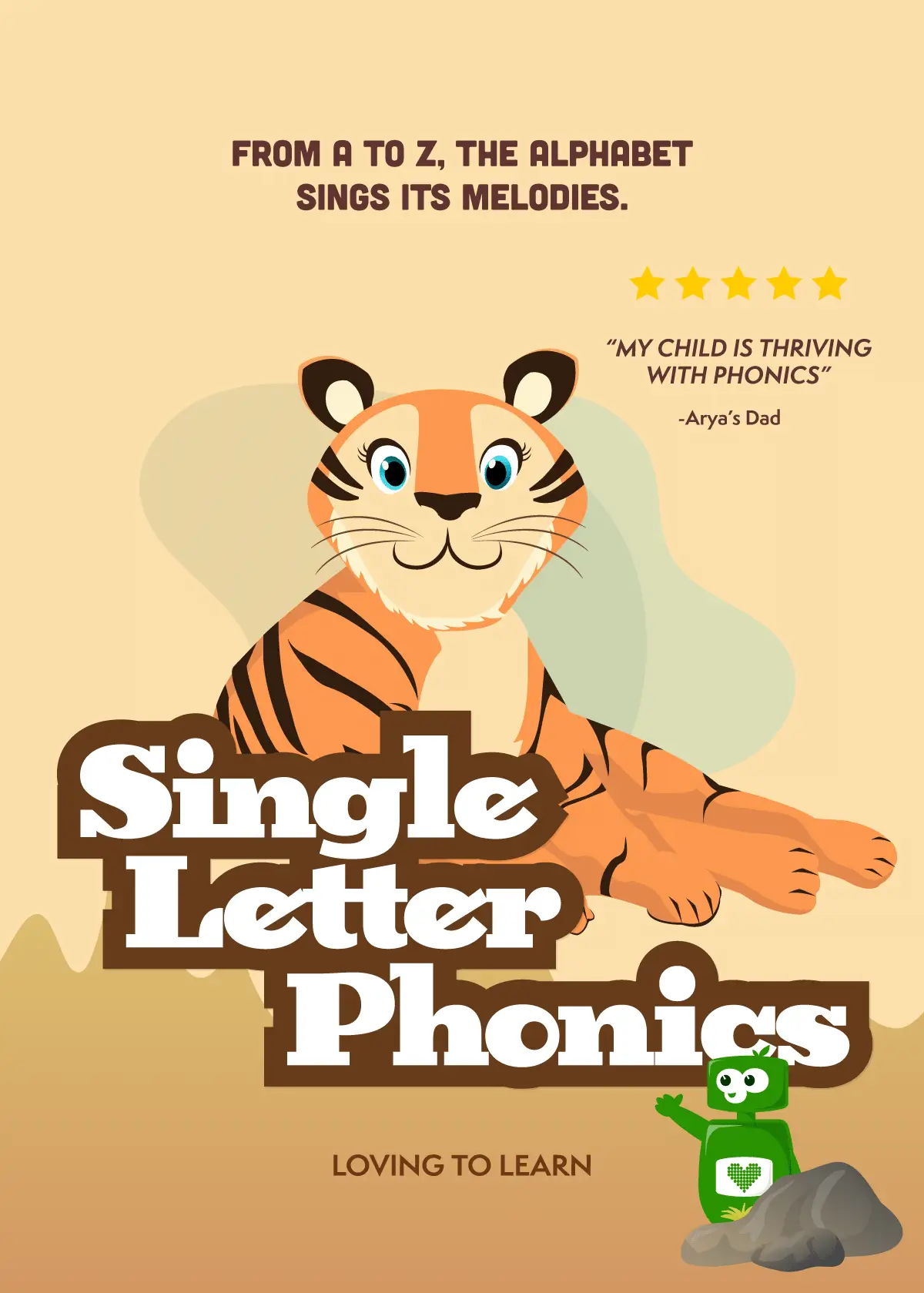
Your little one joins Meera the tiger for a friendly introduction to the sounds every letter makes. After watching, they'll start connecting letters to sounds—the essential first step toward reading!
3 minutes
Ages 2-5
Skill: Letter sounds (phonemic awareness)
Your kid watches Meera teach all 26 letter sounds clearly. You get 3 minutes to [drink your coffee while it's still warm].
Meera the tiger appears in a peaceful jungle setting and introduces the alphabet. The screen then shows each letter (uppercase and lowercase) on a clean black background while Meera pronounces each sound three times, giving your child time to repeat along.
What your child learns:
This video builds phonemic awareness—the understanding that letters represent sounds. Your child hears each of the 26 letter sounds pronounced clearly and consistently, creating the mental connections between written symbols and spoken language.
- Recognizes all 26 letters of the alphabet (uppercase and lowercase)
- Hears the distinct phonetic sound each letter makes
- Practices auditory discrimination between similar sounds
- Builds the foundation for blending sounds into words
- Develops listening skills through repetition
They'll use these skills when:
- Spotting the first letter of their name on a birthday card
- Sounding out words on cereal boxes at breakfast
- Playing "I Spy" games with letters at the grocery store
- Recognizing letters on playground signs and storefronts
The Story (what keeps them watching)
Meera the tiger welcomes your child to a jungle classroom with one exciting mission: learn the sounds of every letter! She shows the full alphabet, then takes kids through each letter one by one. The clean, simple format keeps little eyes focused—no distractions, just letters and sounds. Meera pronounces each sound three times with pauses, inviting kids to say it back. By the end, your child has heard all 26 sounds and gets a cheerful reminder from Meera to practice every day. Simple, effective, and perfectly repeatable!
How We Teach It (the clever part)
- First 30 seconds: Meera introduces herself and explains what phonics are, showing the complete alphabet to give context
- Minutes 0:30-2:30: Each letter appears individually with its sound pronounced three times, allowing processing time and verbal practice
- Final 30 seconds: Meera celebrates the accomplishment and encourages daily practice to build memory
Teaching trick: The three-time repetition with pauses isn't random—it matches how young brains need to hear new sounds to store them in memory. The pause gives your child time to attempt the sound themselves!
After Watching: Quick Wins to Reinforce Learning
- Mealtime activity: "What sound does your banana start with? Buh-buh-banana!" (Reinforces connecting sounds to familiar objects they can see and touch)
- Car/travel activity: "Let's find something that starts with the 'sss' sound!" (Practices identifying beginning sounds in the real world)
- Bedtime activity: "What sound does your name start with? Let's whisper it together." (Makes phonics personal and creates a calming routine)
- Anytime activity: Point to letters on book covers and ask "What sound does this one make?" (Builds letter-sound recognition in everyday moments)
When Kids Get Stuck. And How to Help.
- "My child just watches but won't repeat the sounds." - Totally normal! Receptive learning (listening) comes before expressive learning (speaking). Keep watching together, and one day they'll surprise you by joining in.
- "They mix up similar sounds like 'b' and 'd'." - These sounds are tricky because they're made the same way in the mouth! Focus on one at a time and use silly exaggeration: "Buh-buh-BIG balloon!"
- "Is 3 minutes enough to actually learn anything?" - Short and repeatable beats long and forgotten! Daily 3-minute sessions build stronger memory pathways than occasional long sessions.
What Your Child Will Learn
Prerequisites and Building Blocks
Children watching this video benefit from basic listening skills and some letter recognition familiarity. This video serves as an excellent entry point to the Kokotree phonics curriculum, introducing isolated letter sounds before progressing to blending and word-building. It pairs well with alphabet recognition videos and prepares children for CVC (consonant-vowel-consonant) word activities. No prior phonics knowledge is required—this is foundational content designed for true beginners.
Cognitive Development and Teaching Methodology
The teaching approach leverages spaced repetition—each sound is pronounced three times with deliberate pauses. This matches how 2-5 year olds process auditory information, requiring multiple exposures to encode new sounds into long-term memory. The clean visual presentation (letter on black background) reduces cognitive load, allowing full attention on the auditory component. This multi-sensory approach connects visual symbols with auditory sounds, strengthening neural pathways essential for reading.
Alignment with Educational Standards
This video directly supports pre-kindergarten literacy standards focusing on phonemic awareness. Children demonstrate understanding that spoken words are made up of sequences of sounds (CCSS.ELA-LITERACY.RF.K.2). The content aligns with kindergarten readiness indicators requiring children to recognize and produce rhyming words and identify beginning sounds. Teachers expect incoming kindergarteners to know most letter sounds—this video builds exactly that foundation.
Extended Learning Opportunities
Pair this video with Kokotree's letter tracing activities to connect sounds with letter formation. Alphabet matching games in the app reinforce visual recognition alongside phonetic knowledge. Parents can create simple sound sorting games using household objects. Consider watching related videos on beginning sounds in words after mastering isolated letter sounds. Printable letter cards make excellent car activities for continued practice.
Transcript Highlights
- "There are 26 letters in the alphabet. Each letter makes a sound." - Clear, simple explanation of the core concept
- "Just follow my voice, and follow along. Ready? Let's go." - Invites active participation
- "Make sure you practice this every day." - Establishes the importance of repetition for mastery
- "Wow, phonics are fun!" - Positive association with learning sounds
Character Development and Story Arc
Meera the tiger models the role of an encouraging, patient teacher. Her warm greeting ("I'm so happy to see you") creates emotional safety for learning. She demonstrates clear instruction-giving, showing children what good teaching looks like. Her celebration at the end ("Wow, phonics are fun!") models enthusiasm for learning and a growth mindset. The reminder to practice daily shows persistence as a value, teaching children that mastery comes through repeated effort.
Phonemic Awareness: The Gateway to Reading
Phonemic awareness—the ability to hear, identify, and manipulate individual sounds in spoken words—is the single strongest predictor of early reading success. This video targets the most foundational phonemic skill: understanding that letters represent sounds.
Unlike letter names ("ay, bee, see"), letter sounds ("ah, buh, kuh") are what children actually use when decoding words. When a child sees "cat," they don't think "see-ay-tee"—they blend "kuh-ah-tuh." This video teaches the sounds children will actually use for reading.
The three-repetition format serves a specific purpose in auditory processing. Young children need multiple exposures to distinguish between similar phonemes. The sounds for 'b' and 'p' or 'm' and 'n' differ only slightly, and repeated listening helps the brain categorize these subtle differences.
Research shows that children who master isolated letter sounds before attempting blending have significantly higher reading fluency by first grade. This video provides that crucial first step—clear, consistent pronunciation of each sound without the confusion of trying to blend too early.
The video's design also supports children learning English as an additional language, as the sounds are presented without cultural context, making them accessible to learners worldwide. The visual pairing of uppercase and lowercase letters builds automatic recognition that transfers directly to reading readiness.