
What's Counting by 2s, 5s, & 10s About?
Your child joins Rocko and friends on an outdoor math adventure, learning to skip count using real-world objects! They'll master counting by 2s, 5s, and 10s—turning "one, two, three" into lightning-fast number jumps.
5.5 minutes
Ages 3-6
Skill: Skip counting patterns
Your kid watches friendly animals count tadpoles, bananas, and flowers. You get 5 minutes to finish that cup of coffee.
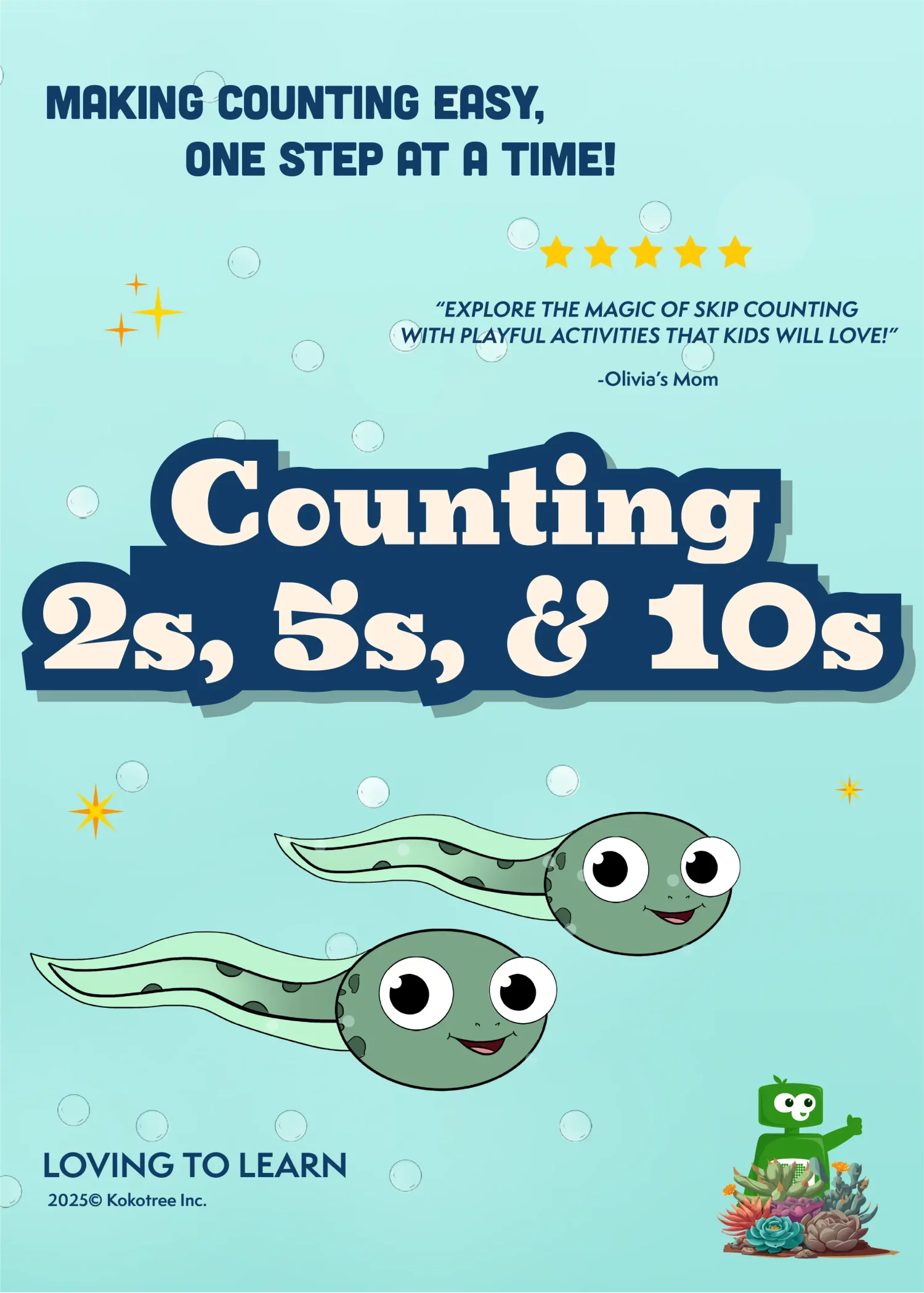
The Kokotree classroom moves outdoors to a peaceful pond where tadpoles swim in pairs. Rocko the math teacher guides the children through three counting adventures—first with wiggly tadpoles swimming two-by-two, then with piles of bananas in bunches of five, and finally with flowers that have exactly ten petals each.
What your child learns:
Skip counting is a foundational math skill that builds number sense and prepares kids for multiplication. Your child will understand that counting doesn't always mean "one at a time"—sometimes we can take bigger jumps!
- Counts by 2s up to 20 (2, 4, 6, 8, 10...)
- Counts by 5s up to 30 (5, 10, 15, 20...)
- Counts by 10s up to 100 (10, 20, 30...)
- Recognizes patterns in number sequences
- Understands that bigger skip counts reach higher numbers faster
They'll use these skills when:
- Counting pairs of socks while helping with laundry
- Figuring out how many fingers are on both hands (and toes!)
- Counting coins or small toys in groups
- Playing counting games with friends at the playground
The Story (what keeps them watching)
The adventure starts when the Kokotree kids discover tadpoles swimming in a pond. Rocko explains that tadpoles are baby frogs—they breathe through gills and will eventually grow legs! But the real fun begins when Rocko shows everyone how to count the tadpoles in pairs. Ruby and Eddie take turns, making adorable mistakes along the way (Eddie accidentally says "five" after "four"—oops!). Then Maddy and Eddie get excited about a pile of bananas, learning to count by 5s before munching their reward. The lesson wraps up with beautiful flowers, each with 10 petals, as Tiki proudly reaches 100!
How We Teach It (the clever part)
- First 2 minutes: Rocko introduces skip counting through tadpole pairs. Kids see that counting "2, 4, 6" is faster than "1, 2, 3, 4, 5, 6." Characters make relatable mistakes and self-correct.
- Minutes 2-4: The concept expands to counting by 5s with bananas. Children see the pattern grow—5, 10, 15, 20—and understand that bigger jumps mean faster counting.
- Final 1.5 minutes: Counting by 10s with flower petals shows how quickly we can reach 100. A visual recap board shows all three patterns side by side.
Teaching trick: Each counting method uses a different object (tadpoles, bananas, flowers), so children connect the abstract number pattern to concrete, countable things. When characters make mistakes and correct themselves, it normalizes the learning process.
After Watching: Quick Wins to Reinforce Learning
- Mealtime activity: "Can you count the grapes on your plate by 2s?" (Group them in pairs first, then let your child hop through the numbers. Works with any small food!)
- Car/travel activity: "Let's count by 10s every time we see a red car!" (Start at 10 and see how high you can go. Great for building anticipation and number fluency.)
- Bedtime activity: "Count your fingers by 2s—how many do you have?" (Touch each pair together as you count: 2, 4, 6, 8, 10. Then try toes!)
- Anytime activity: "How many steps to the kitchen? Let's count by 5s!" (Take five steps, say "5!" Take five more, say "10!" Makes walking anywhere a math game.)
When Kids Get Stuck. And How to Help.
- "My child keeps slipping back to counting by 1s." - Totally normal! Skip counting feels unnatural at first because they've practiced 1-2-3 for so long. Try clapping or hopping on each number to make the "skip" physical and memorable.
- "They mix up the patterns—saying 2, 4, 5 instead of 2, 4, 6." - This shows they're thinking! The patterns take time to become automatic. Practice one skip count at a time until it clicks, then add the next.
- "Counting by 10s to 100 seems too hard for my 3-year-old." - Start smaller! Counting by 10s to 30 or 40 is a great beginning. The video exposes them to 100, but mastery comes with repeated, low-pressure practice over months.
What Your Child Will Learn
Prerequisites and Building Blocks
Children benefit most from this video when they can already count sequentially from 1-20 and recognize written numerals. This lesson builds on basic one-to-one counting correspondence and introduces the concept of number patterns. It serves as a bridge between rote counting and early multiplication concepts. In the Kokotree learning progression, this follows basic number recognition and precedes more complex pattern work and early addition strategies.
Cognitive Development and Teaching Methodology
Skip counting leverages preschoolers' natural pattern recognition abilities while building procedural memory through repetition. The video uses concrete-representational-abstract (CRA) methodology—starting with physical objects (tadpoles, bananas, flowers), showing visual number representations (floating bubbles), then presenting the abstract pattern on a summary board. Multiple characters attempting the skill addresses varied learning paces, while kinesthetic learners benefit from the animated "twirling" that accompanies each count.
Alignment with Educational Standards
This video addresses Common Core Math Standard K.CC.1 (count to 100 by ones and tens) and builds toward 2.NBT.A.2 (skip count by 5s). Kindergarten readiness assessments frequently include skip counting by 10s to 100. The progression from 2s to 5s to 10s mirrors typical early elementary curriculum sequencing. Teachers expect incoming kindergarteners to demonstrate emerging skip counting awareness, making this video excellent preparation.
Extended Learning Opportunities
Pair this video with printable number line worksheets highlighting skip count patterns. The Kokotree app includes interactive games where children tap objects in groups of 2, 5, or 10. Extend learning with a "skip count scavenger hunt"—find things that come in pairs (shoes, eyes), fives (fingers), or tens (toes). Egg cartons make excellent manipulatives for practicing groups of 2 and 6.
Transcript Highlights
- "When you count by 2s, one pair is 2, two pairs make 4, three pairs 6… see how quickly we jump along numbers?"
- "Hold on, Eddie! After four, we jump another two, which lands on six—not five. Give it another go!"
- "When we count by 5s, we add 5 each time. The first bunch is 5 bananas, then adding another 5 is 10, then 15, 20…"
- "It's like taking giant steps through numbers! Let me try: 10, 20, 30, 40, 50, 60, 70, 80, 90… and 100!"
Character Development and Story Arc
The characters model authentic learning behaviors throughout. Ruby initially counts "one, two, three" before self-correcting to skip counting—demonstrating that mistakes are part of learning. Eddie's error (saying "five" after "four") and gentle correction from Rocko shows how to handle confusion without shame. Tiki's excitement at reaching 100 models mathematical confidence. Maddy's enthusiasm about bananas keeps engagement high while showing that math connects to things children love.
Mathematical Foundations of Skip Counting
Skip counting is far more than a memorization trick—it builds foundational number sense that supports mathematical thinking for years. When children count by 2s, they're discovering that numbers exist in patterns and relationships, not just as isolated symbols. This pattern recognition is the cognitive precursor to multiplication (3 groups of 2 equals 6) and division (12 split into pairs makes 6 groups).
The video strategically sequences the skip counts from smallest to largest jumps (2s → 5s → 10s), allowing children to notice that bigger jumps reach higher numbers faster. This builds proportional reasoning—understanding that 10 is "more" than 2 in a functional way.
Counting by 5s specifically prepares children for telling time (clock faces move by 5s) and money concepts (nickels). Counting by 10s establishes place value understanding—the cornerstone of our base-10 number system. When children fluently count "10, 20, 30," they're internalizing that each decade represents a complete group of ten.
The use of concrete objects (tadpoles, bananas, flowers) isn't arbitrary. Research shows that children ages 3-6 are in Piaget's preoperational stage, requiring tangible representations before abstract understanding develops. By connecting number patterns to real, countable things, the video builds mental models children can reference when skip counting becomes purely verbal.