
What's Discovering Digraphs: Ph, Wh, & Gh About?
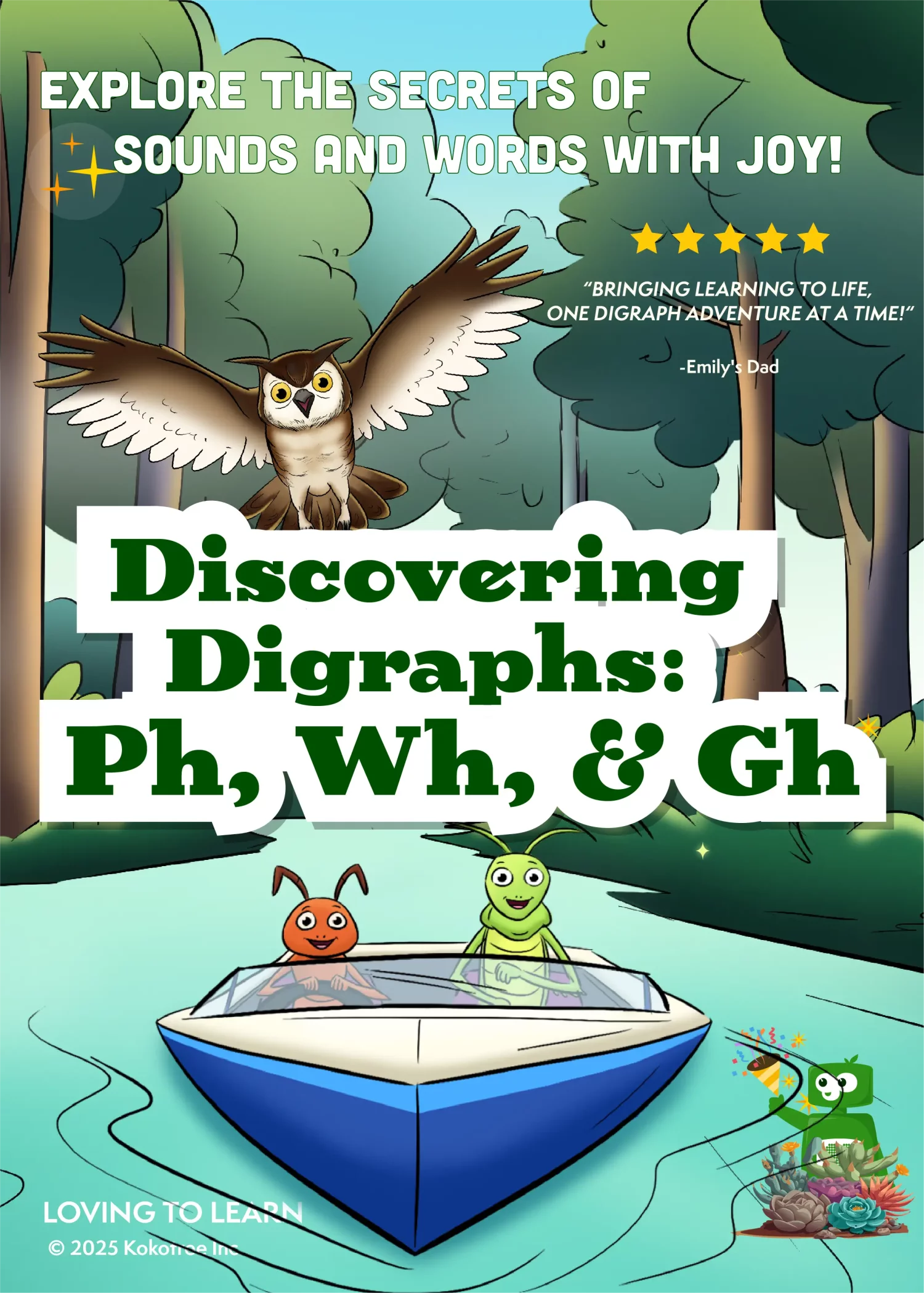
Your child joins friendly adventurers Andy and Greg on a magical boat ride to discover how certain letter pairs create special sounds! They'll learn to spot 'wh,' 'ph,' and 'gh' in everyday words—building real reading confidence.
10 minutes
Ages 4-6
Skill: Recognizing digraphs (letter pairs that make one sound)
Your kid watches animal friends discover letter sounds on a jungle adventure. You get 10 minutes to finish that cup of coffee while it's still warm.
Andy the adventurer and Greg paddle through magical locations—Whistling Woods where trees whisper 'wh' sounds, a sparkling fountain that sprays 'ph' words like 'phone' and 'photo,' and a mysterious mangrove where giggly monkeys help explain tricky 'gh' sounds. Back in the Kokotree classroom, Miss Meera and the animal friends play a quick digraph game to lock in learning.
What your child learns:
This video builds on previous digraph knowledge (ch, sh, th) and introduces three new letter combinations. Your child will understand that some letters work as teams to make sounds you can't predict from the individual letters alone.
- Recognizes 'wh' makes the "whuh" sound (whale, wheel, whistle)
- Identifies 'ph' makes the "f" sound (phone, photo, elephant)
- Understands 'gh' can sound like "f" (laugh, cough) or be silent (though)
- Spots digraphs in the middle and end of words, not just beginnings
- Connects letter patterns to real objects they already know
They'll use these skills when:
- Sounding out new words in picture books at bedtime
- Recognizing "phone" on mom's device or "photo" in an album
- Understanding why "elephant" doesn't start with an "f" sound
- Playing word games with siblings or at preschool
The Story (what keeps them watching)
Andy and Greg continue their magical boat adventure from a previous lesson! First, they paddle into the Whistling Woods where mysterious sounds teach them about 'wh' words like whistle, whale, and wheel. Next, they discover a spectacular fountain that sprays words made with 'ph'—phone, photo, and even elephant! Finally, they navigate through a slightly spooky mangrove where giggling monkeys introduce the tricky 'gh' digraph. The Wise Owl guides them throughout, celebrating each discovery. Back in the classroom, Miss Meera and friends like Eddie Elephant and Gina Giraffe play a fun matching game to practice all six digraphs they've learned!
How We Teach It (the clever part)
- First 3 minutes: Reviews previously learned digraphs (ch, sh, th) through classroom discussion, activating prior knowledge before introducing new concepts
- Minutes 3-8: Introduces wh, ph, and gh through immersive story settings—each digraph gets its own magical location with visual word displays and repeated sound practice
- Final 2 minutes: Reinforces all learning through an interactive classroom game where characters identify digraphs in familiar words
Teaching trick: Each digraph is tied to a memorable location (Whistling Woods for 'wh,' the fountain for 'ph,' the mangrove for 'gh'), giving children mental "hooks" to remember which letters make which sounds.
After Watching: Quick Wins to Reinforce Learning
- Mealtime activity: "Can you find the 'wh' sound? What color is your plate?" (Your child practices hearing 'wh' at the beginning of 'white' while eating—no prep needed!)
- Car/travel activity: "Let's be sound detectives! When we see a phone or photo, say 'ph makes f!'" (Reinforces the ph=f connection using things they'll naturally spot)
- Bedtime activity: "What made you laugh today?" Then point out: "Laugh has that sneaky 'gh' that sounds like 'f'!" (Connects the trickiest digraph to a positive emotion)
- Anytime activity: Play "Whisper or Whistle"—whisper a 'wh' word, then try to whistle. Both start with 'wh'! (Physical activity reinforces the sound through repetition)
When Kids Get Stuck. And How to Help.
- "My child keeps saying 'puh-hone' instead of 'phone'" - Totally normal! The 'ph' making an 'f' sound is genuinely weird in English. Keep casually pointing it out: "Funny, right? P and H are pretending to be F!" Repetition over weeks does the trick.
- "They can't remember which digraph is which" - Focus on just one at a time. Pick 'wh' this week and whisper-whistle together. Next week, take photos and say 'ph.' Building slowly beats overwhelming them with all three.
- "The 'gh' rules seem too complicated for my preschooler" - You're right that 'gh' is tricky even for older kids! At this age, just knowing 'gh' exists and sometimes sounds like 'f' is enough. The silent 'gh' will click later with more reading exposure.
What Your Child Will Learn
Prerequisites and Building Blocks
This video is Part 2 of the digraph series—children should first watch the episode introducing ch, sh, and th. Learners need basic letter recognition (especially c, h, s, t, w, p, g) and understanding that letters represent sounds. This lesson builds phonemic awareness by showing that two letters can combine to create entirely new sounds, preparing children for decoding multisyllabic words and advancing toward independent reading.
Cognitive Development and Teaching Methodology
The narrative-based approach leverages preschoolers' love of stories to embed abstract phonics concepts in memorable contexts. Each digraph is introduced through a distinct sensory environment (whistling sounds, visual fountain, auditory laughter), addressing visual, auditory, and kinesthetic learners. The spaced repetition—hearing each sound multiple times across different words—aligns with how young brains form lasting neural pathways for phonological processing.
Alignment with Educational Standards
This content addresses Common Core Foundational Skills RF.K.3 (knowing letter-sound correspondences) and RF.1.3a (knowing spelling-sound correspondences for common consonant digraphs). It supports kindergarten readiness indicators for phonemic awareness and prepares children for first-grade decoding expectations. The interactive review segment models the call-and-response assessment style used in early elementary classrooms.
Extended Learning Opportunities
Pair this video with Kokotree's digraph sorting games and printable word-picture matching worksheets. Create a "Digraph Detective" journal where children paste pictures of 'wh,' 'ph,' and 'gh' words from magazines. The app's phonics practice section offers interactive activities where children tap digraphs they hear. Re-watch Part 1 (ch, sh, th) to reinforce the complete digraph family.
Transcript Highlights
- "So W and H together make the whuh sound!" - Greg discovers the pattern through environmental observation
- "P and H together make the 'f' sound! Even the word 'digraph' ends with that 'f' sound—di-gra-ph!" - Andy connects new learning to the lesson's vocabulary
- "Gh can be quite sneaky. But now you know: gh might say 'f' or say nothing at all!" - Wise Owl acknowledges complexity while building confidence
- "Even though it starts with an 'e', it has the 'ph' sound in the middle!" - Greg models finding digraphs in unexpected word positions
Character Development and Story Arc
Andy and Greg model collaborative learning—they build on each other's observations and celebrate discoveries together. When Greg feels nervous in the dark mangrove, Andy demonstrates calm problem-solving by identifying the source of the sound. The Wise Owl serves as a supportive guide who validates effort ("Wonderful work!") rather than just correct answers. Back in the classroom, each animal character contributes answers, showing that everyone has something to offer.
Phonics Deep Dive: Understanding Consonant Digraphs
Digraphs represent a critical milestone in phonics development—the understanding that English spelling isn't always one-letter-one-sound. The three digraphs in this video showcase different phonetic behaviors: 'wh' is relatively consistent (always making the breathy "wh" sound), 'ph' reliably produces the /f/ phoneme, while 'gh' demonstrates English's complexity with multiple possible sounds.
For young learners, 'ph' words often cause confusion because children logically expect P and H to make their individual sounds. This video cleverly uses high-frequency words (phone, photo) that children encounter regularly, building sight-word recognition alongside phonetic understanding. The inclusion of 'elephant'—where 'ph' appears mid-word—extends learning beyond initial-sound focus.
The 'gh' digraph introduces an important concept: sometimes letters are silent. Rather than overwhelming children with rules, the video presents this as "sneaky" behavior, making irregularity feel like a fun puzzle rather than a frustrating exception. Research shows that presenting spelling patterns as interesting discoveries (rather than rules to memorize) increases retention and positive attitudes toward reading.
The story structure—moving through distinct environments—creates what cognitive scientists call "memory palaces." Children can mentally revisit the Whistling Woods when trying to remember 'wh' words, leveraging spatial memory to support phonological recall. This multimodal encoding significantly strengthens learning compared to isolated drill-and-practice approaches.