
What's Discovering Digraphs: Ch, Sh, & Th About?
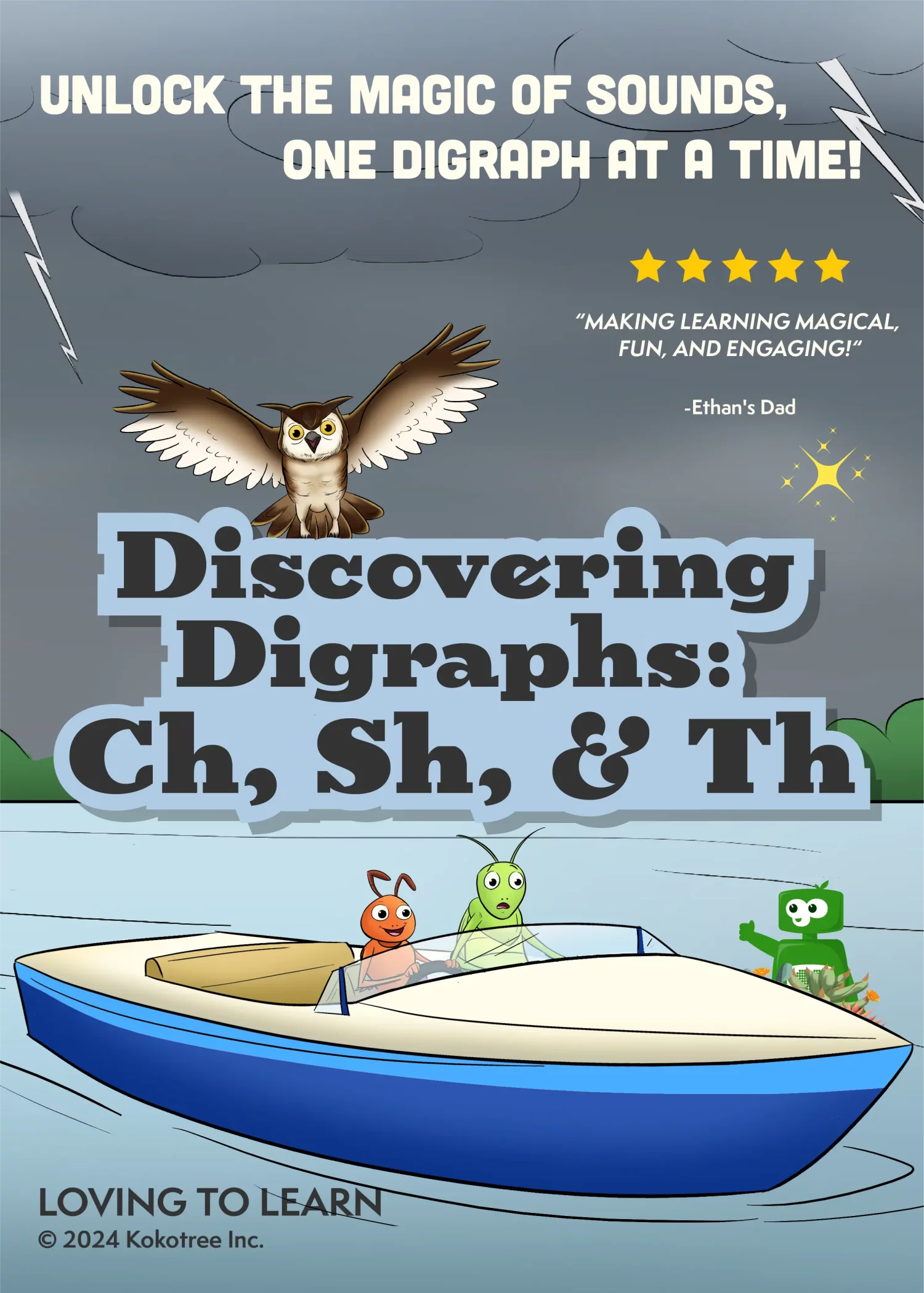
Your child joins Andy and Greg on a magical boat adventure through a jungle, discovering that two letters can team up to make one awesome sound! After watching, they'll be pointing out 'ch' words at lunch and 'sh' sounds at the beach.
13 minutes
Ages 3-6
Skill: Letter combinations that make special sounds (digraphs)
Your kid watches jungle explorers hunt for magical letter sounds. You get 13 minutes to finish that coffee in peace.
Andy and Greg paddle down a sparkling river, stopping at a church surrounded by cherry trees (ch-ch-church!), then discovering seashells on a sandy shore (sh-sh-shell!), and finally braving a thunderstorm (th-th-thunder!). Friendly animal characters in the classroom frame the story, getting just as excited about finding these sounds in their own lives.
What your child learns:
This video introduces three foundational digraphs—ch, sh, and th—showing kids that when certain letters pair up, they create entirely new sounds. Through adventure and repetition, children learn to recognize these sounds at the beginning of words and connect them to familiar objects.
- Recognizes that 'ch' makes one sound (like in cheese, chair, chicken)
- Identifies the 'sh' sound in everyday words (shell, ship, shore)
- Understands that 'th' creates a unique sound (thunder, think, thumb)
- Connects letter combinations to real-world objects they already know
- Builds confidence in early phonics and pre-reading skills
They'll use these skills when:
- Sounding out words in picture books and recognizing familiar patterns
- Playing "I Spy" games and describing objects they see
- Learning to write and spell simple words
- Talking about their day and noticing sounds in new vocabulary
The Story (what keeps them watching)
Meera opens a magical book that transports the classroom friends into an adventure! Andy and Greg wake from a nap to find Wise Owl with a mission: explore the jungle and find words with special digraph sounds. They hop in a boat and paddle to a church surrounded by children, chickens, and a mischievous cheese-stealing chimpanzee (so many 'ch' words!). Next, they discover a beautiful shore covered in shiny shells. Finally, they brave a thunderstorm—scary at first, but thrilling once Greg realizes he's found another digraph! The classroom animals can't wait to continue the adventure next time.
How We Teach It (the clever part)
- First 3 minutes: Meera introduces the magical book and builds excitement. Wise Owl explains that digraphs are "two letters teaming up like superheroes" to make one sound—an analogy kids instantly understand.
- Minutes 3-11: Each river stop focuses on ONE digraph with 5-7 example words. Visual animations highlight the letter pairs while characters repeat the sounds naturally in conversation ("ch-ch-church!").
- Final 2 minutes: Classroom animals share digraph words from their own lives (shampoo! bath! lunch!), reinforcing that these sounds are everywhere—not just in the story.
Teaching trick: Characters stutter-repeat the digraph sound before each word ("ch-ch-chocolate!"), training ears to isolate and recognize the target sound before hearing the full word.
After Watching: Quick Wins to Reinforce Learning
- Mealtime activity: "Can you find something on your plate that starts with 'ch'?" (Cheese, chicken, chips, cherry tomatoes—watch them scan their food like little detectives!)
- Car/travel activity: "Let's play 'sh' spy! I see something shiny..." Take turns finding 'sh' words out the window—shops, shadows, shoes on people walking by.
- Bedtime activity: "What 'th' things did we do today? We thought, we thanked, we took a bath!" This helps them hear 'th' in words they use constantly.
- Anytime activity: When they hear a digraph word naturally, pause and celebrate: "You just said 'chair'—that's a 'ch' word! High five, word detective!"
When Kids Get Stuck. And How to Help.
- "My child keeps saying the letters separately instead of blending them." Totally normal! Model the blended sound slowly ("ch... ch... ch...") and have them feel the air on their hand as they say it. The physical sensation helps the sound click.
- "They can hear the sounds but can't identify which digraph it is." Focus on one digraph at a time for a few days before mixing them. Mastery of 'ch' first makes 'sh' and 'th' easier to distinguish later.
- "Is this too advanced for my 3-year-old?" Not at all! Younger kids may not memorize spellings, but they'll start hearing these sounds everywhere—which is the real goal. Recognition comes before reading.
What Your Child Will Learn
Prerequisites and Building Blocks
Children benefit most from this video if they already recognize individual letters and understand that letters represent sounds (basic phonemic awareness). This lesson builds on alphabet knowledge and prepares children for blending sounds into words. It's an ideal bridge between letter recognition and early reading, fitting into a phonics progression after single-letter sounds but before word families and CVC words.
Cognitive Development and Teaching Methodology
The adventure narrative leverages preschoolers' love of stories and magical thinking, making abstract phonics concepts concrete and memorable. Repetition through character dialogue ("ch-ch-church!") supports auditory processing, while on-screen text with highlighted letter pairs addresses visual learners. The physical journey down a river provides kinesthetic anchoring—each location becomes a "memory palace" for different sounds.
Alignment with Educational Standards
This video addresses Common Core Foundational Skills RF.K.3a (demonstrating knowledge of letter-sound correspondences) and RF.1.3a (knowing spelling-sound correspondences for common consonant digraphs). It supports kindergarten readiness indicators for phonological awareness and prepares children for first-grade decoding expectations. Teachers expect entering kindergarteners to recognize that letter combinations can represent single sounds.
Extended Learning Opportunities
Pair this video with digraph sorting activities using picture cards, or play "digraph hopscotch" where children jump to the correct digraph when you say a word. The Kokotree app offers interactive digraph games for continued practice. Extend learning by creating a "digraph detective journal" where children draw or paste pictures of ch, sh, and th words they discover throughout the week.
Transcript Highlights
- Wise Owl explains digraphs: "Like superheroes joining forces, letters like C and H create the 'ch' sound!"
- Andy teaches recognition: "So, the letters C and H together make the 'ch' sound in words like church, children, chickens, chocolate, chairs, cheese, and chimpanzee!"
- Modeling careful listening: "Shhh... Try to remain silent. Listen carefully to the waves... shhh..."
- Real-world connection: "Miss Meera! I heard the 'ch' sound in 'lunch' earlier!" / "I heard 'sh' in 'shampoo' this morning!" / "And 'th' in 'bath' last night!"
Character Development and Story Arc
Andy models confident learning and patient teaching, always encouraging Greg through challenges. Greg demonstrates that it's okay to be initially confused ("Digra-what?") and even scared (during the thunderstorm), but curiosity and persistence lead to discovery. The classroom animals show enthusiasm for applying learning to their own lives, modeling the transfer of knowledge from screen to real world. Wise Owl represents trusted guidance without giving away answers.
Phonics Deep Dive: Understanding Digraphs in Early Literacy Development
Digraphs represent a critical milestone in phonics instruction because they challenge children's initial understanding that each letter makes one sound. When children learn that 'c' says /k/ and 'h' says /h/, discovering that 'ch' makes an entirely different sound (/tʃ/) requires cognitive flexibility—a skill that predicts reading success.
The three digraphs in this video were strategically chosen. 'Ch,' 'sh,' and 'th' are among the most frequently occurring digraphs in English and appear in words children encounter daily (the, this, she, chat). Mastering these three unlocks decoding ability for hundreds of common words.
This video employs onset-focused teaching, emphasizing digraphs at the beginning of words where they're easiest to isolate and identify. Research shows children recognize initial sounds before final sounds, making this approach developmentally appropriate. The repetitive "ch-ch-chocolate" pattern isn't just cute—it's a phonemic isolation technique that trains the brain to segment the digraph from the rest of the word.
The multisensory approach matters: children hear the sounds repeatedly, see the letters highlighted on screen, and are encouraged to feel the sounds (the puff of air in 'ch,' the continuous airflow in 'sh,' the tongue position in 'th'). This addresses diverse learning styles and creates multiple neural pathways to the same knowledge.
Importantly, the video distinguishes between digraphs and blends without using confusing terminology. Children learn that digraphs make ONE new sound (unlike blends like 'bl' where you hear both letters). This conceptual clarity prevents confusion as phonics instruction advances.