
What's Greater, Less, and Equal To About?
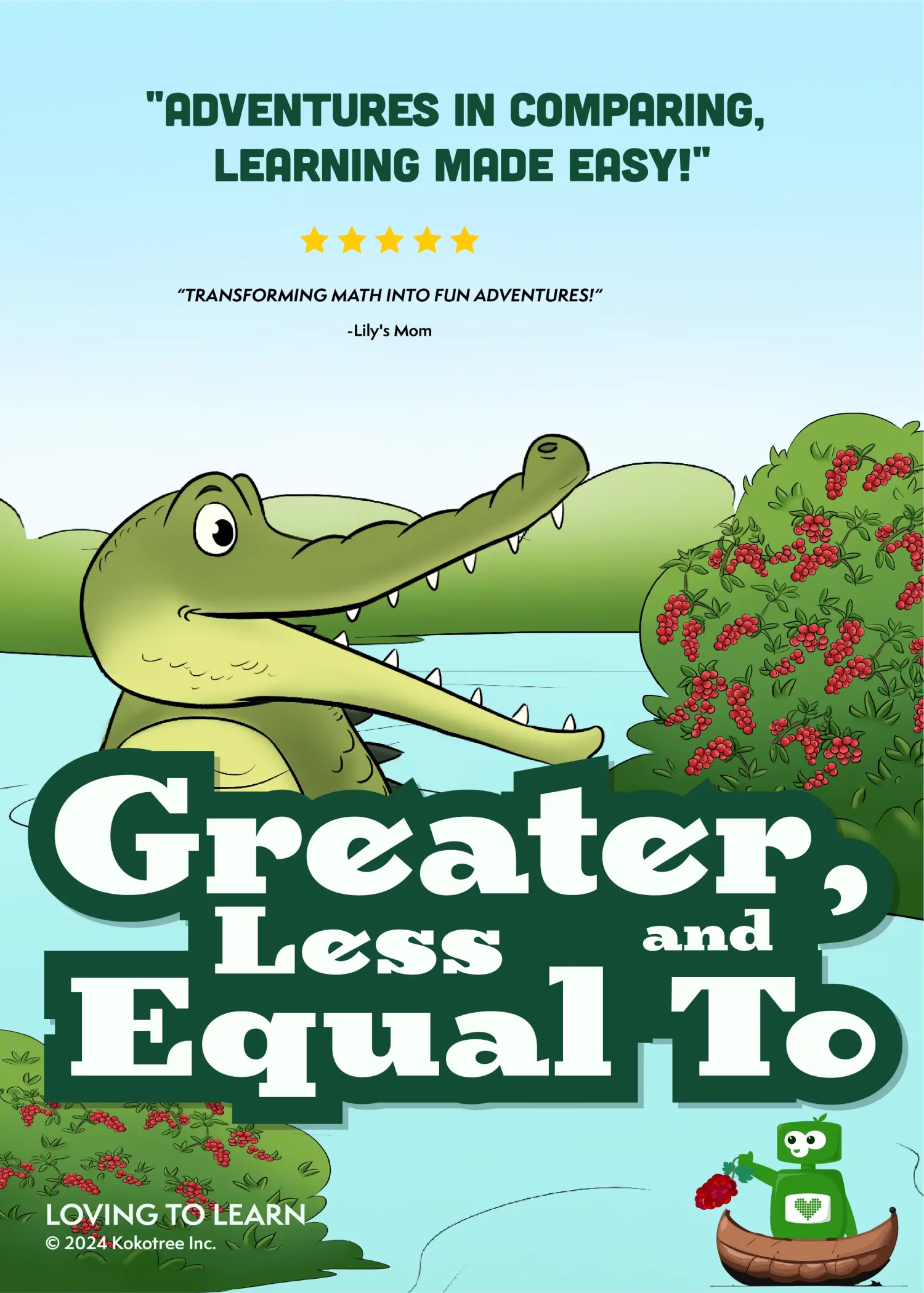
Your child joins the Kokotree animal friends on a jungle adventure where a hungry alligator teaches them to compare numbers! They'll master the greater than, less than, and equal to symbols through a memorable story about Mr. Alligator always choosing the bigger pile of food.
11 minutes
Ages 3-6
Skill: Comparing Numbers
Your kid watches friendly animals learn math with a hungry alligator. You get 11 minutes to [enjoy your coffee in peace].
The Kokotree friends gather by a jungle river watching Mr. Alligator swim toward berry bushes. Mr. Rocko, their math teacher, arrives and turns their curiosity into a fun game. Together, they discover that the alligator's open mouth looks just like the greater than and less than symbols—always pointing toward the bigger number!
What your child learns:
This video introduces comparison concepts through a memorable visual: an alligator's mouth always opens toward more food, just like the > and < symbols point toward bigger numbers. Children practice comparing single and double-digit numbers while building foundational math reasoning.
- Comparing numbers to identify which is greater or less
- Recognizing and using the greater than (>) symbol
- Recognizing and using the less than (<) symbol
- Understanding the equal to (=) symbol for same amounts
- Applying comparison skills to numbers up to 15
They'll use these skills when:
- Dividing snacks fairly between friends ("Who has more crackers?")
- Playing board games that involve counting spaces or points
- Choosing between options at the store ("Which bag has more?")
- Helping sort toys by quantity during cleanup time
The Story (what keeps them watching)
The Kokotree animal friends spot Mr. Alligator swimming in the jungle river, always choosing the berry bush with MORE berries. When Mr. Rocko arrives, he turns their observation into an exciting game called "Mr. Alligator's Big Mouth." The kids discover that the alligator's wide-open jaws look exactly like math comparison symbols! Through playful rounds comparing apples, oranges, bananas, and fish, they master greater than, less than, and equal to. Bobby Bear even does a hilarious alligator impression, and everyone laughs when Mr. Alligator gets confused by equal numbers and does a silly dance!
How We Teach It (the clever part)
- First 3 minutes: Children observe Mr. Alligator's behavior and discuss why he always swims toward more berries, building curiosity and activating prior counting knowledge.
- Minutes 3-8: Mr. Rocko introduces the "Mr. Alligator's Big Mouth" game, connecting the alligator's open mouth to the > and < symbols through multiple practice rounds with different fruits and numbers.
- Final 3 minutes: The equal sign is introduced when numbers match, reinforced by Mr. Alligator's confused dance. Children practice all three symbols with increasing confidence.
Teaching trick: The alligator's mouth visual is genius—kids remember that the "hungry mouth" always opens toward the bigger number. This concrete image makes abstract symbols instantly understandable and impossible to forget!
After Watching: Quick Wins to Reinforce Learning
- Mealtime activity: "Which plate has more peas—yours or mine? Show me with your hands like Mr. Alligator's mouth!" (Practices visual comparison and symbol orientation)
- Car/travel activity: "I spy 3 red cars and 5 blue cars. Which number would Mr. Alligator's mouth open toward?" (Reinforces greater than concept in real-world counting)
- Bedtime activity: "Let's count your stuffed animals on each side of the bed. Are they equal, or is one side greater?" (Practices all three comparison types)
- Anytime activity: Hold up different numbers of fingers on each hand and ask, "Quick! Which hand would Mr. Alligator choose?" (Builds automatic number comparison skills)
When Kids Get Stuck. And How to Help.
- "My child keeps mixing up the greater than and less than symbols." - Totally normal! Remind them: "The alligator is always hungry for MORE." Have them make a chomping motion with their hand toward the bigger number—the physical movement helps it stick.
- "They can compare small numbers but struggle with bigger ones like 11 and 13." - This is a great sign they're ready to grow! Start by counting out objects in two groups, then gradually move to just looking at the numbers. The video's progression from small to larger numbers models this perfectly.
- "My child says the video is too easy or too hard." - The beauty of this lesson is its flexibility. For kids who find it easy, try three-digit numbers or timed challenges. For those who need more support, stick with numbers under 10 and use physical objects to count first.
What Your Child Will Learn
Prerequisites and Building Blocks
Children watching this video should have basic number recognition (1-15) and one-to-one counting skills. This lesson builds on foundational counting concepts and prepares children for more complex mathematical operations like addition and subtraction. It connects to earlier Kokotree content about number identification and counting sequences. Understanding "more" and "less" as vocabulary concepts helps children engage immediately with the comparison activities presented.
Cognitive Development and Teaching Methodology
This video leverages concrete-to-abstract learning progression, perfect for preoperational stage development (ages 2-7). The alligator mouth metaphor provides a concrete visual anchor before introducing abstract symbols. Multiple modalities are engaged: visual (animated symbols), auditory (character dialogue), and kinesthetic (children can mimic the alligator mouth with their hands). Repetition with variation—using different fruits and numbers—builds neural pathways without causing boredom.
Alignment with Educational Standards
This content aligns with Common Core Math Standard K.CC.C.6 (identify whether the number of objects in one group is greater than, less than, or equal to objects in another group) and K.CC.C.7 (compare two numbers between 1 and 10 presented as written numerals). It addresses kindergarten readiness indicators for mathematical reasoning and symbol recognition. The progression to numbers beyond 10 provides appropriate challenge for advanced preschoolers and supports first-grade standards.
Extended Learning Opportunities
Pair this video with printable comparison worksheets featuring the alligator mouth visual. The Kokotree app includes interactive games where children drag the correct symbol between number pairs. Extend learning with sorting activities using household items—comparing groups of blocks, crayons, or snacks. Create a simple "Hungry Alligator" hand puppet for ongoing practice. Follow up with videos on counting and number sequences to strengthen prerequisite skills.
Transcript Highlights
- "When the first number is greater than the second number, Mr. Alligator opens his mouth to the greater number, it looks like this: '>'. We call it the 'greater than' sign."
- "The 'open mouth' of the symbol always points toward the greater number, just like our hungry Mr. Alligator who always wants to eat the bigger number!"
- "When the numbers are the same, we use the 'equal to' sign, which looks like two little lines."
- "So, does that mean the greater than '>' and less than '<' signs are the same shape, just pointing different ways?"
Character Development and Story Arc
The Kokotree friends model ideal learning behaviors throughout. Tiki Tiger demonstrates courage by asking clarifying questions despite feeling shy. Maddy Monkey shows enthusiasm that keeps energy high, while Eddie Elephant uses dramatic play to reinforce concepts (acting like Mr. Alligator). Mr. Rocko models patient teaching, validating each answer and building on children's observations. The characters progress from curious observers to confident mathematicians, showing viewers that questions lead to understanding.
Mathematical Comparison Concepts Deep Dive
Number comparison is a foundational mathematical skill that underpins all future arithmetic operations. When children understand that 7 > 4, they're developing number sense—an intuitive understanding of quantity relationships that predicts later math success.
The video brilliantly uses the "hungry alligator" mnemonic, a time-tested teaching strategy that transforms abstract symbols into memorable images. This approach works because young children think in pictures before they think in symbols. The alligator's mouth opening toward "more food" creates an emotional and logical connection: the symbol literally looks like it's eating the bigger number.
Mathematically, this video covers three critical comparison relationships:
- Greater than (>): Understanding that one quantity exceeds another
- Less than (<): Recognizing when one quantity is smaller
- Equal to (=): Identifying equivalent quantities
The progression from comparing quantities of objects (apples, oranges) to comparing written numerals (7 and 4) follows research-based best practices. Children first need concrete experiences before they can work with abstract representations.
Notably, the video extends beyond typical preschool content by including two-digit numbers (11, 12, 13, 15). This appropriate challenge introduces place value concepts implicitly while building comparison confidence. Tiki Tiger's observation that the symbols are "the same shape, just pointing different ways" demonstrates the mathematical reasoning this video cultivates—children aren't just memorizing; they're discovering patterns and relationships that form the basis of mathematical thinking.