
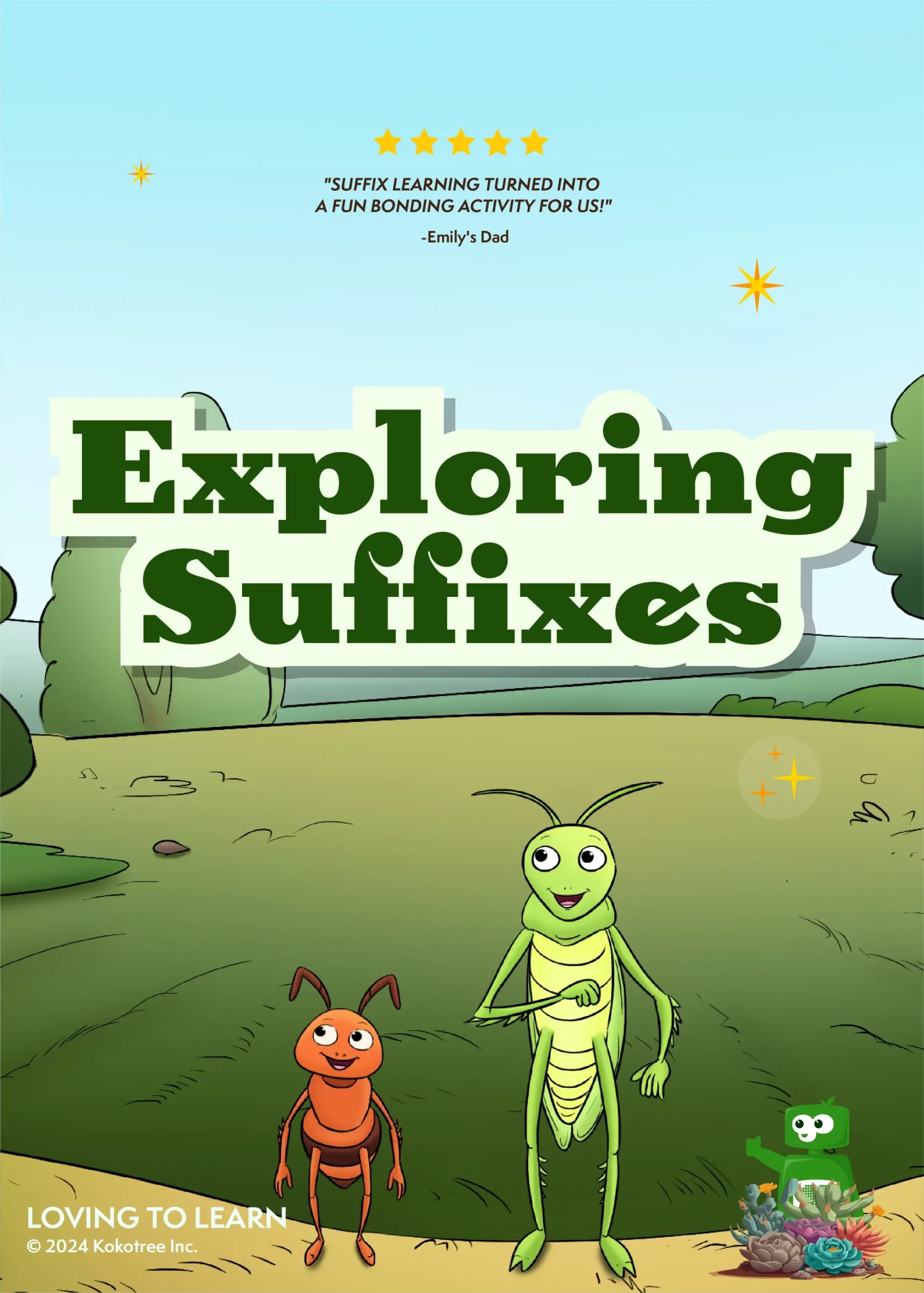
What's Exploring Suffixes -s, -es, -ed, & -ing About?
Your child joins Andy and Greg on an adventure through Suffix Land, learning how tiny word endings create big meaning changes! They'll master turning singular words into plurals and present actions into past tense—skills they'll use every time they speak.
9 minutes
Ages 4-6
Skill: Word Building with Suffixes
Your kid watches friendly animals explore magical suffix lands. You get 9 minutes to enjoy your coffee in peace.
The video starts in a cozy classroom where Ruby and Ronnie debate whether "books" or "bookes" is correct. Miss Meera settles the argument by opening her magical storybook, transporting everyone to Suffix Land where animated suffix characters (-s, -es, -ed, and -ing) teach Andy and Greg how each ending changes words in different ways.
What your child learns:
This video breaks down four essential suffixes that form the foundation of English grammar. Your child will understand that -s and -es make words plural, -ed shows past tense, and -ing shows actions happening right now.
- Adds -s to make regular plurals (cat → cats, flower → flowers)
- Uses -es for words ending in s, x, z, sh, or ch (box → boxes, dish → dishes)
- Changes verbs to past tense with -ed (jump → jumped, paint → painted)
- Shows ongoing actions with -ing (run → running, swim → swimming)
- Recognizes when to double letters before adding -ing (hop → hopping)
They'll use these skills when:
- Telling you about their day: "We played outside and I jumped so high!"
- Describing what they see: "Look at all the birds flying!"
- Reading beginner books and recognizing word patterns
- Writing their first sentences and stories at school
The Story (what keeps them watching)
It all starts with a classroom debate—Ruby says "books" but Ronnie insists it's "bookes." Miss Meera steps in with her magical storybook, whisking everyone to Suffix Land! Andy and Greg meet the bouncy Suffix Twins (-s and -es) in the Meadow of Plurals, wise -ed in the Valley of the Past, and energetic -ing in the Forest of Actions. Each character teaches their special power through games and examples. The adventure ends at Suffix Summit where Andy and Greg prove they've mastered all four suffixes by completing a tricky sentence challenge!
How We Teach It (the clever part)
First 3 minutes: The classroom debate hooks kids immediately—they want to know who's right! Miss Meera introduces suffixes as "little pieces we add to words" with simple examples like cat/cats.
Minutes 3-7: Each suffix gets its own magical land with a memorable character. Kids see words physically joining with suffixes on screen, making abstract grammar concepts visual and concrete.
Final 2 minutes: The Suffix Summit challenge lets kids apply everything they learned, then the classroom wrap-up reinforces key concepts with quick practice questions.
Teaching trick: Each suffix is personified as a friendly character with a distinct personality—-ing is bouncy and energetic (because it shows action!), while -ed is wise (because it knows about the past). This helps kids remember which suffix does what.
After Watching: Quick Wins to Reinforce Learning
Mealtime activity: "Can you make 'carrot' plural?" Point to foods on their plate and ask them to add -s or -es. "One grape, many...?" (Practices plural formation with real objects they can see and touch.)
Car/travel activity: "I spy something that ends in -ing!" Take turns spotting actions—"That dog is running! That bird is flying!" (Reinforces present progressive tense through observation.)
Bedtime activity: "Tell me three things you did today using -ed words." Help them recount: "I played, I jumped, I laughed." (Practices past tense in meaningful context.)
Anytime activity: Play "Suffix Switch"—say a base word and have them add different suffixes. "Jump" becomes "jumps, jumped, jumping." Celebrate each correct answer! (Builds flexibility with all four suffixes.)
When Kids Get Stuck. And How to Help.
"My child keeps saying 'runned' instead of 'ran'" - Totally normal! This video focuses on regular verbs that follow the rules. Irregular verbs (run/ran, go/went) come later. For now, celebrate that they understand the -ed concept!
"They can't remember when to use -es versus -s" - Practice with the "hissing sounds" trick: if a word ends with a sound that hisses or buzzes (s, x, z, sh, ch), it needs -es. Try saying "boxs"—it's hard! That's why we need "boxes."
"The doubling rule for -ing seems too advanced" - Don't worry about perfection yet! The video introduces this concept gently. If they say "hoping" instead of "hopping," just model the correct form. The pattern will click with more exposure.
What Your Child Will Learn
Prerequisites and Building Blocks
Children should recognize individual letters and have basic phonemic awareness before watching. This video builds on letter recognition and simple word reading skills introduced in earlier Kokotree phonics content. It bridges the gap between reading single words and understanding how words change form—a crucial step toward reading fluency and sentence construction. This lesson prepares children for more complex grammar concepts like verb conjugation and subject-verb agreement they'll encounter in kindergarten.
Cognitive Development and Teaching Methodology
This video leverages narrative transportation—embedding lessons within an adventure story—which research shows increases retention in preschoolers. The personification of suffixes as characters with distinct personalities taps into children's natural animistic thinking at this age. Visual animations showing words physically combining with suffixes support concrete operational thinking, while the call-and-response format engages auditory learners. Kinesthetic learners benefit from the movement-based examples (hopping, spinning) that connect actions to -ing words.
Alignment with Educational Standards
This content aligns with Common Core Language Standards L.K.1c (form regular plural nouns) and L.K.1d (understand and use verbs in past, present, and future tense). It supports kindergarten readiness indicators for oral language development and early grammar awareness. The lesson addresses Pre-K learning foundations for English Language Arts, specifically understanding that words can be modified to change meaning. Teachers expect entering kindergarteners to recognize basic plural forms and use appropriate verb tenses in speech.
Extended Learning Opportunities
Pair this video with Kokotree's printable suffix sorting worksheets where children categorize words by their endings. The app's "Word Builder" game lets kids drag suffixes onto base words to create new forms. Extend learning with magnetic letters on the refrigerator—write base words and let children physically add suffix endings. Create a "suffix hunt" during reading time, asking children to find words ending in -s, -ed, or -ing in their favorite picture books.
Transcript Highlights
- "A suffix is a little piece that we add to the end of a word to change its meaning. For example, when we add -s to 'cat,' it becomes 'cats,' meaning more than one!"
- "I help words that end in S, X, Z, SH, or CH, like 'bus' turning into 'buses' or 'box' becoming 'boxes.'"
- "I am -ed. I help words tell about the past. If you 'jump' today, you 'jumped' yesterday!"
- "When we add -ing, sometimes we double the last letter! Like 'spin' becomes 'spinning' with an extra 'n'!"
Character Development and Story Arc
Andy and Greg model ideal learning behaviors throughout their adventure—asking questions, making predictions, and celebrating discoveries. When they encounter each suffix character, they don't just listen passively; they actively try out new words and check their understanding. The characters demonstrate growth mindset when tackling the final Suffix Summit challenge, working together and thinking through problems step by step. Back in the classroom, Ronnie models graceful acceptance of correction, showing children that being wrong is simply a chance to learn something new.
Morphological Awareness: The Building Blocks of Language
Morphological awareness—understanding how word parts combine to create meaning—is one of the strongest predictors of reading success. When children grasp that "jumped" contains two meaningful units (jump + ed), they unlock a powerful decoding strategy. Instead of memorizing thousands of individual words, they learn to recognize patterns and apply rules.
The four suffixes in this video represent foundational morphemes that appear in over 65% of English words children encounter in early readers. The -s/-es distinction introduces children to phonological conditioning—the idea that a word's sound determines which suffix form to use. This prepares them for more complex spelling patterns later.
The -ed suffix is particularly valuable because it represents a single grammatical concept (past tense) despite having three different pronunciations: /t/ as in "jumped," /d/ as in "played," and /ɪd/ as in "painted." Children naturally acquire these pronunciation variations through exposure, even before they can articulate the rule.
The -ing suffix introduces the concept of aspect—specifically, progressive aspect showing ongoing action. This grammatical understanding helps children move beyond simple present tense ("I jump") to more nuanced expression ("I am jumping right now"). The doubling rule (hop → hopping) gently introduces spelling patterns related to syllable structure, preparing children for more systematic phonics instruction about short vowels and consonant doubling.