
What's Five Senses About?
Your little one joins Bobby Bear and friends on a sensory jungle adventure, discovering how we smell, hear, see, touch, and taste the world around us. After watching, they'll be pointing out textures, identifying sounds, and telling you exactly why that peach smells so good!
11 minutes
Ages 3-6
Skill: Understanding the five senses and how our bodies use them
Your kid watches jungle animals discover peaches using their senses. You get 11 minutes to finish that cup of coffee.
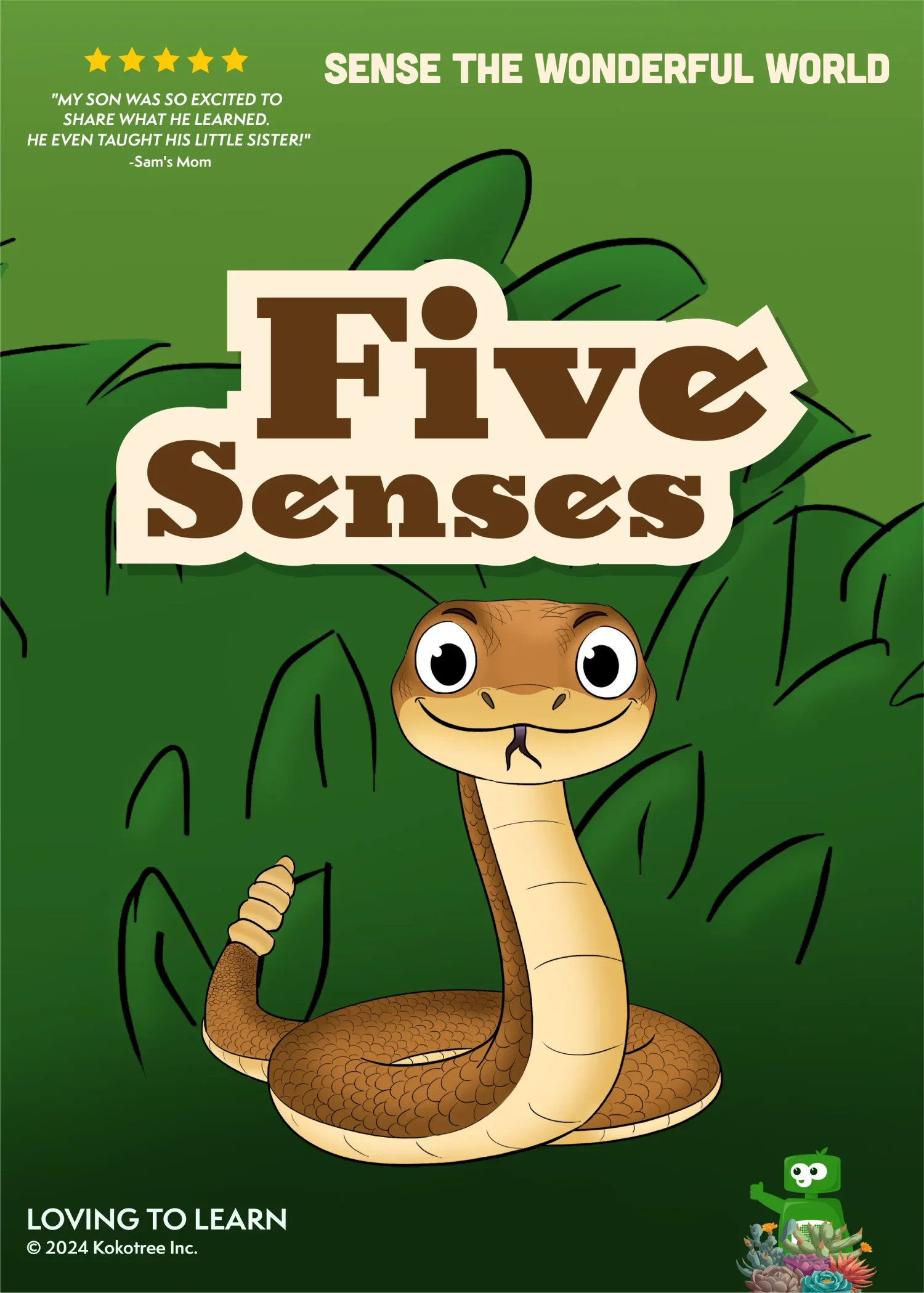
Bobby Bear catches a mysterious sweet scent and leads his friends through the jungle to find its source—a beautiful peach tree! Along the way, they encounter buzzing bees, spot a camouflaged rattlesnake, feel the fuzzy texture of ripe peaches, and taste the sweet fruit. Miss Meera guides them through understanding each sense with real examples.
What your child learns:
Through hands-on discovery, your child learns that we have five distinct senses that help us understand our environment. They'll see how different animals use their senses in unique ways—like how snakes smell with their tongues!
- Names and identifies all five senses: smell, hearing, sight, touch, and taste
- Connects each sense to the body part that controls it (nose, ears, eyes, skin, tongue)
- Understands that different textures feel different (soft peaches vs. rough bark)
- Learns that animals have special sensory abilities (bears smell from miles away, snakes sense heat)
- Recognizes that senses work together to help us understand the world
They'll use these skills when:
- Describing what their food smells and tastes like at dinner
- Identifying sounds around the house ("I hear the washing machine!")
- Feeling different textures at the playground or in nature
- Explaining why they don't like certain foods ("It feels squishy!")
The Story (what keeps them watching)
Bobby Bear's super-sniffer nose catches something amazing—sweet, ripe peaches somewhere in the jungle! He leads Ruby Rabbit, Eddie Elephant, and their friends on a scent-tracking adventure. Along the way, Ruby's sharp ears detect a rattlesnake hiding in the bushes (don't worry, it slithers away safely!), and Tiki's keen eyes spot it first. When they finally reach the peach tree, Eddie discovers how soft the fruit feels with his amazing trunk. Miss Meera turns their adventure into a lesson about all five senses—even challenging them to guess if white powder is sugar or salt using only their eyes (spoiler: they need their taste buds!). The episode ends with everyone enjoying juicy peaches while using ALL their senses at once.
How We Teach It (the clever part)
- First 3 minutes: Introduces smell through Bobby tracking the peach scent, making the concept immediately relatable and exciting
- Minutes 4-7: Layers in hearing (Ruby hears the rattlesnake), sight (Tiki spots it), and touch (Eddie feels the peach's texture) through natural story moments
- Final 4 minutes: Introduces taste with the salt vs. sugar challenge, then reinforces all five senses together with fun animal facts about snakes
Teaching trick: Miss Meera uses a hands-on experiment (identifying salt vs. sugar) to show kids that sight alone isn't enough—we need multiple senses working together. This "prove it yourself" moment makes the lesson stick.
After Watching: Quick Wins to Reinforce Learning
Mealtime activity: "Can you use all five senses to describe your snack?" Have them smell it first, describe how it looks, feel the texture, listen for any crunch, then taste it. They're practicing sensory vocabulary without even realizing it!
Car/travel activity: "What can you hear right now that I can't see?" Play a listening game where they identify sounds—car engines, birds, wind. This sharpens their awareness of hearing as a distinct sense.
Bedtime activity: "Let's do a texture hunt!" Have them close their eyes and feel three objects (stuffed animal, blanket, book). Can they guess what each is using only touch? Just like Eddie feeling the peach!
Anytime activity: "Be a super-sniffer like Bobby Bear!" Walk around the house or yard and have them describe different smells—soap in the bathroom, grass outside, dinner cooking. They're building sensory vocabulary!
When Kids Get Stuck. And How to Help.
"My child keeps mixing up which body part goes with which sense." Totally normal! Make it physical—point to your nose and sniff dramatically, cup your ears and listen, etc. Body movements help cement the connections faster than words alone.
"They say everything tastes 'good' or 'bad'—no other words." Expand their vocabulary gently by offering choices: "Is it sweet like a peach or salty like chips?" The video introduces sweet, salty, sour, and bitter—use those exact words at mealtimes.
"The snake part scared my child a little." The video handles this beautifully—Miss Meera explains the snake was scared too and just warning them. Revisit that moment and emphasize how Ruby's hearing and Tiki's sight kept everyone safe. Senses as superpowers!
What Your Child Will Learn
Prerequisites and Building Blocks
Children watching this video should have basic body part recognition (nose, ears, eyes, hands, tongue) and understand simple cause-and-effect relationships. This episode serves as a foundational introduction to sensory science and pairs well with videos about animals, nature exploration, and body awareness. It builds toward more complex concepts like how senses help us stay safe, make choices about food, and understand our environment—key kindergarten readiness skills.
Cognitive Development and Teaching Methodology
This video leverages narrative-based learning, which research shows increases retention by 65% in preschoolers compared to direct instruction alone. The multi-sensory approach addresses visual learners (seeing the snake, peaches), auditory learners (hearing explanations, rattling sounds), and kinesthetic concepts (touching textures). The story structure—problem (what's that smell?), journey, discovery—mirrors how young brains naturally process and store information.
Alignment with Educational Standards
This content aligns with NGSS K-LS1-1 (using observations to describe patterns of what plants and animals need to survive) and Head Start Early Learning Outcomes Framework goals for scientific reasoning. Kindergarten readiness indicators expect children to "use senses to observe and explore materials and natural phenomena." The video directly addresses these benchmarks while building vocabulary essential for science instruction.
Extended Learning Opportunities
Pair this video with sensory sorting activities—gather items with different textures, smells, or sounds for classification games. The Kokotree app's "Animal Senses" matching game reinforces which animals have special sensory abilities. Create a simple "Five Senses Journal" where children draw what they experienced with each sense today. Nature walks become instant extensions—challenge them to find something for each sense!
Transcript Highlights
- Teaching smell: "Your sense of smell is what helped you detect the peaches from so far away. Your nose picks up different scents and sends messages to your brain so you can recognize them!"
- Teaching touch: "Your skin helps you feel textures—like soft peaches, rough tree bark, or cool water."
- Teaching taste: "That's your sense of taste! It helps you tell if something is sweet, salty, sour, or bitter."
- Synthesis moment: "Our five senses—smell, hearing, sight, touch, and taste—help us understand the world. And when we use them all together, we can learn even more!"
Character Development and Story Arc
Bobby Bear models curiosity-driven learning—his enthusiasm about the mysterious smell motivates the entire adventure. Ruby Rabbit demonstrates alertness and the value of careful listening when she detects danger. Miss Meera exemplifies the guide-on-the-side teaching approach, asking questions rather than simply telling answers. The salt-vs-sugar challenge shows children that even confident guesses ("It's sugar!") can be wrong, normalizing mistakes as part of learning.
The Science of Sensory Perception: A Deep Dive
The five senses represent one of the most fundamental STEAM concepts for early learners, forming the foundation for all scientific observation. Each sense involves a specialized receptor system: olfactory receptors in the nose detect airborne molecules, mechanoreceptors in the ear respond to sound wave vibrations, photoreceptors in the eyes process light, various skin receptors detect pressure and temperature, and taste buds identify chemical compounds in food.
What makes this video particularly effective is its introduction of comparative animal biology. When Miss Meera explains that bears can smell from miles away, or that snakes use their tongues to "taste" the air through their Jacobson's organ, children begin understanding that sensory abilities vary across species—a key evolutionary concept presented in age-appropriate terms. The heat-sensing pits of rattlesnakes introduce infrared detection, expanding children's understanding beyond human sensory limitations.
The video also subtly introduces sensory integration—how our brain combines information from multiple senses to create a complete picture. Maddy's final observation ("I can feel how soft this peach is, smell how sweet it is, see how golden it looks, hear the crunch when I bite it, and taste how delicious it is!") perfectly demonstrates this concept. Research in developmental neuroscience shows that children who can articulate multi-sensory experiences develop stronger observational skills and scientific vocabulary, directly supporting later success in laboratory sciences and empirical reasoning.