What's Mass, Capacity, & Volume About?
Your little scientist joins friendly jungle animals on a quest to save a river by solving measurement puzzles! They'll discover that what we see can trick us—and learn to think like real scientists who test instead of guess.
9 minutes
Ages 3-6
Skill: Understanding how to measure and compare weight and space
Your kid watches jungle friends solve measurement puzzles together. You get 9 minutes to finish that coffee in peace.
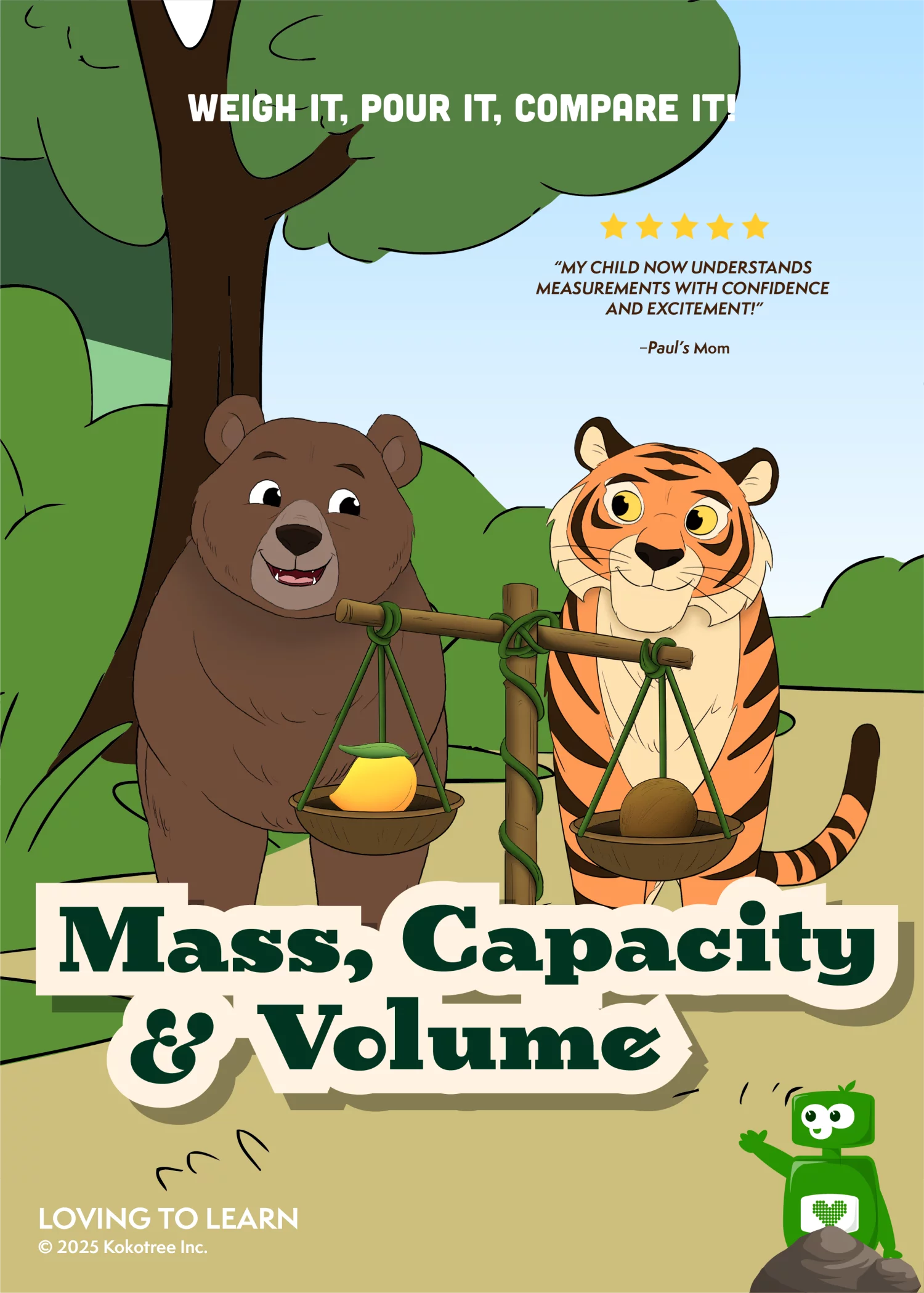
In Miss Meera's classroom, the Kokotree kids discover that two different-shaped glasses can hold the same amount of water. Then they're transported to an Indian jungle where Tango the Tiger and Balu the Bear must work together to solve measurement challenges and save the Great River. They compare a mango and coconut on a balance scale and fill different bowls with berries to see which holds more.
What your child learns:
This video introduces three foundational math concepts through hands-on experimentation. Children discover that appearances can be deceiving—something tall isn't always bigger, and something heavy doesn't always look heavy. They learn the vocabulary scientists use to describe measurement.
- Understands that mass means how heavy something is
- Learns that volume is the space inside a container
- Discovers that capacity means how much a container can hold
- Recognizes that size and shape don't always indicate weight or volume
- Practices scientific thinking: guess first, then test!
They'll use these skills when:
- Pouring their own juice and noticing different cup shapes
- Helping sort groceries and feeling which items are heavier
- Playing with water toys in the bath and filling containers
- Comparing snacks with siblings ("Mine looks bigger!" becomes a learning moment)
The Story (what keeps them watching)
Maddy Monkey kicks things off with a tricky question—which glass has more water? The kids guess, but Miss Meera teaches them to test like real scientists. Then comes the adventure! Tango the Tiger and Balu the Bear are arguing over a mango tree when Wise Owl appears with urgent news: the Great River is drying up! The only way to save it? Solve puzzles about mass, volume, and capacity. The former rivals become teammates, discovering that a juicy mango weighs less than a solid coconut, and a short wide bowl holds more berries than a tall narrow one. Teamwork and science save the day!
How We Teach It (the clever part)
- First 2 minutes: The classroom experiment hooks kids immediately—two glasses that look different but hold the same water. Introduces vocabulary (mass, volume, capacity) in simple terms.
- Minutes 2-7: The jungle story brings concepts to life through relatable challenges. Kids watch Tango and Balu make wrong guesses (just like they might!), then discover the truth through testing.
- Final 2 minutes: Back in the classroom, Miss Meera reinforces definitions through student questions, cementing the learning with clear repetition.
Teaching trick: The video deliberately shows characters making incorrect guesses based on appearances—"The tall one looks bigger!"—then proving themselves wrong. This normalizes mistakes and shows kids that testing beats guessing.
After Watching: Quick Wins to Reinforce Learning
Mealtime activity: "Which is heavier—this apple or this bread roll?" Let them hold both and guess, then find something to use as a balance (even a ruler on a finger works!). They practice comparing mass without being fooled by size.
Car/travel activity: "I spy something that could hold a LOT of water!" Point out containers of different shapes—a tall water bottle, a wide bucket, a tiny cup. They practice thinking about capacity in the real world.
Bathtime activity: Grab two different containers and ask, "Which one do you think holds more water?" Let them pour and test. They experience volume and capacity hands-on with zero mess stress (it's already bath time!).
Anytime activity: "Let's be scientists like Tango and Balu!" Find two objects and ask which is heavier. Let them hold one in each hand before you "test" on a makeshift scale. They learn that real scientists don't just guess—they test!
When Kids Get Stuck. And How to Help.
"My child keeps saying the bigger thing is always heavier." - Totally normal! This is exactly what the video addresses. Keep offering comparison opportunities with surprising results—a big balloon vs. a small rock is perfect. Repetition with real objects builds understanding.
"They mix up volume and capacity." - Even adults find this tricky! For now, focus on the simple version: volume is the space, capacity is what fills it. Using water play makes this click faster than any explanation.
"This seems advanced for my preschooler." - The vocabulary is new, but the concepts are things they already experience! Every time they pour juice or compare snacks, they're using these ideas. The video just gives them words for what they already notice.
What Your Child Will Learn
Prerequisites and Building Blocks
Children benefit from basic comparison skills (bigger/smaller, more/less) before watching. This video builds on early measurement concepts and connects to previous Kokotree content about shapes and sizes. It serves as a foundation for future lessons on standard measurement units, scientific method, and mathematical reasoning. The progression moves from visual comparison to hands-on testing to vocabulary acquisition—scaffolding that prepares children for more complex STEM concepts.
Cognitive Development and Teaching Methodology
This video leverages cognitive conflict—showing children that their initial perception is wrong—which research shows creates memorable learning moments. The story format engages narrative processing while the classroom bookends provide explicit instruction. Visual learners see the experiments, auditory learners hear explanations, and the video prompts kinesthetic follow-up activities. The repetition of key terms (mass, volume, capacity) across different contexts supports vocabulary retention typical for ages 3-6.
Alignment with Educational Standards
This content aligns with Common Core Math standards for measurement (K.MD.A.1, K.MD.A.2) and kindergarten readiness indicators for comparing objects by observable attributes. It introduces scientific inquiry methods emphasized in Next Generation Science Standards. Teachers expect entering kindergartners to compare objects using terms like "heavier" and "holds more"—this video builds exactly that foundation while introducing precise vocabulary that gives children a head start.
Extended Learning Opportunities
Pair this video with hands-on water table play using various containers. Kokotree's measurement games reinforce these concepts digitally. Create a simple balance scale with a hanger and two cups for ongoing exploration. Cooking activities (measuring ingredients) extend learning naturally. Visit a grocery store and let children hold different fruits to compare mass. Sand play offers another medium for exploring volume and capacity concepts.
Transcript Highlights
- "Volume is how much space something takes up, not how tall or wide it looks." — Miss Meera's clear definition addresses the core misconception.
- "Mass depends on how heavy something is, not just its size." — Wise Owl reinforces that appearances deceive.
- "The space inside a container is called its volume. When we fill that space—with water, air, or even berries—we call that capacity." — Wise Owl connects abstract concepts to tangible examples.
- "Real scientists don't guess—they test and measure!" — Miss Meera emphasizes scientific thinking as the takeaway.
Character Development and Story Arc
Tango and Balu model a powerful learning journey—from conflict to collaboration. Their initial argument over territory transforms into teamwork when faced with a bigger problem. Both characters make wrong guesses confidently, showing children that mistakes are part of learning. Wise Owl demonstrates patient teaching without judgment. The characters show curiosity, willingness to test their assumptions, and graceful acceptance when proven wrong—essential growth mindset behaviors for young learners.
Understanding Mass, Volume, and Capacity: A STEAM Deep Dive
Mass, volume, and capacity form the cornerstone of measurement literacy—skills children will use throughout their education and daily lives. These concepts are notoriously tricky because they require children to move beyond perceptual judgment ("it looks bigger") to conceptual understanding ("let's measure to find out").
Mass refers to the amount of matter in an object, experienced as weight in everyday terms. Young children naturally assume larger objects are heavier—a cognitive shortcut that works sometimes but fails with materials of different densities. The mango vs. coconut comparison brilliantly illustrates this: the mango's size suggests more mass, but the coconut's density makes it heavier.
Volume describes three-dimensional space. Children must understand that shape affects how space is distributed—a tall narrow container and a short wide container can have identical volumes despite looking completely different. This concept connects to geometry and spatial reasoning skills.
Capacity specifically refers to how much a container can hold when filled. While technically related to volume, capacity emphasizes the functional aspect—what can we put inside? This distinction matters for real-world applications like cooking and pouring drinks.
The video's approach of showing incorrect predictions followed by experimental verification mirrors authentic scientific method. This teaches children that knowledge comes from testing, not assuming—a foundational STEAM mindset. Conservation of quantity (understanding that amount stays the same despite changes in appearance) typically develops between ages 5-7, so this video plants important seeds while remaining accessible to younger viewers through concrete examples.