
What's Segmenting Phonemes About?
Your little one joins a fun clapping adventure where they'll learn to break words into their tiniest sounds—one clap at a time! After watching, they'll confidently sound out words by identifying each phoneme, building the foundation for reading success.
10 minutes
Ages 3-6
Skill: Breaking words into individual sounds (phonemes)
Your kid watches pandas clap through jungle word puzzles. You get 10 minutes to enjoy your coffee in peace.
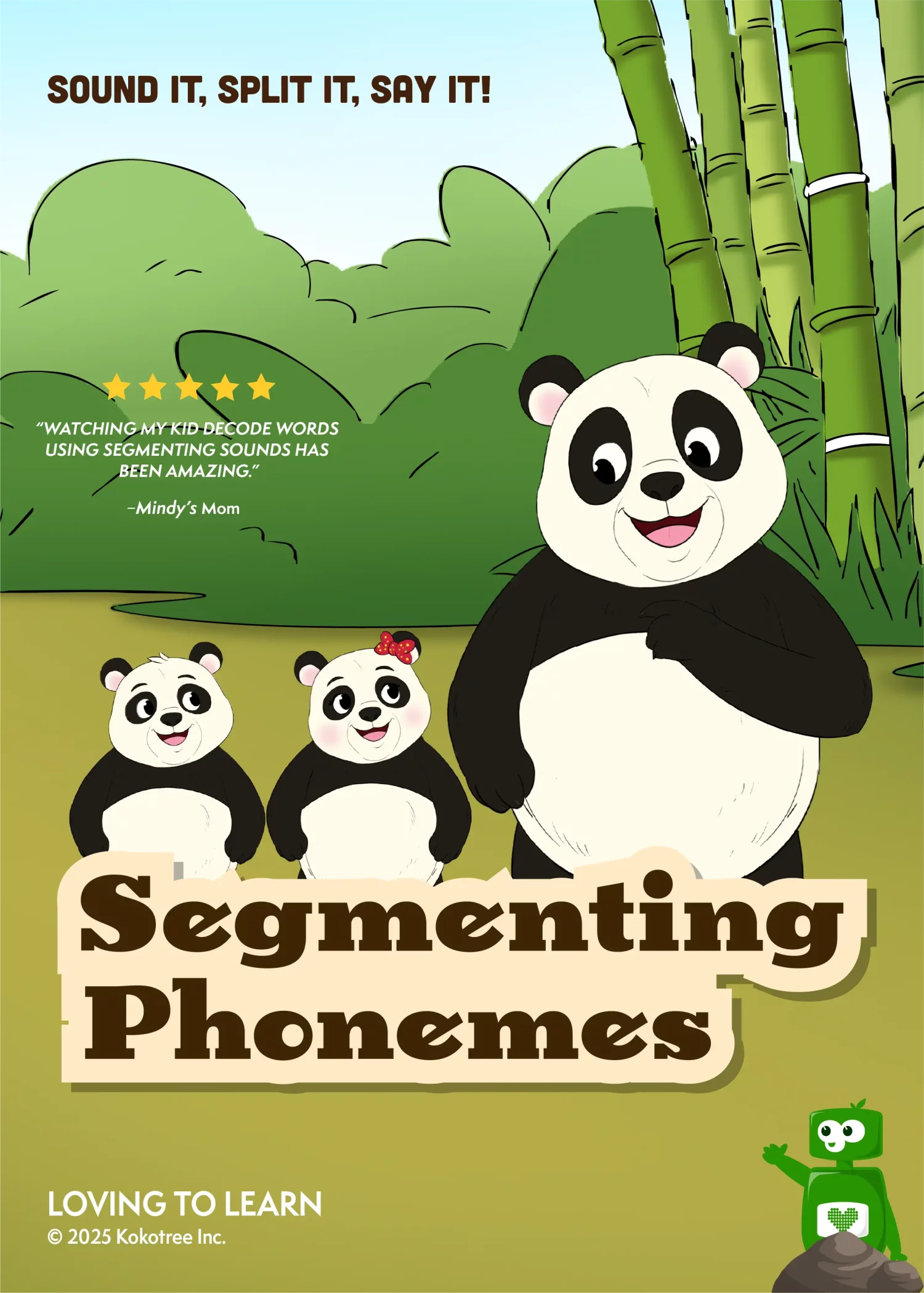
Miss Meera introduces phoneme segmenting with her classroom friends, then the story follows Mr. Panda and his two cubs on a jungle adventure. They discover word signs throughout the bamboo forest and clap out each sound together—from simple three-sound words like "dog" to trickier five-sound words like "splash."
What your child learns:
This video teaches the foundational reading skill of phonemic awareness—the ability to hear and identify individual sounds in words. Children practice with progressively challenging words, learning that some letter combinations (like "sh" and "ck") make single sounds called digraphs.
- Identifying individual phonemes (sounds) in spoken words
- Clapping out 3, 4, 5, and 6-sound words systematically
- Recognizing digraphs like "sh," "ck," and "ch" as single sounds
- Understanding consonant blends like "gr," "sp," and "pl"
- Building confidence with longer, more complex words
They'll use these skills when:
- Sounding out new words in picture books at bedtime
- Writing their first words by stretching out sounds
- Playing rhyming games with friends or siblings
- Spelling simple words during early writing activities
The Story (what keeps them watching)
Wise Owl flies to China to visit his friend Mr. Panda with a special mission: find ten hidden words throughout the jungle and clap out their sounds! Mr. Panda brings his son and daughter along, and together they discover word puzzles on signs, rocks, and even fish leaping from the river. Starting with simple words like "dog" and "sun," the cubs build confidence until they're tackling tricky words like "crisp" and "splash." Back in Miss Meera's classroom, the Kokotree kids try their own clapping challenges with "stamp" and "dragon"—proving that any word can be broken down with practice!
How We Teach It (the clever part)
- First 2 minutes: Miss Meera explains phonemes as "the tiniest sounds in words" and demonstrates with "cat" (/c/-/a/-/t/), showing children exactly what segmenting looks and sounds like.
- Minutes 2-8: The Panda family practices with ten words of increasing difficulty—from 3-phoneme words (dog, sun) to 5-phoneme words (plant, splash)—with Mr. Panda explaining concepts like digraphs and blends along the way.
- Final 2 minutes: Back in the classroom, Ruby and Eddie successfully segment challenging words independently, reinforcing that practice builds mastery.
Teaching trick: Every single clap produces a glowing bubble showing the sound, so children see AND hear each phoneme separately—making the invisible concept of "sounds in words" totally visible and concrete.
After Watching: Quick Wins to Reinforce Learning
- Mealtime activity: "Let's clap out what we're eating! Ready? B-R-E-A-D!" (Your child practices segmenting familiar food words, starting with 3-4 sounds and working up.)
- Car/travel activity: "I spy something... can you clap out C-A-R?" (Turn travel time into phoneme practice with objects you pass.)
- Bedtime activity: "Let's clap out the animals in your book before we read!" (Segmenting character names like "frog" or "bear" connects the skill to reading.)
- Anytime activity: "Clap your name with me! What sounds do you hear?" (Personal names make phoneme practice meaningful and fun.)
When Kids Get Stuck. And How to Help.
- "My child claps for letters, not sounds" - This is completely normal! Gently remind them that "sh" in "fish" is ONE clap because it's ONE sound, even though it has two letters. Practice digraphs separately until they click.
- "They can do short words but freeze on longer ones" - Start with the first two sounds only, then add one more. "PLANT" becomes "P-L" first, then "P-L-A," building confidence gradually.
- "My child rushes and blends sounds together" - Slow down by stretching each sound dramatically: "Ssssss... ppppp... iiiiii... nnnn." Make it silly! The exaggeration helps them hear each sound distinctly.
What Your Child Will Learn
Prerequisites and Building Blocks
Children benefit most from this video if they can already recognize that words are made of sounds (basic phonological awareness) and can identify beginning sounds in words. This lesson builds on letter-sound knowledge and prepares children for blending phonemes together to read words. It's an essential bridge between knowing letter sounds and actual decoding—the skill of reading unfamiliar words independently.
Cognitive Development and Teaching Methodology
The clapping technique leverages kinesthetic learning, engaging muscle memory alongside auditory processing. At ages 3-6, children learn best through multisensory experiences—here they hear sounds, see visual bubbles, and feel the rhythm through clapping. The progressive difficulty (3 sounds → 6 sounds) follows scaffolded learning principles, building confidence before introducing complexity. Repetition across ten examples ensures mastery.
Alignment with Educational Standards
Phonemic segmentation is a core kindergarten readiness skill aligned with Common Core RF.K.2d ("Isolate and pronounce initial, medial vowel, and final sounds in three-phoneme words"). This video extends beyond basic standards by introducing digraphs and blends, preparing children for first-grade phonics expectations. Teachers assess this exact skill during reading readiness screenings.
Extended Learning Opportunities
Pair this video with printable phoneme counting mats where children place tokens for each sound. The Kokotree app includes interactive games for dragging sound bubbles into word boxes. Extend learning with Elkonin boxes (sound boxes) using household items as counters. Follow up with the "Blending Phonemes" video to complete the decode-encode cycle.
Transcript Highlights
- "Phonemes are the tiniest sounds that make up a word. And segmenting means breaking that word into each of those little sounds—bit by bit!" — Clear, child-friendly definition
- "Even though 'SH' sounds like one letter, it's a sound!" — Explicitly teaching the digraph concept
- "When two consonants like 'G' and 'R' come together, we call it a blend." — Introducing terminology naturally
- "Even longer words can be segmented with practice!" — Growth mindset reinforcement after Eddie segments "dragon"
Character Development and Story Arc
The Panda cubs model ideal learning behavior—they volunteer eagerly, think carefully before answering, and celebrate each other's successes. When facing increasingly difficult words, they don't show frustration; instead, they approach each challenge with curiosity. Mr. Panda demonstrates supportive coaching by explaining concepts (digraphs, blends) exactly when children need them, modeling how adults can scaffold learning without taking over.
Phonemic Awareness Deep Dive: The Science of Sound Segmentation
Phonemic awareness—the ability to hear, identify, and manipulate individual sounds in spoken words—is the strongest predictor of early reading success, even more than IQ or vocabulary size. Research consistently shows that children who can segment words into phonemes learn to read faster and with better comprehension.
This video teaches segmentation specifically, which is harder than blending (putting sounds together) because children must hold the whole word in memory while pulling it apart. The clapping technique provides a physical anchor for each sound, reducing cognitive load. When children clap for /s/-/p/-/l/-/a/-/sh/, they're creating five distinct motor memories linked to five distinct sounds.
The progression from CVC words (consonant-vowel-consonant like "dog") to CCVCC words (like "crisp") follows established phonics scope and sequence. Introducing digraphs ("sh," "ck") and blends ("gr," "sp," "pl") within the story normalizes these patterns—children learn that English sounds don't always match one-to-one with letters, a crucial insight for decoding.
The visual bubble animation serves a critical purpose: it makes the abstract concept of "a sound" concrete and countable. Children at this age are concrete operational thinkers—they understand what they can see and touch. By showing each phoneme as a separate, poppable bubble, the video transforms an invisible auditory skill into a visible, tangible game. This multimodal approach (auditory + visual + kinesthetic) ensures the concept sticks regardless of a child's primary learning style.