
What's Number Bonds About?
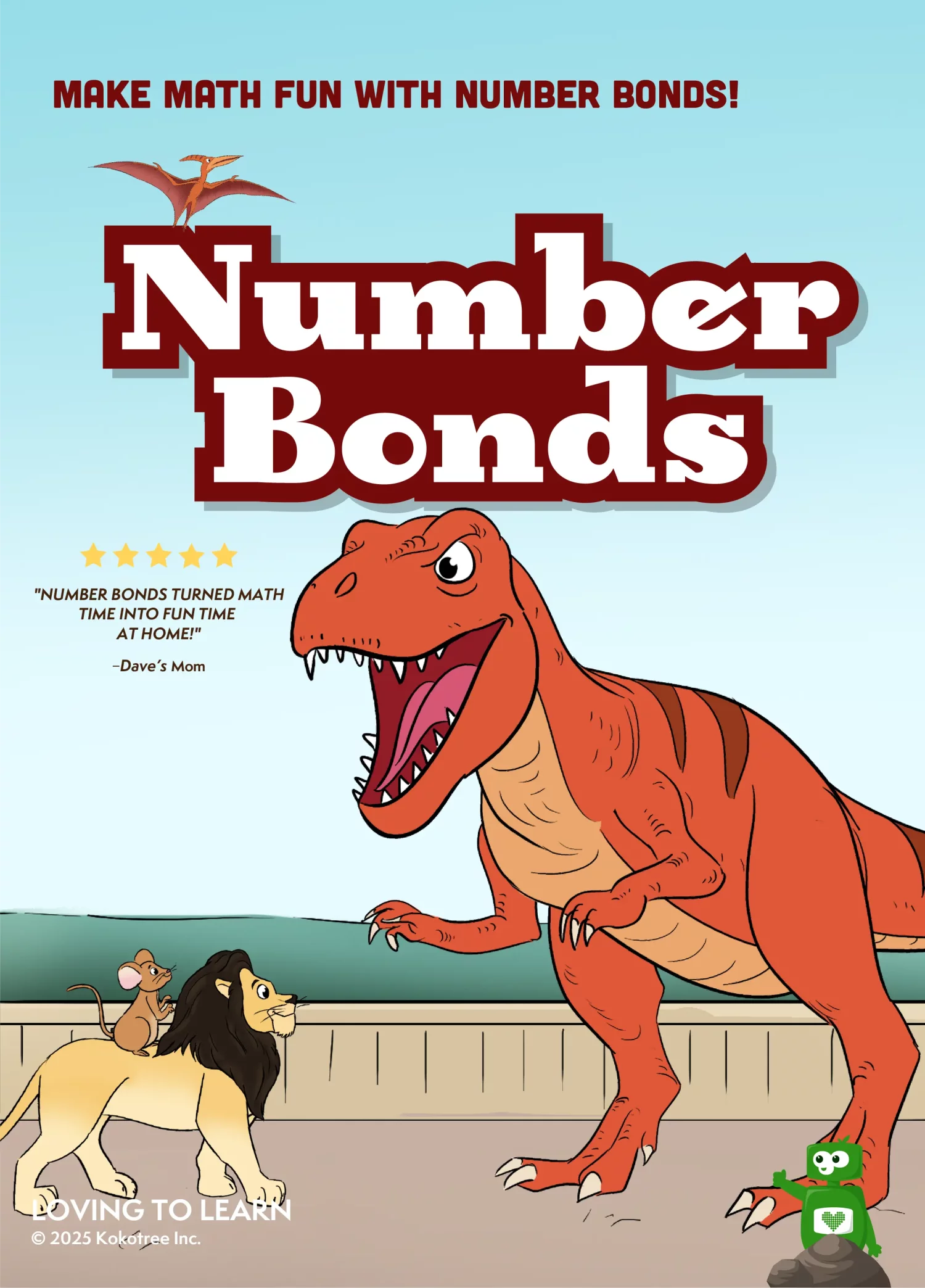
Your child joins brave animal heroes Leo and Mika as they solve number bond riddles to save a magical kingdom from dinosaurs! They'll discover how numbers pair together to make 20—building the mental math foundation that makes addition and subtraction click.
14 minutes
Ages 4-6
Skill: Understanding how numbers combine to make 20
Your kid watches animal heroes solve math puzzles to defeat dinosaurs. You get 14 minutes to drink hot coffee.
Friendly classroom animals get into a silly argument about 16 + 3, which launches an epic story adventure. Leo the Lion and Mika the Mouse travel through a magical jungle, meeting gentle dinosaurs who challenge them with number bond riddles. Each correct answer brings them closer to saving the kingdom!
What your child learns:
Number bonds are the secret building blocks of mental math. When kids instantly know that 12 + 8 = 20 or that 17 needs 3 to make 20, they're building the foundation for quick addition, subtraction, and eventually multiplication.
- Identifies number pairs that combine to make 20 (12+8, 15+5, 17+3)
- Understands that numbers "bond" together like puzzle pieces
- Practices mental math through story-based problem solving
- Builds confidence with increasingly challenging number combinations
- Develops number sense by seeing patterns in how numbers relate
They'll use these skills when:
- Counting out exact change at a pretend store ("I have 14 coins, I need 6 more for 20!")
- Splitting snacks fairly between friends
- Playing board games that involve adding dice rolls
- Helping set the table ("We need 20 forks—we have 12, so we need 8 more!")
The Story (what keeps them watching)
When Eddie Elephant and Ronnie Rhino argue about whether 16 + 3 equals 19 or 20, Miss Meera settles it with an adventure story! Leo the Lion and Mika the Mouse must journey through Numerelia, solving number bond riddles from friendly dinosaurs—Paddy the Parasaur, Tina the Triceratops, and Bob the Brontosaurus. Each correct answer gets them closer to finding Steffi the Stegosaurus, the only one who can defeat the fearsome Rex and save the kingdom. Math literally saves the day!
How We Teach It (the clever part)
First 3 minutes: The classroom argument hooks kids emotionally—they want to know who's RIGHT about 16 + 3. Miss Meera introduces number bonds as "numbers that join together like best friends."
Minutes 3-11: Each dinosaur presents progressively challenging riddles (12+?=20, 5+?=20, 9+?=20, 17+?=20). Kids hear Leo and Mika think through each answer, modeling the mental process.
Final 3 minutes: Steffi's three rapid-fire riddles (14+6, 18+2, 10+10) reinforce learning through repetition, then the triumphant ending connects math skills to real heroism.
Teaching trick: The dinosaurs don't just ask questions—they wait while Leo and Mika visibly think, showing kids it's okay to pause and figure things out. The friendly encouragement after each correct answer builds confidence.
After Watching: Quick Wins to Reinforce Learning
Snack time bonds: "We have 20 crackers to share. If I take 12, how many do you get?" Let your child figure out the "bond" between your portions.
Car counting: "I spy 7 red cars. How many more until we see 20?" Turn any drive into a number bond game with things you pass.
Bedtime countdown: "Let's count to 20 together—I'll say a number, you say its partner!" Start with 10+10, then try 15+5, building to trickier pairs.
Toy cleanup game: "We need to put away 20 blocks. You grab some, I'll grab the rest—let's see what number bonds we make!" Count together to check.
When Kids Get Stuck. And How to Help.
"My child just guesses random numbers" - Totally normal at first! Use fingers or objects: "Let's count up from 12 until we reach 20." Physical counting builds the mental picture.
"They only remember 10+10" - That's actually the perfect starting point! Build from there: "If 10+10=20, what about 11+9? We just moved one over!" Show with blocks or crackers.
"This seems too hard for my preschooler" - Number bonds to 20 are challenging! Start with bonds to 10 instead (what pairs with 3 to make 10?). The video plants seeds—mastery comes with practice over months, not minutes.
What Your Child Will Learn
Prerequisites and Building Blocks
Children watching this video should be comfortable counting to 20 and have basic familiarity with addition concepts. This builds on earlier number recognition and counting skills, extending into the critical pre-algebraic concept of part-part-whole relationships. Number bonds to 20 represent an intermediate step—ideally, children have already explored bonds to 5 and 10. This video bridges concrete counting toward abstract mental math, preparing children for multi-digit addition and subtraction strategies they'll encounter in kindergarten and first grade.
Cognitive Development and Teaching Methodology
The narrative-based approach leverages preschoolers' natural love of stories and emotional engagement. By embedding math problems within a hero's journey, the video activates episodic memory—children remember the dinosaur who asked about 12+8 long after they'd forget a flashcard. The progressive difficulty (starting with 12+8, building to 17+3) follows scaffolded learning principles. Visual representation of numbers "coming together" on Miss Meera's board addresses visual learners, while the dialogue supports auditory processing.
Alignment with Educational Standards
Number bonds directly align with Common Core Math Standard K.OA.A.4 (fluently add and subtract within 5) and 1.OA.C.6 (add and subtract within 20). This video specifically targets the "making 20" benchmark that kindergarten teachers assess for math readiness. Understanding part-whole relationships is identified by the National Council of Teachers of Mathematics as foundational for algebraic thinking. Children who master number bonds demonstrate stronger performance on standardized kindergarten readiness assessments.
Extended Learning Opportunities
Pair this video with hands-on manipulatives—twenty small objects split into two groups helps children visualize bonds physically. The Kokotree app's number bond practice games reinforce these concepts through interactive play. Printable "bond houses" (showing a roof with 20 and two rooms below for the parts) make excellent refrigerator practice. For extension, challenge children to find ALL the ways to make 20, creating a complete bond family. Connect to real-world math by counting items in groups during grocery shopping.
Transcript Highlights
"Number bonds show us how numbers can join together like best friends—to make new numbers!" - Miss Meera introduces the core concept using relatable friendship metaphor.
"Remember, 16 bonds perfectly with 4 to make 20. But 16 plus 3 equals 19—not 20." - Miss Meera clarifies Ronnie's mistake, modeling how close numbers can cause confusion.
"Hmm, let me think... It's 8! Because 12 plus 8 equals 20!" - Leo demonstrates the thinking process, showing children it's normal to pause and calculate.
"Easy peasy—it's 10! 10 plus 10 equals 20!" - Mika's confident response to the doubles fact reinforces this anchor bond that children often learn first.
Character Development and Story Arc
Leo and Mika model complementary learning behaviors—Leo shows brave determination while Mika demonstrates that even nervous learners can succeed through persistence. When Mika admits being "terrified of dinosaurs" but continues anyway, children see that courage isn't the absence of fear. The classroom characters' initial argument transforms into collaborative learning, showing that mistakes (Ronnie's wrong answer) lead to teaching moments rather than shame. Steffi the Stegosaurus models how knowledge creates power—her wisdom, not just strength, defeats Rex.
The Mathematics of Number Bonds: Building Mental Math Foundations
Number bonds represent one of the most powerful tools in early mathematics education, forming the cognitive foundation for mental arithmetic that children will use throughout their lives. Unlike rote memorization of addition facts, number bonds teach children to see numbers as flexible, decomposable quantities—a concept mathematicians call "number sense."
When a child understands that 20 can be split into 12 and 8, or 15 and 5, or 17 and 3, they're developing part-whole thinking. This isn't just memorizing facts—it's understanding the very nature of how numbers relate to each other. Research in mathematical cognition shows that children with strong number bond fluency perform significantly better on later arithmetic tasks because they can mentally manipulate numbers rather than counting on fingers.
The choice to focus on bonds to 20 is pedagogically strategic. Twenty is large enough to challenge preschoolers beyond simple finger-counting, yet small enough to remain concrete and visualizable. It's also a "friendly" number in our base-10 system, making it ideal for developing place value intuition.
The video's progression from 12+8 to 17+3 follows research-based sequencing. Bonds with larger "jumps" (12 needs 8) are typically easier than bonds close to 20 (17 needs only 3) because children can more easily visualize larger missing pieces. By ending with 10+10—the anchor doubles fact—the video reinforces the most important number bond while giving children a confidence-building success moment.
This understanding directly transfers to subtraction (if 12+8=20, then 20-8=12), multiplication foundations, and eventually algebraic thinking where variables represent unknown parts of equations.