
What's Consonant Blends: GH, GN, SC, TW About?
Your child joins Andy and Greg on a magical forest mystery while mastering tricky consonant blends! They'll learn to hear and identify blended sounds in everyday words—a crucial step toward reading independence.
8 minutes
Ages 4-6
Skill: Recognizing consonant blends (two consonant sounds together)
Your kid watches forest friends solve a ghost mystery with phonics clues. You get 8 minutes to finish that coffee in peace.
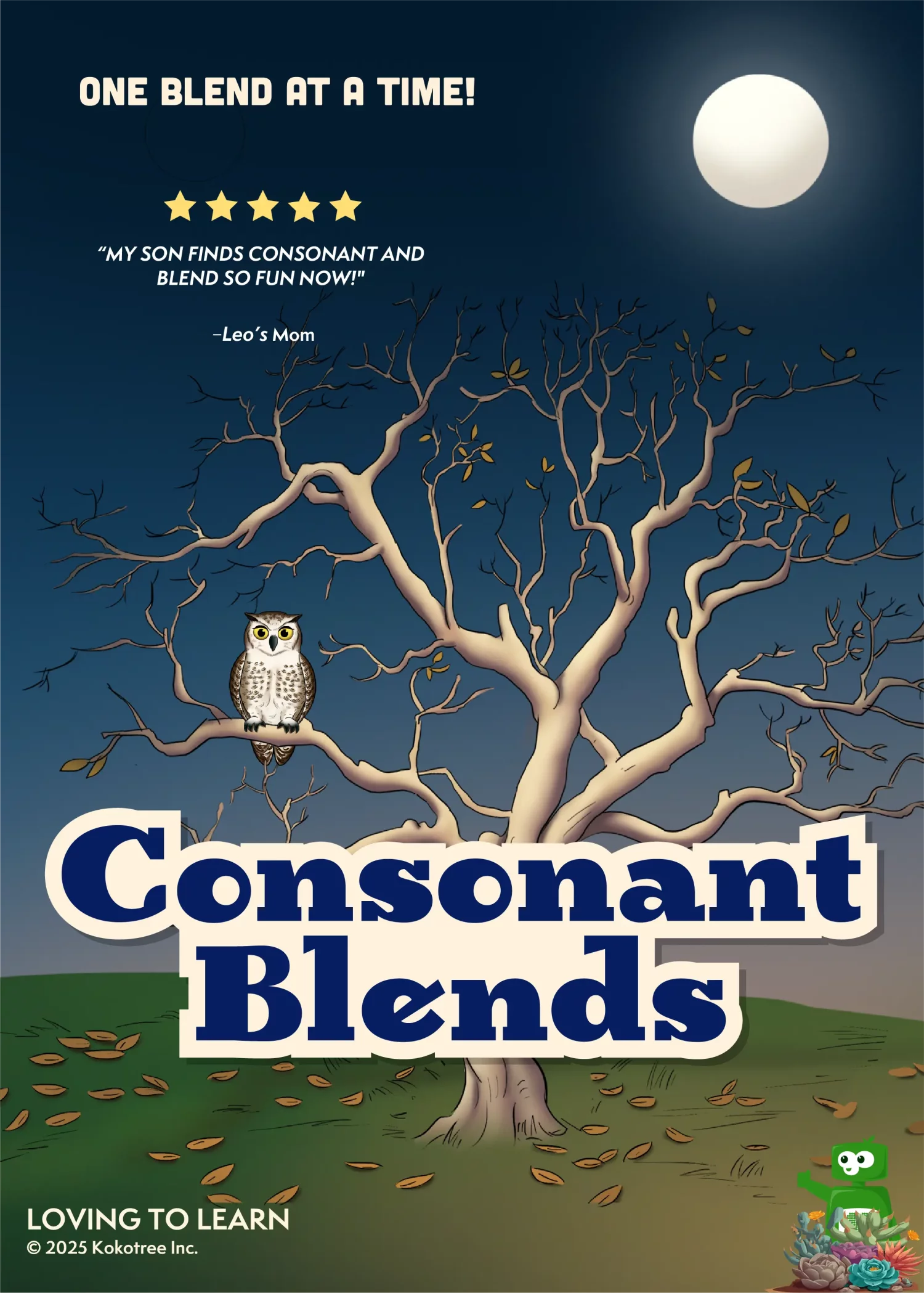
Friendly animal characters venture through a magical forest searching for a mysterious "ghost" named Twizzle. Along the way, they meet twin snakes named Scout and Scarlet, discover twisted trees and twigs, and realize the "ghost" was just a snowy owl all along! Letters appear on screen highlighting each blend as characters say the words.
What your child learns:
This video teaches children to recognize when two consonants work together at the beginning of words while keeping both sounds audible. Through story and repetition, kids practice identifying TW, SC, GH, and GN blends in context.
- Identifies TW blends in words like twin, twist, twig, and twilight
- Recognizes SC blends in scout, scaly, scamper, and scarlet
- Understands that consonant blends keep both letter sounds audible
- Distinguishes blends from single consonant sounds
- Builds phonemic awareness for early reading success
They'll use these skills when:
- Sounding out new words in picture books at story time
- Playing "I Spy" games and describing what they see ("I spy something twisty!")
- Learning to write and spell blend words in preschool activities
- Recognizing familiar words on signs, menus, and labels during outings
The Story (what keeps them watching)
Ruby tells her classmate about twin friends named Blaire and Claire, which sparks Miss Meera to introduce consonant blends. She reads a story about Andy and Greg searching for a mysterious forest ghost named Twizzle! They meet Freddy the Frog and twin snakes Scout and Scarlet, who guide them to a twisted white tree. The spooky "ghost" turns out to be a friendly snowy owl! Along the way, kids discover TW and SC words everywhere—twin, twist, scout, scaly—proving that word sounds can be an adventure too.
How We Teach It (the clever part)
- First 2 minutes: Miss Meera introduces consonant blends through a relatable twin story, showing letters on screen as she explains how TW, BL, and CL work together while keeping both sounds.
- Minutes 2-6: The forest adventure reinforces learning through story immersion—every new character and object features blend words (twin snakes, twisted tree, scout, scamper) with natural repetition.
- Final 2 minutes: Characters celebrate their discovery and recap all the blend words they found, connecting the adventure back to the classroom lesson.
Teaching trick: The video embeds blend words into character names (Scout, Scarlet, Twizzle) so kids hear target sounds repeatedly without feeling like they're drilling. When Scout says "I scamper through these woods, scanning for secrets," children absorb multiple SC words in one fun sentence!
After Watching: Quick Wins to Reinforce Learning
- Mealtime activity: "Can you find something on your plate that starts with a blend?" Point to a spoon (SP), a straw (STR), or bread (BR). (Practices identifying blends in everyday objects)
- Car/travel activity: "Let's play Twin Words! I say 'twist'—can you think of another TW word?" Try tree, truck, or twelve! (Builds blend vocabulary through word association)
- Bedtime activity: "In our story tonight, listen for words where two consonants sneak together at the start!" Pause and celebrate when they catch one. (Transfers blend recognition to new contexts)
- Anytime activity: "Let's be word scouts like Scout the Snake! Walk around and find things that start with SC, TW, or any blend." A clock, a plant, a blanket—they're everywhere! (Reinforces that blends appear in real life)
When Kids Get Stuck. And How to Help.
- "My child says 'tuh-win' instead of blending the sounds smoothly." Totally normal! Blending takes practice. Try saying the word slowly together, then gradually speed up: "tw...tw...twin!" Make it a game—who can say it fastest?
- "They can hear blends in the video but can't find them in other words." This skill transfers with exposure. Point out blends casually throughout the day: "Oh look, a TRUCK! TR is a blend like TW!" Low-pressure repetition builds recognition.
- "Some blends seem harder than others—is that okay?" Absolutely! GH and GN are trickier because they sometimes make unexpected sounds. Start with TW and SC (more predictable), then revisit the others. Mastery isn't instant—it's a journey!
What Your Child Will Learn
Prerequisites and Building Blocks
Children watching this video should already recognize individual letter sounds and understand that letters represent sounds in words. This lesson builds on basic phonemic awareness—the ability to hear distinct sounds in spoken language. It's ideal for children who've mastered single consonant sounds and are ready to understand how two consonants can work together. This video prepares learners for more complex blends (three-letter combinations) and eventually digraphs where two letters make one new sound.
Cognitive Development and Teaching Methodology
At ages 4-6, children learn best through narrative and emotional engagement—this video leverages story-based learning to make abstract phonics concepts memorable. The mystery format activates curiosity and prediction skills, keeping attention high. Visual letter highlighting addresses visual learners, character dialogue supports auditory processing, and the adventure format engages kinesthetic learners who connect movement words (scamper, slither, sprint) to their meanings. Repetition is embedded naturally through character names and dialogue.
Alignment with Educational Standards
This video addresses Common Core Foundational Skills for Kindergarten (RF.K.2, RF.K.3), specifically phonological awareness and phonics instruction. Children practice distinguishing initial sounds and understanding that spoken words are made of sound sequences. These skills align with kindergarten readiness benchmarks requiring students to "demonstrate basic knowledge of one-to-one letter-sound correspondences" and recognize common consonant blends. Pre-K learning frameworks similarly emphasize blend recognition as foundational for decoding.
Extended Learning Opportunities
Pair this video with Kokotree's consonant blend matching games and printable blend word cards featuring TW, SC, GH, and GN words. The app's "Blend Hunt" activity lets children tap objects starting with target blends. Extend learning with sidewalk chalk—write blend words and have children hop to each one while saying it aloud. Create a "Blend Book" where children draw pictures of blend words they discover throughout the week.
Transcript Highlights
- "Consonant blends are when two consonants sit together in a word, and you can still hear both sounds. Like tw in twin, bl in Blaire, and cl in Claire!" - Miss Meera's clear definition with relatable examples
- "I scamper through these woods, scanning for secrets!" - Scout demonstrates multiple SC blends in natural dialogue
- "A twisted tree… a ghost named Twizzle… this ghost sure likes tw words!" - Andy models noticing patterns in language
- "Twin, twist, twig, scout, scaly, slither… what an adventure!" - Greg's recap reinforces all target vocabulary
Character Development and Story Arc
Andy models curiosity and brave problem-solving, encouraging viewers to approach unfamiliar things (like new sounds) with confidence rather than fear. Greg demonstrates that it's okay to feel nervous—his character arc from scared to triumphant shows growth mindset in action. Scout and Scarlet, the twin snakes, model collaboration and helpfulness. Miss Meera serves as a warm guide who celebrates discovery rather than demanding perfection, showing children that learning is an adventure worth taking.
Phonics Deep Dive: Understanding Consonant Blends in Early Literacy
Consonant blends represent a critical milestone in phonological development. Unlike digraphs (where two letters create one new sound, like SH), blends maintain the identity of each consonant while requiring smooth, rapid articulation of both sounds. This video focuses on initial blends—those appearing at word beginnings—which research shows children typically master before final blends.
The TW blend featured prominently (twin, twist, twig, twilight, Twizzle) is relatively accessible because both sounds are easily distinguishable. The SC blend (scout, scaly, scamper, scarlet) introduces the concept that S frequently partners with other consonants. GH and GN blends are more complex—in many words, these combinations create unexpected sounds (ghost, gnome), making them important to introduce but challenging to master.
Neurologically, blend recognition requires children to process two phonemes in rapid succession while maintaining word meaning—a significant cognitive task for developing brains. The video's approach of embedding blends in memorable character names (Scout, Scarlet, Twizzle) leverages the brain's superior memory for emotionally-tagged information.
For parents, understanding blends explains why early readers sometimes struggle with words like "stop" or "tree"—the child may recognize individual letters but hasn't yet automated the blending process. This video builds that automation through joyful repetition, preparing children for the decoding demands of kindergarten and first-grade reading curricula. Mastering blends typically precedes success with consonant-vowel-consonant (CVC) word families and multisyllabic word reading.