
What's Ollie and the Seashells About?
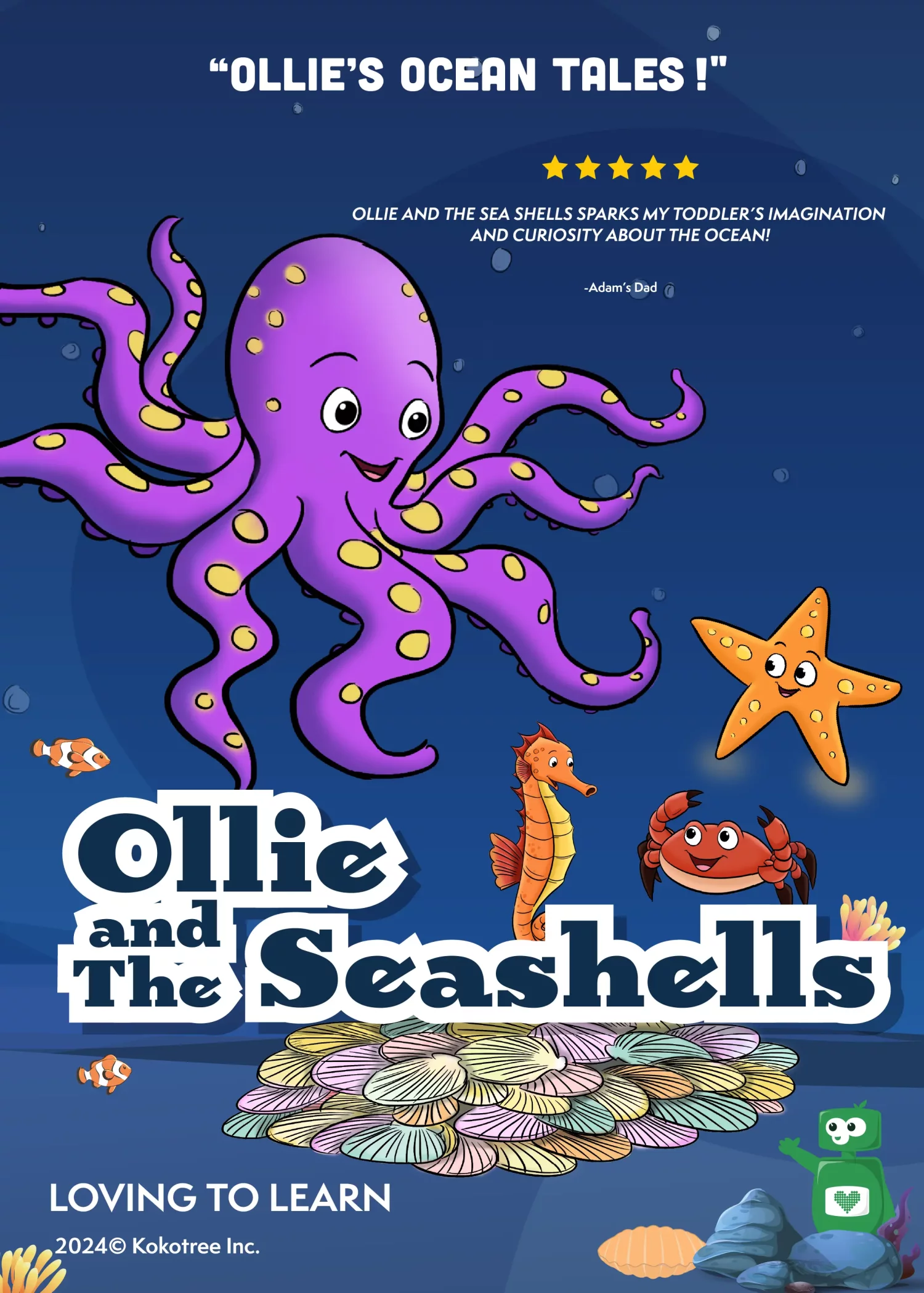
Join the Kokotree kids as they discover that math is a superpower through an adorable underwater story! Your child will count seashells alongside Ollie the Octopus and learn that numbers help us share fairly and solve everyday problems.
9 minutes
Ages 3-6
Skill: Counting, Addition & Fair Sharing
Your kid watches an octopus divide seashells between sea friends. You get 9 minutes to drink your coffee while it's still warm.
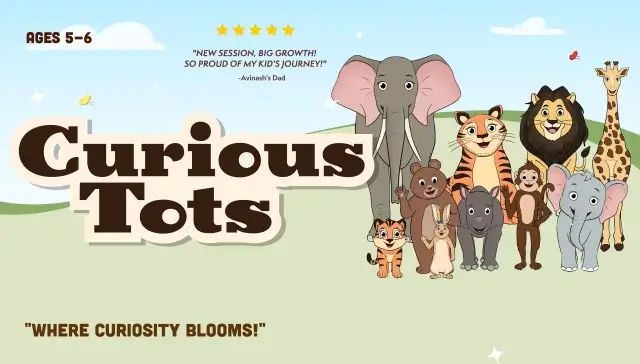
Elizabeth the Elephant gathers her jungle classroom to tell a story about Ollie the Octopus. When Ollie's sea friends—Starfish, Seahorse, and Crab—find a pile of shiny seashells but can't figure out how to share them equally, Ollie uses counting and addition to save the day. The episode wraps up with the jungle kids practicing their own counting games.
What your child learns:
This episode transforms abstract math concepts into a relatable story about friendship and fairness. Children see counting in action as Ollie organizes seashells into equal groups, making division feel natural and achievable.
- Counting objects from 1-15 with confidence
- Understanding that addition means "putting more together"
- Grasping the concept of equal sharing (early division)
- Recognizing that math solves real-world problems
- Building number sense through visual grouping
They'll use these skills when:
- Dividing crackers equally between siblings or friends at snack time
- Counting steps on a staircase or tiles on the floor
- Figuring out if everyone at the table has the same number of strawberries
- Playing board games that require counting spaces
The Story (what keeps them watching)
Elizabeth the Elephant welcomes her students to Curious Tots with a promise of adventures in math, science, and stories. When Tiki Tiger asks for a tale, Elizabeth shares the story of Ollie the Octopus. Deep in the ocean, Ollie's friends discover beautiful seashells but can't share them fairly. Ollie counts out 10 shells for each friend, then divides the remaining 15 equally—5 more each! Back in the jungle classroom, the kids practice counting and adding with Elizabeth, discovering that math makes sharing fun and fair.
How We Teach It (the clever part)
First 2 minutes: Elizabeth builds excitement about learning and introduces math as a "superpower" that helps solve problems—priming children to see numbers as useful tools, not abstract concepts.
Minutes 2-7: The underwater story demonstrates counting and division through Ollie's seashell problem. Numbers appear on screen with sound effects as Ollie counts, inviting participation. Children watch equal groups form visually.
Final 2 minutes: Elizabeth leads interactive counting games with the jungle kids, reinforcing addition (3+2=5, 6+3=9) and connecting the story's lesson to real-life sharing scenarios.
Teaching trick: Ollie counts out loud while physically moving shells into piles, so children see AND hear the numbers simultaneously—doubling the learning pathways into their brains.
After Watching: Quick Wins to Reinforce Learning
Snack time sharing: "We have 6 apple slices. Can you share them fairly between us?" (Practices equal division with real objects they can touch and eat)
Car counting: "Let's count red cars! When we get to 5, let's add 3 more. What number will we reach?" (Reinforces addition while keeping little eyes busy)
Bedtime grouping: "Can you put your stuffed animals into groups of 2? How many groups do you have?" (Builds understanding of equal sets before sleep)
Anytime challenge: "Here are 9 blocks. Can you share them fairly with me so we both have the same?" (Direct practice of the episode's core concept)
When Kids Get Stuck. And How to Help.
"My child loses count after 10" - Totally normal! Have them touch each object as they count. Physical contact anchors each number. Start with smaller groups (count to 5, then 7) and build up gradually.
"They don't understand 'equal' sharing yet" - Use visual comparison: line up two groups side by side. Ask "Which has more? Which has less?" before introducing "same." The concept clicks when they can see the match.
"Addition seems too advanced for my 3-year-old" - Focus on the counting and grouping parts—that's the foundation. Addition understanding will emerge naturally. For now, celebrate every correct count!
What Your Child Will Learn
Prerequisites and Building Blocks
Children benefit most from this episode if they can count to 10 with one-to-one correspondence (touching objects while counting). This video builds on basic number recognition introduced in earlier Kokotree content and serves as a bridge to more complex addition and early division concepts. It fits within the early numeracy progression, preparing children for multi-digit operations by establishing strong counting fluency and introducing the concept that numbers can be combined and separated.
Cognitive Development and Teaching Methodology
This episode leverages narrative-based learning, which research shows increases retention in preschoolers by embedding abstract concepts in memorable stories. The dual presentation—visual grouping of shells plus verbal counting—addresses both visual and auditory learners. The interactive counting segment at the end engages kinesthetic learners through imagined participation. Repetition of counting sequences (1-10, then 1-15) builds automaticity, while the problem-solving context gives numbers meaningful purpose.
Alignment with Educational Standards
This content aligns with Common Core Kindergarten standards K.CC.A.1 (count to 100 by ones), K.CC.B.4 (understand counting relationship), and K.OA.A.1 (represent addition). It supports Head Start Early Learning Outcomes in Mathematics, specifically "Number Concepts and Quantities." The fair sharing concept introduces early division thinking expected in first grade. Kindergarten teachers expect entering students to count to 20 and understand "more," "less," and "same"—all reinforced here.
Extended Learning Opportunities
Pair this video with Kokotree's counting games featuring numbers 1-20. Print simple seashell counting worksheets where children draw equal groups. Extend learning with household sorting activities—dividing toys into equal piles, counting steps, or sharing snacks. The app's "Number Friends" series builds on these same counting foundations. For advanced learners, introduce counting by 2s or 5s using the seashell grouping concept.
Transcript Highlights
- Teaching counting: "Let's start counting—one, two, three, four, five, six, seven, eight, nine and ten." (Clear, sequential demonstration)
- Introducing addition: "We still have 15 seashells left! Let's add five more shells to each of your piles so that everyone has the same amount!" (Problem-solving context)
- Reinforcing fair sharing: "That's called fair sharing!" (Explicit vocabulary instruction)
- Interactive practice: "What's three plus two?" followed by "Three plus two makes 5!" (Call-and-response engagement)
Character Development and Story Arc
Ollie the Octopus models calm problem-solving when friends are frustrated. Rather than becoming upset when the seashells can't be divided easily, Ollie approaches the challenge with curiosity: "Don't worry! We can solve this with some math magic!" This demonstrates growth mindset—the belief that problems have solutions if we think carefully. Elizabeth reinforces this by calling the children "problem-solving heroes," building mathematical confidence and showing that persistence leads to success.
Mathematical Foundations: Counting, Addition, and Equal Division
This episode introduces three interconnected mathematical concepts that form the bedrock of early numeracy. Counting is presented as a sequential, one-to-one process—Ollie touches each shell as he counts, modeling the essential skill of cardinality (understanding that the last number counted represents the total quantity). This physical counting reinforces that numbers aren't just words but represent real quantities.
Addition emerges naturally from the story's problem: when 30 shells must become 45 to share fairly, children see addition as "putting groups together." The episode uses concrete representation (visual shell piles) before abstract symbols, following the Concrete-Pictorial-Abstract progression recommended by math educators. When Elizabeth later asks "What's three plus two?" children have already seen addition in action.
Equal division (early fraction and division thinking) appears when Ollie creates three identical piles. This concept—that a whole can be separated into equal parts—is foundational for later fraction understanding. The episode wisely uses the term "fair sharing" rather than "division," connecting mathematical operations to social experiences children already value.
The repeated counting sequences (1-10, 1-15, 1-5 multiple times) build counting fluency through varied repetition. Research indicates that preschoolers need 50+ exposures to number sequences before achieving automaticity. By embedding counting in an engaging narrative, this episode makes those repetitions enjoyable rather than tedious, supporting both procedural fluency and conceptual understanding.