
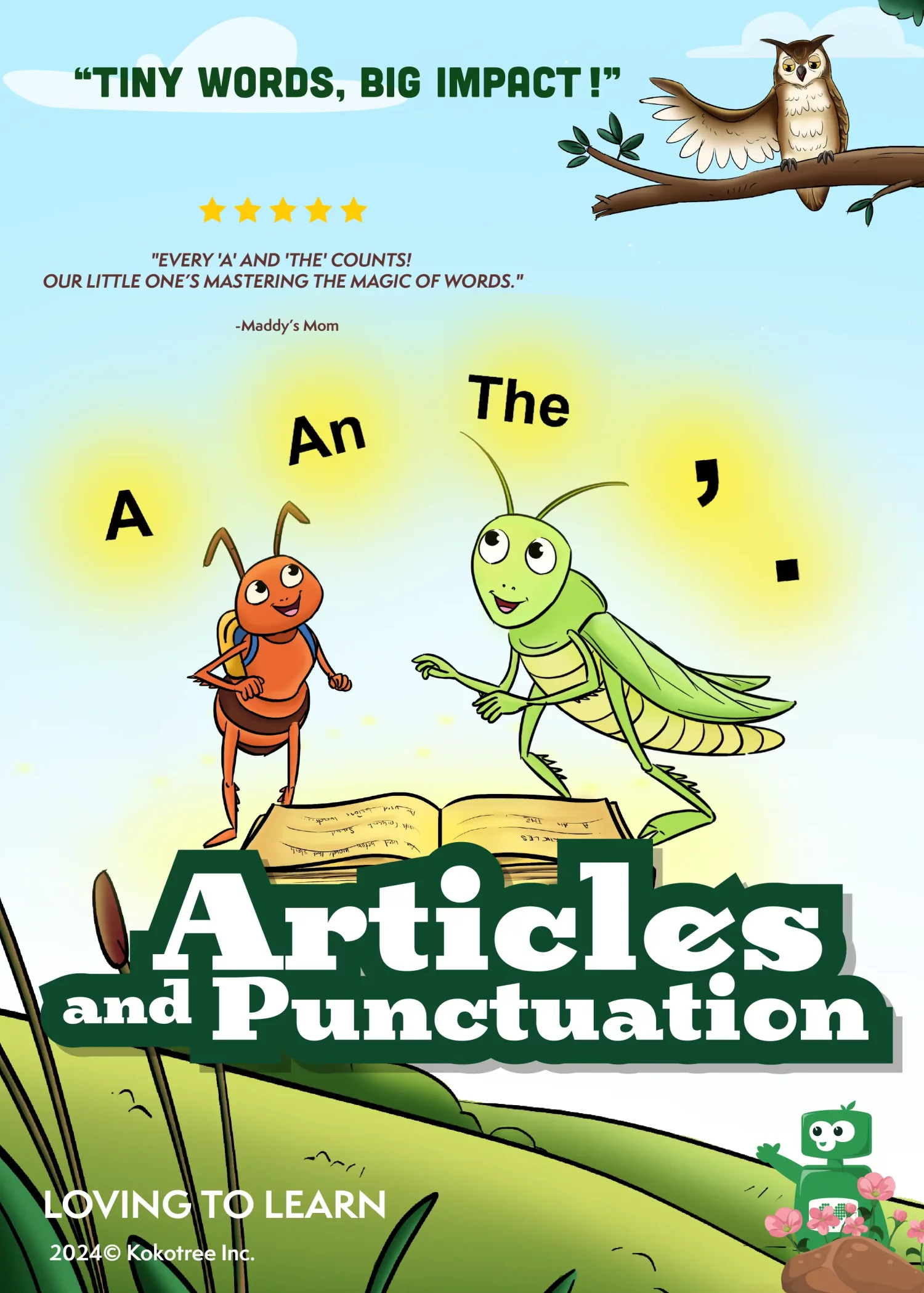
What's Articles & Punctuation About?
Your child joins a curious ant on a treasure hunt and discovers the magic of words! They'll learn exactly when to say 'a ball' versus 'an apple' and why sentences need full stops—skills they'll use every time they speak or write.
12 minutes
Ages 4-6
Skill: Grammar basics (articles and punctuation)
Your kid watches an ant find a magical book of floating words. You get 12 minutes to finish that coffee in peace.
Andy the Ant and his grasshopper friend Greg follow a treasure map through caves, across rivers, and past a riddle-telling owl. When they finally open the treasure chest, magical letters float into the air—'a,' 'an,' 'the,' commas, and full stops all dancing around them. A wise owl teaches them exactly how to use each one.
What your child learns:
This video transforms abstract grammar rules into visual, memorable lessons. Your child will understand that 'an' goes before vowel sounds (like 'an umbrella') while 'a' pairs with consonant sounds (like 'a tiger'). They'll also grasp why we pause at commas and stop at full stops.
- Choosing between 'a' and 'an' based on the sound that follows
- Using 'the' when talking about something specific
- Recognizing that full stops end complete sentences
- Understanding commas separate items in a list
- Building clearer, more organized sentences
They'll use these skills when:
- Describing what they want at snack time ('I want an orange' vs. 'I want a banana')
- Telling you about their day in complete sentences
- Making lists of toys they want to play with
- Reading books aloud and pausing in the right places
The Story (what keeps them watching)
Andy the Ant isn't your ordinary ant—he's an adventurer! Armed with a map, an apple, and an umbrella, he sets off to find legendary treasure in the Whispering Woods. Along the way, he teams up with Greg the Grasshopper, solves an owl's riddle about clocks, and hitches a ride on a friendly turtle's shell. The treasure? A magical golden book that makes words come alive! Floating letters teach them grammar secrets, and the wise owl guides them through practice sentences. By the end, Andy and Greg become the forest's greatest storytellers.
How We Teach It (the clever part)
- First 4 minutes: The adventure begins! Andy packs 'an apple' and 'an umbrella'—planting article examples naturally in the story before any teaching happens.
- Minutes 4-9: The magical book reveals floating words. The owl introduces the rules: 'a' before consonant sounds, 'an' before vowel sounds, 'the' for specific things. Kids see real examples with objects from a basket.
- Final 3 minutes: Andy and Greg practice building sentences with commas and full stops. Miss Meera reinforces that these tools help us 'tell clearer stories.'
Teaching trick: The owl uses a basket of real items (apple, ball, umbrella) and asks the characters to describe what they see. Kids hear the correct article used, then immediately learn WHY it's correct—connecting the rule to the sound at the start of each word.
After Watching: Quick Wins to Reinforce Learning
- Mealtime activity: "Is that A banana or AN banana?" Point to foods on the table and let your child pick the right article. They're practicing vowel vs. consonant sounds without even realizing it.
- Car/travel activity: "I spy AN..." Play I Spy but require the correct article. "I spy a tree" or "I spy an airplane." Bonus points if they can explain why!
- Bedtime activity: "Let's list three things in your room." Help them say: "I see a pillow, a blanket, and the nightlight." They're practicing commas in lists and using 'the' for specific items.
- Anytime activity: "Full stop or keep going?" Read a picture book together and pause dramatically at full stops. Ask: "Why did we stop there?" They'll start noticing punctuation everywhere.
When Kids Get Stuck. And How to Help.
"My child keeps saying 'a apple' instead of 'an apple.'" - Totally normal! The vowel sound rule takes time to stick. Try exaggerating the sounds together: "Aaaaaapple starts with 'ahhhh'—that's a vowel sound, so we say AN apple!" Make it silly and they'll remember.
"They don't understand why 'the' is different from 'a.'" - Use their toys! Hold up any stuffed animal and say "a teddy bear." Then point to THEIR specific teddy and say "THE teddy bear you sleep with." The difference clicks when it's personal.
"Full stops and commas seem too advanced for my preschooler." - At this age, they just need exposure, not mastery. If they understand that sentences end (like taking a breath), that's a win! The video plants seeds they'll build on in kindergarten and beyond.
What Your Child Will Learn
Prerequisites and Building Blocks
Children watching this video should recognize letters and understand that words make sentences. This builds on basic vocabulary development and early phonemic awareness—knowing that words start with different sounds. It's an ideal bridge between letter recognition and early reading, preparing children for more complex grammar concepts they'll encounter in kindergarten writing activities.
Cognitive Development and Teaching Methodology
This video leverages narrative transportation—embedding grammar rules within an engaging adventure story. Preschoolers learn best through context, not isolated rules. The visual representation of floating articles and punctuation marks addresses visual learners, while the owl's verbal explanations support auditory processing. Kinesthetic learners benefit from the interactive question-and-answer format that invites mental participation.
Alignment with Educational Standards
This content aligns with Common Core Language Standards for Kindergarten (L.K.1), specifically the use of frequently occurring articles and basic punctuation. It supports kindergarten readiness indicators for print awareness and sentence structure. Teachers expect entering kindergarteners to understand that sentences have beginnings and endings—this video establishes that foundational concept.
Extended Learning Opportunities
Pair this video with article sorting games using household objects. Create simple fill-in-the-blank sentences: "I see ___ elephant." Practice writing short lists with commas using drawings instead of words. The Kokotree app offers related phonics videos that reinforce vowel and consonant sound recognition, which directly supports article selection skills.
Transcript Highlights
- Teaching the 'an' rule: "Because 'apple' starts with a vowel sound."
- Explaining article categories: "'A' and 'an' are used when we're talking about one thing, but not a specific one. 'A' is used before words that start with a consonant sound, like 'a tiger,' and 'an' is used before words that start with a vowel sound, like 'an elephant.'"
- Introducing 'the': "We use 'the' because it's a specific star."
- Full stop function: "See the full stop at the end? It shows the sentence is complete."
Character Development and Story Arc
Andy the Ant models curiosity and courage—he's "not like other ants" because he seeks adventures. Greg demonstrates the value of companionship in learning. Together, they show that asking questions leads to discovery. The wise owl represents patient mentorship, guiding without judging. When Andy thinks through the riddle answer, children see that pausing to think is part of problem-solving.
Understanding Articles and Punctuation: A Language Development Deep Dive
Articles ('a,' 'an,' 'the') are among the most frequently used words in English, yet they're surprisingly tricky for young learners. Children typically begin using articles around age 2-3, but consistent correct usage develops between ages 4-6—exactly when this video targets.
The 'a' versus 'an' distinction relies on phonemic awareness, specifically recognizing whether a word begins with a vowel or consonant SOUND (not just letter). This is why 'an hour' and 'a unicorn' exist—the sound matters more than the spelling. This video wisely focuses on clear examples where the letter matches the sound, building a foundation before introducing exceptions.
Definite ('the') versus indefinite ('a/an') articles represent an abstract concept: specificity. Young children are naturally egocentric in their communication, often assuming listeners know exactly what they're referring to. Learning to distinguish 'a ball' (any ball) from 'the ball' (that specific one) develops theory of mind and communication clarity.
Punctuation awareness—even at a basic level—supports reading comprehension. Children who understand that full stops signal sentence endings read with better prosody and comprehension. The comma-in-lists concept introduces the idea that punctuation organizes information, a skill essential for both reading and writing development.
By embedding these concepts in a treasure hunt narrative, the video creates emotional anchors for abstract rules. Children remember 'an umbrella' because Andy packed it for his adventure, not because they memorized a rule about vowel sounds.