
What's Prefixes - un, re, dis, mis About?
Your child becomes a word detective, discovering how adding tiny letters to the beginning of words creates brand new meanings! They'll crack the code of prefixes and start recognizing these patterns in everyday language.
8.5 minutes
Ages 4-6
Skill: Word Building & Vocabulary Expansion
Your kid watches friendly animals solve prefix puzzles in a magical meadow. You get 8 minutes to finish that coffee while it's still warm.
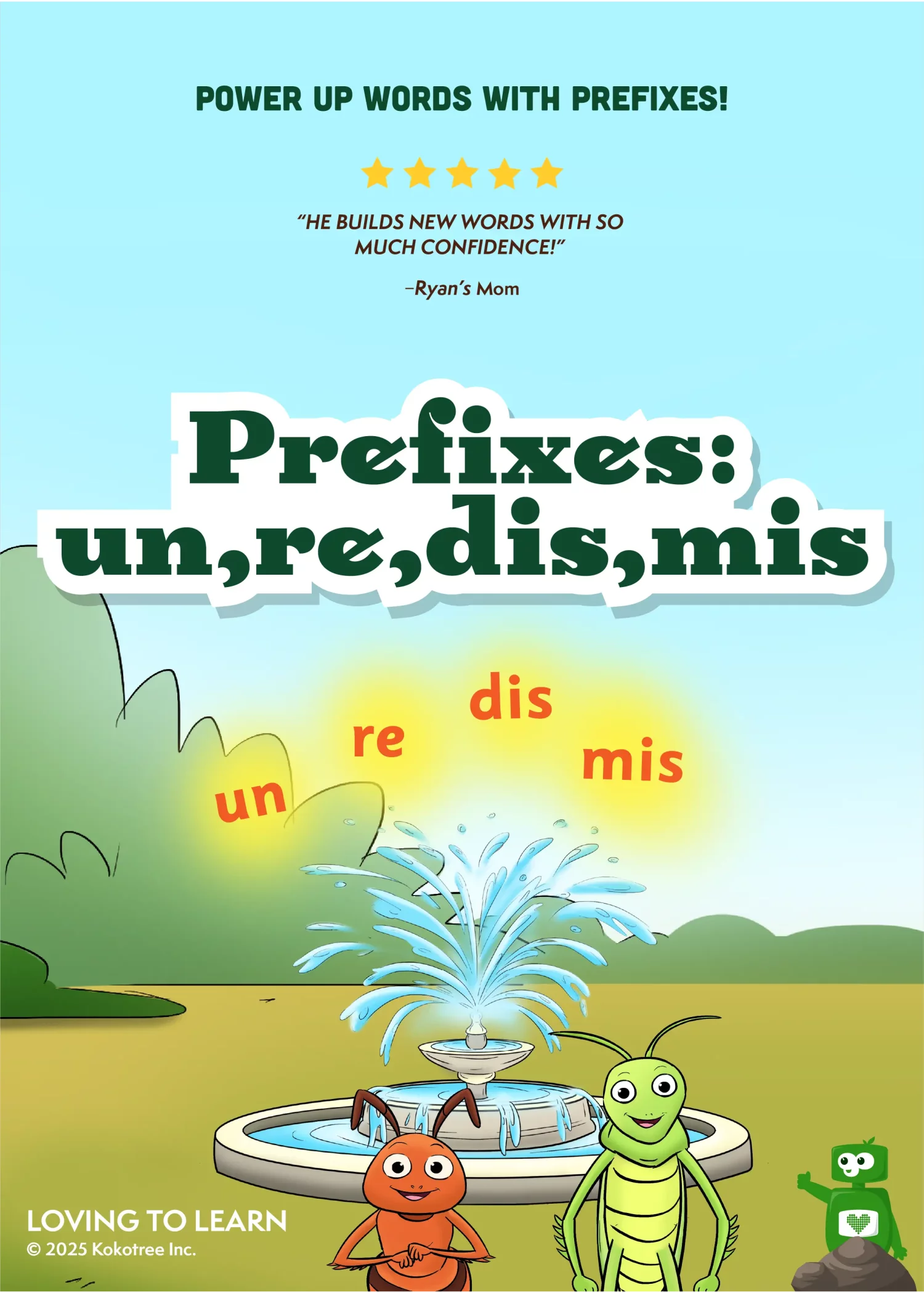
Maddy Monkey accidentally says "unpleased" instead of "displeased," sparking a classroom conversation about prefixes. Miss Meera then takes the class on a story adventure where Andy the Ant and Greg the Grasshopper travel through a magical forest, helping animal friends by solving prefix puzzles at each stop.
What your child learns:
They'll understand that prefixes are special word parts added to the beginning of words that change their meaning. Through the story, they discover four key prefixes and practice using them in context.
- Recognizes that "un-" means "not" (unhappy, unkind, unfair)
- Understands "re-" means "again" (rebuild, rewrite, repaint)
- Identifies "dis-" as "not" or "opposite" (disagree, dislike, disappear)
- Learns "mis-" means "wrong" (misplace, misread)
- Applies prefix knowledge to decode unfamiliar words
They'll use these skills when:
- Reading new words in books and figuring out meanings without asking
- Understanding instructions like "Please redo your drawing" or "Don't misbehave"
- Playing word games and building vocabulary during car rides
- Communicating more precisely ("I disagree" vs. "I don't like it")
The Story (what keeps them watching)
When Maddy Monkey says "unpleased" and Ruby Rabbit corrects him, Miss Meera turns it into a teaching moment about prefixes. She shares a story where Andy the Ant and Greg the Grasshopper follow Wise Owl into a magical meadow where words keep changing meanings! They help Rocky Raccoon "rebuild" his raft, comfort Hazel Hedgehog who feels "unwanted," and assist Kango Kangaroo who's "disappointed." Each puzzle solved makes the prefix glow and fixes the problem. Finally, they unlock a magical fountain by answering prefix riddles, bringing harmony back to the forest!
How We Teach It (the clever part)
- First 2 minutes: Miss Meera introduces the concept through Maddy's real mistake, making prefixes immediately relevant and showing that even smart guesses need the right prefix
- Minutes 2-7: The adventure story presents each prefix through emotional, relatable scenarios—a broken raft needs rebuilding, a sad hedgehog feels unwanted—connecting abstract concepts to feelings kids understand
- Final 1.5 minutes: The fountain quiz reinforces all four prefixes through rapid recall, then celebrates success with visual magic as the meadow blooms
Teaching trick: Each prefix is paired with a character's problem AND a visual animation where the prefix letters physically attach to or detach from words. When "un-" floats away from "unwanted," leaving just "wanted," kids literally SEE how prefixes change meaning.
After Watching: Quick Wins to Reinforce Learning
- Mealtime activity: "Can you make this word opposite? Happy... UNhappy! Now try: kind, fair, lucky." (Practices un- prefix while waiting for food to cool)
- Car/travel activity: "I spy something that needs to be RE-done. What could we rebuild, repaint, or redo?" (Connects re- prefix to the real world outside the window)
- Bedtime activity: "Let's think of things that would make us DIS-appointed or things we DIS-like about rainy days." (Explores dis- prefix through gentle conversation)
- Anytime activity: "Uh oh, I MIS-placed my keys! Can you help me find what I put in the wrong spot?" (Models mis- prefix naturally during daily routines)
When Kids Get Stuck. And How to Help.
- "My child keeps mixing up un- and dis-" - Totally normal! Both mean "not," so the confusion makes sense. Focus on the most common words first (unhappy, disagree) and let the rest come naturally through exposure.
- "They're adding prefixes to every word now, making up silly words" - This is actually fantastic! It means they understand the concept. Gently redirect by saying "That's creative! The real word is..." just like Miss Meera did with Maddy.
- "This seems advanced for my preschooler" - Prefix awareness is perfect for ages 4-6 because they're naturally curious about how words work. They don't need to master every prefix—just recognizing that word beginnings matter is a huge win!
What Your Child Will Learn
Prerequisites and Building Blocks
Children benefit most from this video when they already recognize common sight words and understand that words carry meaning. This builds on basic vocabulary development and letter recognition skills. It's ideal for children who are beginning to notice patterns in language and ask "what does that word mean?" This video bridges the gap between simple vocabulary and early reading comprehension, preparing children for decoding unfamiliar words independently.
Cognitive Development and Teaching Methodology
This video leverages narrative-based learning, which is highly effective for 4-6 year olds whose brains are wired for story absorption. The problem-solution structure at each story stop activates working memory while the visual animations of prefixes attaching to words support concrete operational thinking. Auditory learners benefit from repeated verbal examples, visual learners from animated text, and kinesthetic concepts are addressed through the "magical fixing" that occurs when puzzles are solved.
Alignment with Educational Standards
This content aligns with Common Core ELA standards for Kindergarten (L.K.4b: Use frequently occurring affixes as a clue to word meaning) and first-grade readiness indicators. Early literacy frameworks emphasize morphological awareness—understanding word parts—as a predictor of reading success. Teachers expect entering kindergarteners to show curiosity about word meanings; prefix recognition demonstrates advanced phonological awareness that supports decoding skills.
Extended Learning Opportunities
Pair this video with prefix matching games where children connect un-, re-, dis-, and mis- cards to base words. Create a "Prefix Detective" worksheet where children circle prefixes in simple sentences. The Kokotree app's word-building activities reinforce these concepts through interactive play. Extend learning by creating a family "prefix jar" where everyone adds new prefix words they discover during the week, then reviews them together.
Transcript Highlights
- "A prefix is a little word part that goes at the beginning of another word—and it changes the meaning like magic!"
- "'Re-' is the prefix of repetition... Rebuild – build again, Rewrite – write again, Repaint – paint again"
- "'Un-' is a prefix that turns a word into its opposite."
- "The prefix dis- usually means 'not' or 'the opposite of.'... it often flips the meaning of a word upside down."
Character Development and Story Arc
Andy the Ant and Greg the Grasshopper model ideal learning behaviors throughout the adventure. They approach each puzzle with curiosity rather than frustration, collaborate to find solutions, and celebrate their friends' understanding. When Hazel Hedgehog feels unwanted, they demonstrate empathy before problem-solving. The characters show that making mistakes (like Maddy's "unpleased") is part of learning, and Miss Meera models supportive correction without shame.
Morphological Awareness: The Foundation of Vocabulary Growth
Morphological awareness—the ability to recognize and manipulate meaningful word parts—is one of the strongest predictors of reading comprehension and vocabulary development. Research shows that children who understand prefixes and suffixes can decode approximately 60% of unfamiliar words they encounter in text by analyzing word parts.
The four prefixes taught in this video (un-, re-, dis-, mis-) are among the most frequently occurring in English. Studies indicate that just four prefixes (un-, re-, in-, dis-) account for 97% of prefixed words in printed school English. By mastering these foundational prefixes, children gain a powerful tool for independent word learning.
For 4-6 year olds, morphological instruction works best when embedded in meaningful contexts—exactly what this video provides. Each prefix is introduced through an emotionally resonant scenario: Rocky's frustration with his broken raft makes "rebuild" memorable; Hazel's sadness makes "unwanted" meaningful. This emotional encoding strengthens memory formation.
The progression from concrete examples to abstract application (the fountain quiz) follows established principles of scaffolded instruction. Children first see prefixes in action, then identify them, then generate new examples—moving up Bloom's taxonomy from recognition to application. This prepares them for the independent word analysis they'll need as readers.