
What's Crack The Code About?
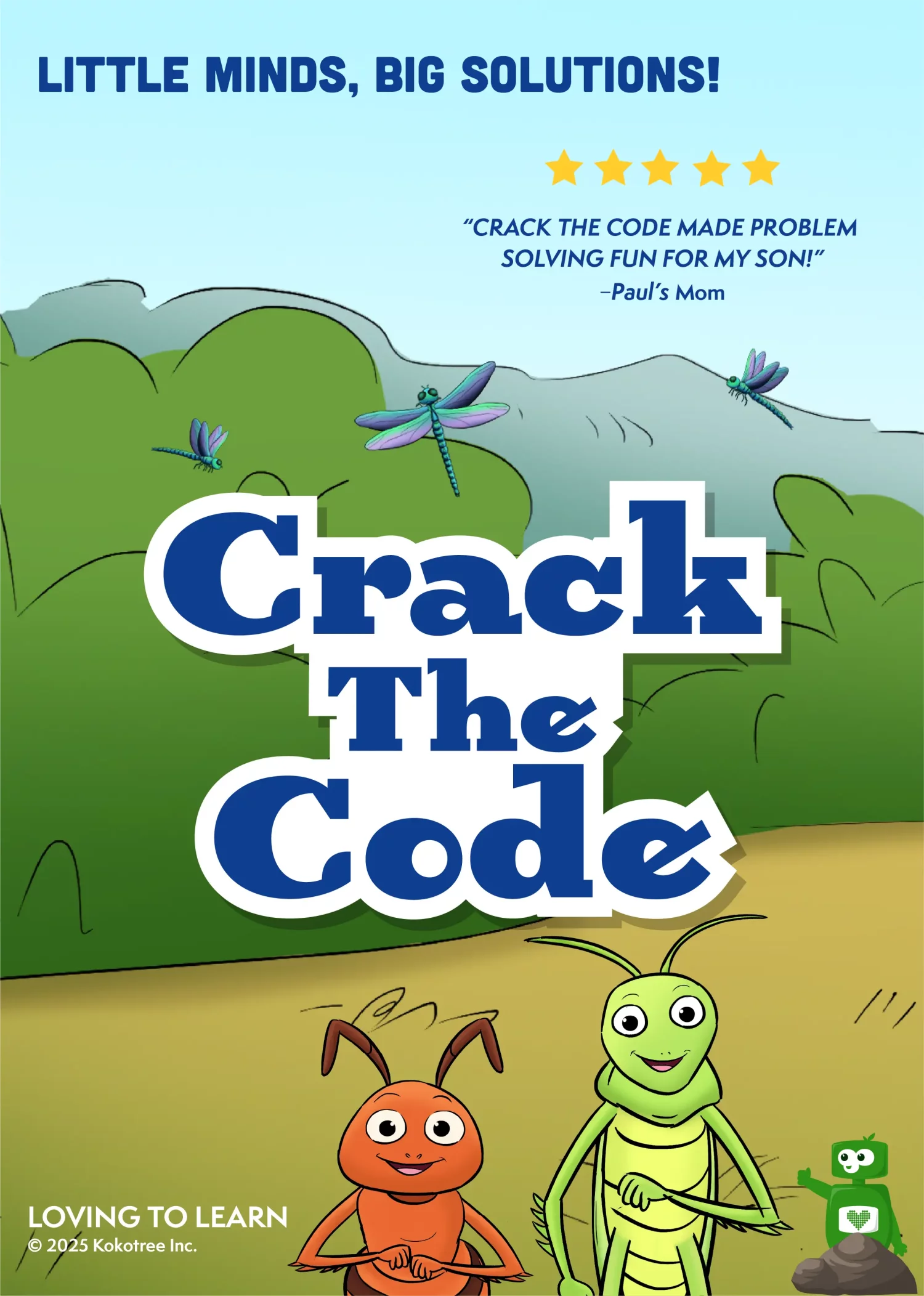
Your little one becomes a math detective, solving missing number mysteries alongside Andy the Ant and Greg the Grasshopper! They'll crack equation puzzles using addition, subtraction, and number bonds—building confidence to tackle real-world math challenges.
11 minutes
Ages 4-6
Skill: Solving missing number equations
Your kid watches friendly bugs solve number mysteries on a magical trail. You get 11 minutes to finish that coffee in peace.
Andy and Greg journey through Number Hill, encountering puzzles carved into bridges, logs, and giant daisies. Each obstacle presents a missing number equation they must solve to continue—counting on fingers, thinking backwards, and using number bonds to crack each code before sunset.
What your child learns:
This adventure transforms abstract math into tangible problem-solving. Children discover that equations are like math sentences where both sides must balance—and that finding missing pieces is actually fun detective work.
- Identifies missing numbers in addition equations (like ⬜ + 5 = 12)
- Solves subtraction puzzles by working backwards (20 – ⬜ = 13)
- Uses number bonds to find partners that make target numbers
- Counts up or down to discover unknown values
- Recognizes equations written in different formats (11 = 4 + ⬜)
They'll use these skills when:
- Figuring out how many more crackers they need to have 10
- Splitting toys fairly between friends ("If you have 4 and we need 9 total...")
- Playing board games that involve counting spaces
- Helping sort items into groups at cleanup time
The Story (what keeps them watching)
Wise Owl delivers urgent news: Number Hill's equations are broken, and the path to the Golden Meadow will stay locked unless someone fixes them before sunset! Andy the Ant and Greg the Grasshopper accept the challenge, hopping from puzzle to puzzle along a magical trail. They encounter a pebble bridge, a giant log, a chatty squirrel, a spinning daisy, and dragonfly-guarded gates—each demanding a solved equation for passage. Through teamwork and clever thinking, they crack every code and arrive just in time for the Bug Bounce Festival!
How We Teach It (the clever part)
First 3 minutes: Wise Owl introduces equations as "math sentences" using the example 8 + 2 = 10, then removes the 2 to show what a missing number looks like—making the abstract concept visual and concrete.
Minutes 3-9: Andy and Greg encounter increasingly varied puzzles—addition with missing first numbers, subtraction problems, and equations written in reverse order. Each solution is shown through counting animations and thinking bubbles.
Final 2 minutes: The heroes celebrate at the Golden Meadow, reinforcing that math skills unlock real rewards. Miss Meera connects the adventure back to classroom learning.
Teaching trick: Greg's thinking bubble shows him counting up from the known number to the target ("6... 7... 8... 9... 10... 11... 12!"), giving children a visual strategy they can copy using their own fingers.
After Watching: Quick Wins to Reinforce Learning
Mealtime activity: "We have 5 strawberries. How many more do we need to have 10?" Let your child count up on their fingers just like Greg did—they're solving real missing number problems!
Car/travel activity: "I spy 3 red cars. If we need to find 8 total, how many more should we look for?" This turns travel time into a number bond game with built-in anticipation.
Bedtime activity: "You read 4 books tonight. If our goal was 6, how many did we skip?" Subtraction feels friendlier when it's about cozy book counting.
Anytime activity: Hide a small number of toys under a blanket and show the rest. "There are 9 blocks total. You can see 5. How many are hiding?" Instant mystery mission!
When Kids Get Stuck. And How to Help.
"My child just guesses random numbers" - Totally normal! Encourage them to count up from the smaller number like Greg does. Say "Let's start at 5 and count until we reach 12" while using fingers together.
"They get confused when the blank is in different spots" - Equations written as ⬜ + 4 = 9 versus 9 = 4 + ⬜ look different but mean the same thing. Use physical objects to show that the mystery number is always the same, no matter where the box appears.
"The bigger numbers seem too hard" - Start with totals under 10, then gradually increase. The video's progression from simple to complex is intentional—rewatching helps cement earlier concepts before tackling the trickier puzzles.
What Your Child Will Learn
Prerequisites and Building Blocks
Children should recognize numbers 1-20 and understand basic addition and subtraction concepts before watching. This video builds on earlier Kokotree lessons covering number recognition, counting sequences, and simple addition facts. It serves as a bridge between concrete counting and abstract algebraic thinking—preparing children for more complex problem-solving where variables replace specific numbers. The mystery narrative format rewards prior math knowledge while introducing new equation-solving strategies.
Cognitive Development and Teaching Methodology
This video leverages the preoperational stage's love of pretend play by embedding math within an adventure narrative. The "thinking bubble" animations externalize metacognition—showing children what problem-solving looks like inside someone's head. Multiple solution strategies (counting up, working backwards, using number bonds) address different learning styles. Visual learners see the equations appear on screen; auditory learners hear the counting aloud; kinesthetic learners are prompted to use their fingers alongside the characters.
Alignment with Educational Standards
This content aligns with Common Core K.OA.A.4 (finding the unknown number in addition/subtraction equations) and 1.OA.D.8 (determining unknown whole numbers). It addresses kindergarten readiness indicators for understanding equality and the meaning of the equals sign. Teachers expect incoming first-graders to solve missing addend problems—this video provides that exact practice through engaging, low-pressure storytelling that builds mathematical confidence.
Extended Learning Opportunities
Pair this video with Kokotree's Number Bonds printable worksheets featuring blank boxes in various positions. The app's "Mystery Math" game reinforces these skills through interactive puzzles. Extend learning with physical manipulatives: use blocks or buttons to recreate the video's equations, letting children physically remove or add objects. Create "mystery cards" at home—write equations with missing numbers and let your child be the detective who solves them.
Transcript Highlights
- "An equation is like a math sentence. It tells us that both sides are equal—but only if all the right numbers are in place." (Wise Owl introducing the core concept)
- "Let's count from 5 up to 12. Ready? 6… 7… 8… 9… 10… 11… 12! We counted 7 numbers—so the missing number is 7!" (Greg modeling the counting-up strategy)
- "Look, we have 20 leaves! Let's take some away until only 13 are left." (Andy demonstrating subtraction through physical removal)
- "8 and 12 are number bonds to 20!" (Greg showing automatic recall of number partnerships)
Character Development and Story Arc
Andy and Greg model collaborative problem-solving throughout their journey. Greg often leads with counting strategies while Andy contributes logical reasoning—demonstrating that different approaches both lead to correct answers. Their enthusiasm ("That was so much fun! I didn't know math could feel like an adventure!") normalizes finding joy in mathematical challenges. Wise Owl serves as a gentle mentor who explains concepts without solving problems for them, encouraging productive struggle and independence.
Understanding Missing Number Equations: A Mathematical Deep Dive
Missing number problems represent a crucial stepping stone toward algebraic thinking. When children solve ⬜ + 5 = 12, they're essentially solving for x in x + 5 = 12—foundational algebra disguised as a puzzle. This video introduces three key strategies that mathematicians use:
Counting On: Starting from the known addend and counting until reaching the sum. Greg demonstrates this explicitly: "Let's count from 5 up to 12." This strategy builds on children's existing counting skills while introducing the concept of finding differences.
Inverse Operations: For subtraction problems like 20 – ⬜ = 13, children learn that subtraction and addition are related. If 20 minus something equals 13, then 13 plus something equals 20. This inverse relationship is fundamental to mathematical fluency.
Number Bonds: The video references number bonds ("8 and 12 are number bonds to 20!"), which are pairs of numbers that combine to make a target sum. Automatic recall of these partnerships dramatically speeds up mental math and reduces cognitive load during problem-solving.
The varied equation formats (⬜ + 5 = 12 versus 12 = 5 + ⬜ versus 15 = ⬜ + 9) are intentionally included. Research shows children often misunderstand the equals sign as meaning "the answer comes next" rather than "both sides are the same." By presenting equations in multiple arrangements, this video builds true understanding of mathematical equality—a concept that predicts later algebra success.