
What's Primary & Secondary Colors About?
Your little artist embarks on a magical jungle quest to discover how just three special colors create an entire rainbow! After watching, they'll confidently identify primary colors and predict what happens when you mix them together.
10 minutes
Ages 3-6
Skill: Color mixing and color recognition
Your kid watches a chameleon rediscover his lost colors through friendship. You get 10 minutes to finally drink that coffee while it's hot.
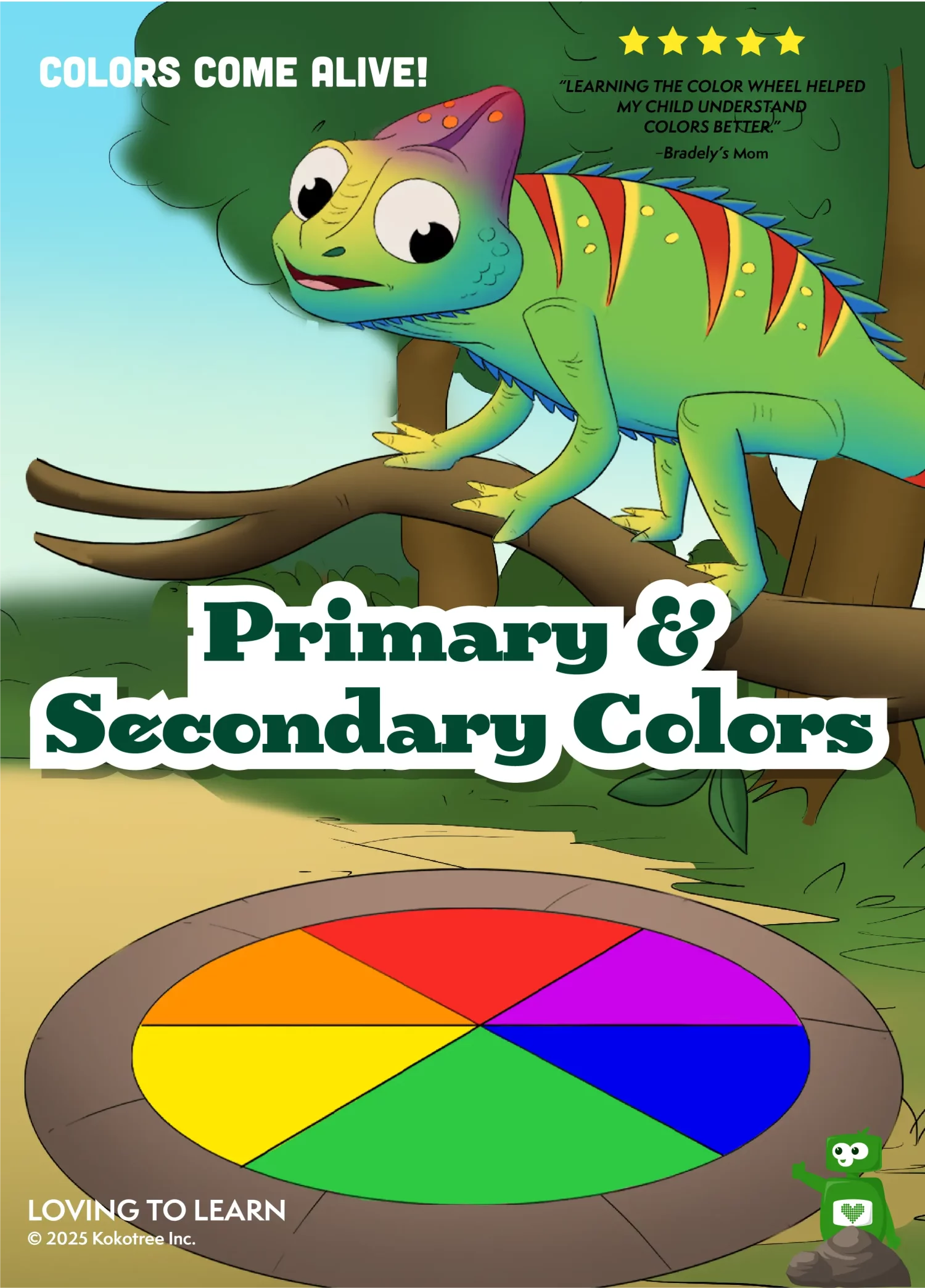
Miss Meera tells a glowing storybook tale about Coco the Chameleon, who wakes up completely grey and colorless. With help from his friends Kango the Kangaroo and Dally the Armadillo, Coco travels to the Red Cliff, Blue Lagoon, and Yellow Field to reclaim each primary color. The adventure ends at a magical color wheel where Coco mixes his colors to create orange, green, and purple—and becomes whole again.
What your child learns:
This video introduces the foundational concept that red, blue, and yellow are "primary colors"—the only colors that can't be made by mixing others. Children discover that combining these three creates "secondary colors" and begin understanding color relationships that will support future art and science learning.
- Identifies red, blue, and yellow as the three primary colors
- Understands that primary colors cannot be made by mixing
- Predicts color mixing outcomes (red + yellow = orange)
- Names all three secondary colors: orange, green, purple
- Connects colors to real-world examples (sunshine = yellow, sky = blue)
They'll use these skills when:
- Choosing paint colors at the art table and predicting what new colors they'll make
- Sorting crayons, blocks, or toys by color families
- Pointing out colors in nature: "That flower is orange like red and yellow mixed!"
- Playing color-mixing games with friends or describing favorite things by color
The Story (what keeps them watching)
Coco the Chameleon wakes up to a big problem—all his beautiful colors have vanished! He's just... grey. His best friends Kango and Dally spring into action, and Wise Owl sends them on an epic Color Quest. First stop: the glowing Red Cliff, where brave-hearted Coco earns his red back. Then to the peaceful Blue Lagoon, where stillness reveals sapphire blue. Finally, a golden field of flowers returns his yellow. But the real magic? When Coco mixes his primary colors at the sacred color wheel and watches orange, green, and purple burst to life. He's not just colorful again—he understands why.
How We Teach It (the clever part)
First 3 minutes: Miss Meera hooks kids with a question—"What's your favorite color?"—then introduces the concept that three colors are extra special because they make all the others. Primary colors are named and defined before the story begins.
Minutes 3-8: Each primary color gets its own mini-adventure with memorable sensory descriptions. Red is "warm like fire and berries and sunsets." Blue is "like the sky, like water, like peace." Yellow "feels like laughter." These emotional anchors help colors stick.
Final 2 minutes: Coco physically mixes colors in glowing bowls while kids watch orange, green, and purple appear. The classroom scene reinforces vocabulary as students repeat what they learned.
Teaching trick: Each color is tied to a feeling and real-world examples (not just "this is red"). When Coco says yellow feels like laughter and sunshine, children create emotional memory hooks that make abstract color concepts concrete and personal.
After Watching: Quick Wins to Reinforce Learning
Mealtime activity: "Can you find all three primary colors on your plate?" Point to ketchup (red), corn (yellow), or blueberries. Ask: "If we could mix the ketchup and corn, what color would we get?" (Practices identifying primaries and predicting mixtures)
Car/travel activity: "Let's play Primary Color Spy! I spy something yellow—your turn to find red or blue." Once they've found all three, ask which two they'd mix to make green. (Reinforces color recognition in real environments)
Bedtime activity: "If you were Coco and lost your colors, which color would you want to find first? Why?" Let them describe what that color feels like to them. (Builds personal connection to color concepts)
Anytime activity: Hand them three crayons—red, blue, yellow—and ask them to draw something using only primaries. Then ask: "What colors are missing that you wish you could make?" (Connects limitation to the need for mixing)
When Kids Get Stuck. And How to Help.
"My child keeps forgetting which colors are primary." Totally normal! The rule of three takes repetition. Try a simple chant: "Red, blue, yellow—can't be made, they're the base!" Singing it to a familiar tune helps it stick faster than drilling.
"They mix the wrong colors and get frustrated." Color mixing is trial-and-error learning! Celebrate "unexpected" results: "Wow, you discovered what red and blue make!" Real paint or playdough mixing builds understanding faster than memorization.
"This seems advanced for my 3-year-old." Start with just recognizing and naming the three primaries—that's a huge win! Mixing concepts can wait. Point out red, blue, and yellow throughout the day, and the mixing logic will click when they're ready.
What Your Child Will Learn
Prerequisites and Building Blocks
Children benefit most from this video if they can already recognize and name basic colors (red, blue, yellow) when they see them. This video builds on simple color identification skills and introduces the more advanced concept of color relationships and mixing. It serves as a foundational lesson for future art activities, color theory exploration, and early science concepts about combining materials to create new results. No prior knowledge of "primary" or "secondary" vocabulary is needed—these terms are clearly defined within the story.
Cognitive Development and Teaching Methodology
This video leverages narrative transportation—children learn best when concepts are embedded in engaging stories rather than direct instruction. The quest structure creates anticipation and emotional investment. Each primary color is introduced with multisensory descriptions ("warm like fire," "feels like laughter"), supporting kinesthetic and emotional learners. Visual learners benefit from the dramatic color transformations on screen. The repetition of color names in different contexts (cliff, lagoon, field, then mixing bowls) provides spaced reinforcement that strengthens memory encoding.
Alignment with Educational Standards
This video aligns with preschool visual arts standards requiring children to "identify and use primary and secondary colors." It supports kindergarten readiness indicators for color recognition and early scientific reasoning (cause and effect of mixing). The content addresses Head Start Early Learning Outcomes Framework goals for creative arts expression and approaches to learning through curiosity and persistence. Teachers expect entering kindergartners to name primary colors confidently and begin understanding that colors can be combined—exactly what this video delivers.
Extended Learning Opportunities
Pair this video with hands-on color mixing using washable paints, colored water, or playdough. The Kokotree app includes interactive color-mixing games where children drag and drop colors to see results. Printable color wheel worksheets help children practice placing colors in the correct positions. For extended learning, try "color scavenger hunts" where children find primary colors in their environment, then hunt for secondary colors and identify which primaries made them.
Transcript Highlights
- Defining primary colors: "We call them Primary Colors—red, blue, and yellow. These are the colors we can't make by mixing others."
- Explaining importance: "And they're important… because every other color is made from them!"
- Multisensory connection: "Red… it's warm. Like fire and berries and sunsets!"
- Teaching secondary colors: "These are Secondary Colors. Born from the three primaries. Just like ideas are born from curiosity."
Character Development and Story Arc
Coco the Chameleon models vulnerability and determination—he admits feeling "empty" but chooses to embark on a challenging quest anyway. His friends Kango and Dally demonstrate loyalty and teamwork, immediately offering help without judgment. Wise Owl represents seeking guidance from knowledgeable sources. Throughout the journey, Coco shows growth mindset by trying even when "nervous but determined." The resolution reinforces that colors (like confidence) were inside him all along—he just needed to "remember how to let them shine."
Understanding Color Theory: The Science Behind Primary and Secondary Colors
Color theory is a foundational STEAM concept that bridges art and science. Primary colors—red, blue, and yellow—are called "primary" because they cannot be created by mixing other colors together. They are the starting point for all color creation in traditional (subtractive) color mixing, which is what children experience with paints, crayons, and markers.
When two primary colors combine, they create secondary colors: red + yellow = orange, blue + yellow = green, and red + blue = purple. This predictable cause-and-effect relationship is one of children's earliest experiences with scientific reasoning—they can hypothesize ("I think red and blue will make..."), test, and observe results.
The color wheel introduced in this video is a visual tool used by artists and scientists alike to understand color relationships. Colors opposite each other on the wheel are "complementary" (though this video focuses only on primary/secondary basics). Understanding that complex outcomes emerge from simple building blocks is a transferable concept—it applies to mixing ingredients in cooking, combining sounds in music, and eventually understanding how atoms combine in chemistry.
For preschoolers, the key takeaway is empowerment: with just three colors, they can create six. This builds creative confidence and encourages experimentation. Research shows that children who understand color mixing engage more deeply in art activities and demonstrate stronger problem-solving approaches when materials are limited. The emotional anchors in this video ("yellow feels like laughter") support memory and personal connection, making abstract concepts tangible for young minds.