
What's Money Matters About?
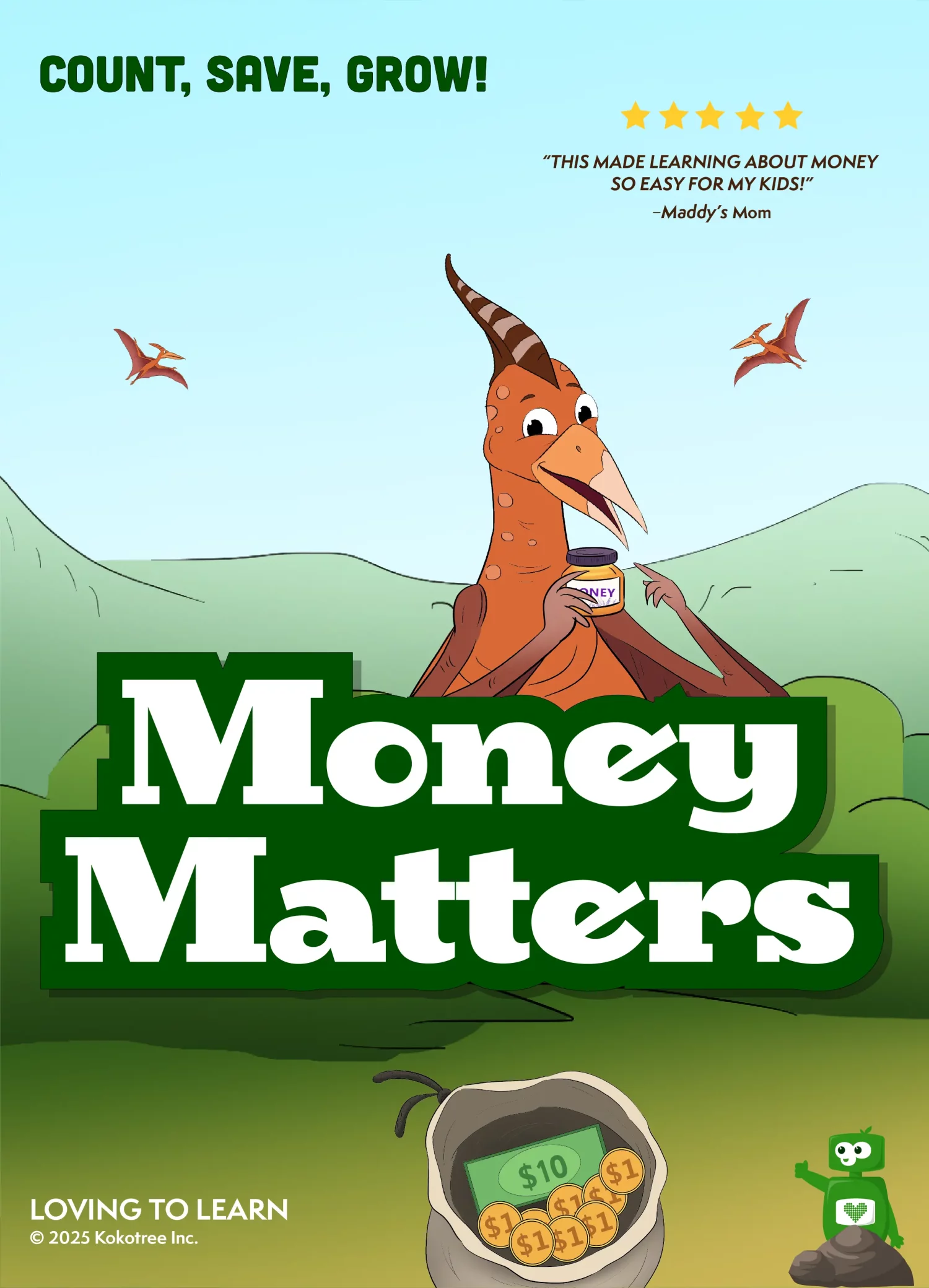
Your child joins Leo the Lion and Mika the Mouse on an exciting jungle shopping adventure where they learn to calculate change and outsmart tricky shopkeepers! After watching, kids will understand that when you pay more than something costs, you get money back—and they'll know how to figure out exactly how much.
11 minutes
Ages 4-6
Skill: Understanding money, change, and basic subtraction
Your kid watches jungle friends buy honey and calculate change. You get 11 minutes to enjoy your coffee in peace.
Leo and Mika trek through a colorful jungle valley filled with pterodactyl-run honey shops. Each shop presents a new math challenge—the shopkeepers try to shortchange our heroes, but Leo and Mika use subtraction to figure out exactly how much change they deserve. Bright animations show the math happening on screen as characters count out dollars and solve problems together.
What your child learns:
This video introduces the concept of money as a tool for buying things, then builds to understanding what "change" means when you overpay. Kids practice mental subtraction through real shopping scenarios—watching characters calculate $20 minus $13, $20 minus $17, and $10 minus $8.
- Understands why we use money instead of trading items
- Learns that "change" is the money returned when you pay more than the price
- Practices subtraction within 20 using money scenarios
- Recognizes when someone gives incorrect change
- Understands that exact payment means no change is needed
They'll use these skills when:
- Helping count coins at a store checkout
- Playing pretend shop with toys at home
- Understanding why parents wait for change after paying
- Recognizing numbers on price tags during shopping trips
The Story (what keeps them watching)
Wise Owl sends Leo the Lion and Mika the Mouse on an urgent mission—the Queen's birthday cake needs special lavender honey from the Jungle of Flying Dinosaurs! Armed with $50 in notes, our heroes must visit five pterodactyl shopkeepers who are known for being sneaky with change. At each shop, Leo and Mika face a new challenge: a grumpy shopkeeper who "forgets" to give change, a speedy one who almost skips the math, and a confused elderly pterodactyl who miscalculates. By staying sharp and doing the subtraction themselves, they collect all five honey jars and save the celebration!
How We Teach It (the clever part)
- First 3 minutes: Miss Elizabeth introduces money using a relatable example—trading apples and bananas—then explains why money works better. Eddie calls it "jungle points," making the concept stick.
- Minutes 3-9: Each honey shop presents progressively different challenges. On-screen animations show the subtraction (20-13=7) as characters think through problems. Kids see what happens when you DON'T check your change versus when you DO.
- Final 2 minutes: Back in the classroom, Ruby, Maddy, and Eddie summarize the key lessons. Miss Elizabeth encourages kids to help count change during real shopping trips.
Teaching trick: The pterodactyl shopkeepers each have distinct personalities—grumpy, speedy, confused, friendly—which keeps kids engaged while demonstrating that you need to check your change no matter who you're dealing with. The visual subtraction animations appear right as characters "think," connecting the mental math to the story action.
After Watching: Quick Wins to Reinforce Learning
Mealtime activity: "If this apple cost $3 and I gave the store $5, how much change would I get?" Use foods on the table to create simple subtraction problems. Kids practice the same skill Leo and Mika used!
Car/travel activity: "Let's play honey shop! I'm buying something for $6 and paying with $10. Can you be the honest shopkeeper and tell me my change?" Take turns being the buyer and seller to reinforce both perspectives.
Bedtime activity: "Remember when the confused pterodactyl said the change was $1 instead of $2? Can you tell me what he did wrong?" Retelling story moments helps cement the lesson about checking your change.
Anytime activity: Set up a pretend shop with toys and play money (or paper with numbers). Let your child be the shopkeeper who must give correct change. Start with small numbers like $5 minus $3.
When Kids Get Stuck. And How to Help.
"My child doesn't understand what change means" - Use a hands-on demo: give them 5 crackers to "pay" for something that costs 3. Count the 2 crackers that come back—that's change! Physical objects make abstract concepts click.
"The subtraction seems too hard for my child" - Start smaller than the video. Practice with numbers under 10 first (like $5 minus $2). Once that's solid, the bigger numbers in the video will make more sense on a rewatch.
"My child just wants to watch the dinosaurs, not do math" - That's actually perfect! The pterodactyls are memorable, so ask "Remember what the grumpy pterodactyl tried to do?" Story recall naturally leads to discussing the math concepts embedded in those fun scenes.
What Your Child Will Learn
Prerequisites and Building Blocks
Children watching this video should already recognize numbers up to 20 and understand basic counting. Familiarity with the concept of "more" and "less" helps, as does exposure to subtraction through earlier Kokotree content. This video builds on foundational number sense and introduces practical application—connecting abstract math to real-world transactions. It serves as an excellent bridge between basic subtraction practice and understanding money's role in everyday life, preparing children for more complex financial literacy concepts.
Cognitive Development and Teaching Methodology
This video leverages narrative-based learning, which research shows dramatically improves retention in 4-6 year olds. The story format activates emotional engagement while the repeated pattern (shop, calculate, verify change) builds procedural understanding. Visual animations showing the subtraction equations address visual learners, dialogue reinforces auditory processing, and the suggestion to "help count change" at stores invites kinesthetic application. The progressive difficulty—from straightforward to tricky shopkeepers—scaffolds learning naturally.
Alignment with Educational Standards
This content aligns with kindergarten math standards for operations and algebraic thinking, specifically solving subtraction word problems within 20. It addresses Common Core standard K.OA.A.2 (solving addition and subtraction word problems) and introduces financial literacy concepts recommended by the Jump$tart Coalition for Personal Financial Literacy. The video builds kindergarten readiness by connecting number operations to practical scenarios teachers use to assess real-world math application.
Extended Learning Opportunities
Pair this video with printable play money worksheets for hands-on practice. The Kokotree app's "Shop & Count" game reinforces these concepts interactively. Parents can extend learning by involving children in real checkout experiences—letting them hand over money and receive change. Creating a home "store" with price tags under $10 provides ongoing practice. Follow up with videos on coin recognition and counting by fives and tens.
Transcript Highlights
- "Let's say you buy something that costs $7, but you give the shopkeeper $10. You gave more than the price—so the shopkeeper must give you back the extra money. That extra money is called... change."
- "20 minus 13 is 7. Yes, we'd like our $7 change."
- "10 minus 8 is 2. You owe us two dollars."
- "That's $6 plus $6… total $12. That's exactly what we have left... No change! We gave the exact amount."
Character Development and Story Arc
Leo and Mika model excellent learning behaviors throughout their adventure. Leo starts overconfident ("Easy! We give them the money, grab the honey, and zoom!") but quickly learns to slow down and calculate. Mika demonstrates careful thinking and double-checking—essential problem-solving skills. Together, they show that asking questions isn't rude; it's smart. When facing the confused shopkeeper, they respond with patience rather than frustration, modeling respectful persistence. Their teamwork reinforces that two minds working together solve problems better.
Understanding Money and Change: A Mathematical Deep Dive
This video introduces one of mathematics' most practical applications: calculating change through subtraction. The concept of "change" represents the mathematical relationship between the amount paid and the price—specifically, the difference. When Leo pays $20 for a $13 item, children witness subtraction in action: 20 - 13 = 7.
The video strategically presents four distinct calculation scenarios:
- $20 - $13 = $7 (subtracting a teen number)
- $20 - $17 = $3 (subtracting when numbers are close)
- $10 - $8 = $2 (smaller numbers, different starting point)
- $12 - $12 = $0 (exact payment, introducing zero difference)
This progression builds mathematical flexibility—children see that subtraction works the same way regardless of the specific numbers involved. The video also introduces an important pre-algebraic concept: verification. By having characters check whether the change they receive matches their calculation, children learn that math can be used to verify real-world outcomes.
The barter system introduction ("one banana for two apples") provides historical context for why standardized currency exists, connecting mathematical thinking to problem-solving throughout human history. This plants seeds for understanding that math develops to solve real problems.
For developing minds, the repeated shop-calculate-verify pattern creates a mental framework children can apply independently. The pterodactyls' attempts to shortchange our heroes add stakes that make the math meaningful—accuracy matters because it affects outcomes. This emotional engagement significantly improves concept retention compared to abstract drill exercises.