
What's Rhyming With Vowels About?
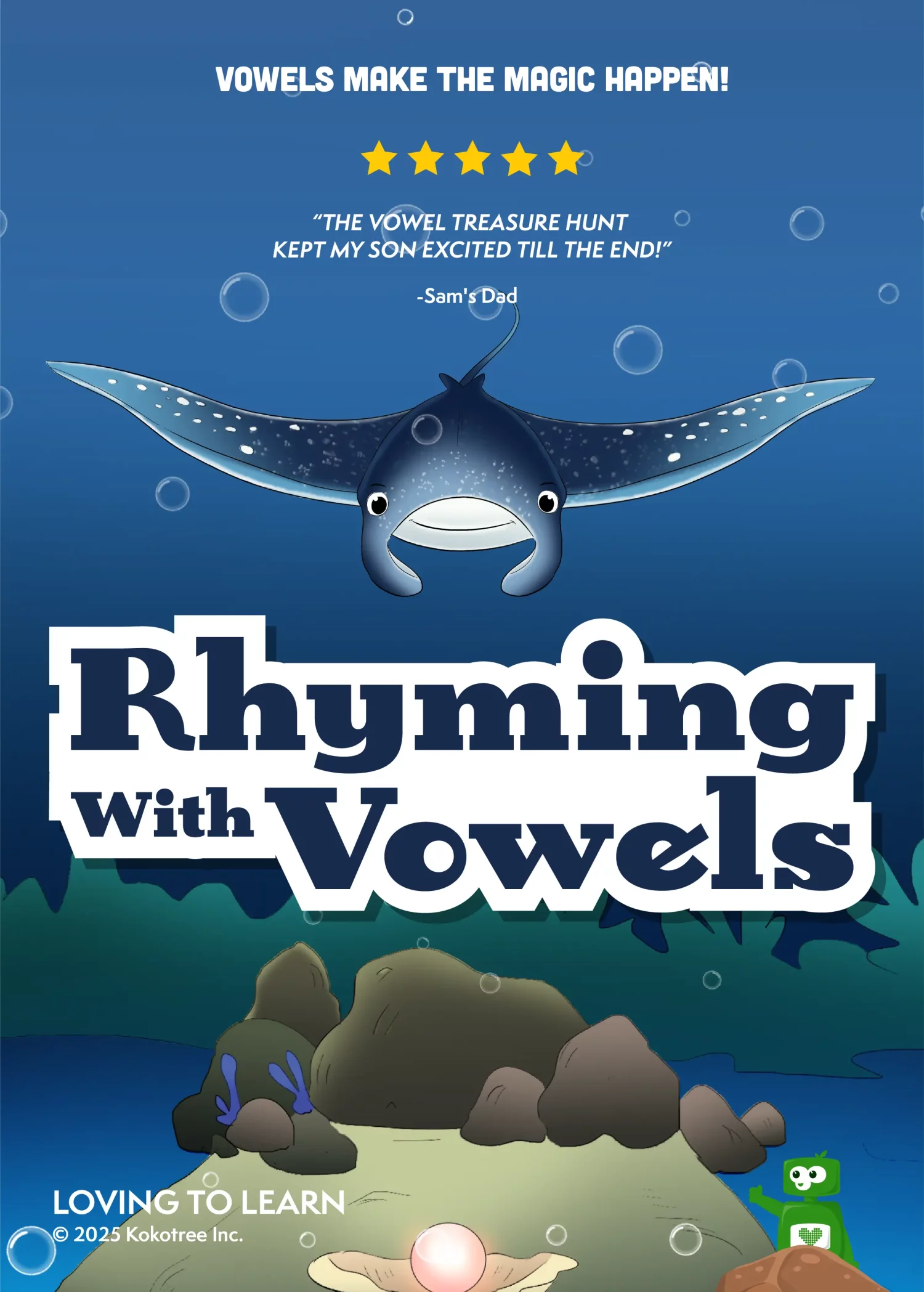
Join Ollie the Octopus on an epic underwater quest to collect five magical vowel pearls! Your child will crack the code of rhyming words by discovering that the vowel in the middle is what makes words sound alike.
10 minutes
Ages 3-6
Skill: Recognizing vowel sounds in rhyming word pairs
Your kid watches Ollie solve rhyme puzzles to save a coral reef. You get 10 minutes to finally drink that coffee while it's hot.
Ollie the Octopus swims through colorful underwater scenes—sandy canyons, echo-y ridges, and glowing tunnels—meeting sea creatures who challenge him with rhyming riddles. Each solved puzzle unlocks a glowing vowel pearl, and kids watch letters appear on screen as Ollie figures out word pairs like nest/pest and grin/spin.
What your child learns:
This video teaches children that rhyming words share the same vowel sound in the middle AND end the same way. They'll see each vowel (A, E, I, O, U) highlighted in word pairs, building the phonemic awareness foundation they need for reading.
- Identifies all five vowels (A, E, I, O, U) by sight and sound
- Recognizes that rhyming words share middle vowel sounds
- Matches four-letter rhyming word pairs
- Listens for vowel sounds in the middle of words
- Understands the pattern that creates rhymes
They'll use these skills when:
- Sounding out new words while learning to read
- Playing word games and making up silly rhymes at dinner
- Singing songs and nursery rhymes with repeated patterns
- Writing their first stories and poems in kindergarten
The Story (what keeps them watching)
Oh no! The Coral Gate is stuck and the magical water has stopped flowing to the reef. Ollie's friend Seahorse explains that only five vowel pearls can fix it—but each pearl wakes up only when Ollie solves a rhyming puzzle! Ollie meets Clam Sam (who's very sleepy), picky sea urchins, a hissing Moray Eel, a fancy Manta Ray, and a gruff Sea Devil. Each creature demands a four-letter rhyming pair with a specific vowel. Can Ollie find crab/grab, nest/pest, grin/spin, boat/coat, and rush/hush before the Moonlight Parade? Spoiler: he totally does, and rainbow bubbles celebrate his victory!
How We Teach It (the clever part)
- First 2 minutes: Miss Meera introduces the concept with lamp/camp, showing kids that the 'a' in the middle is the "rhyming glue" that connects words
- Minutes 2-8: Ollie encounters five different challenges, each focusing on one vowel. Kids see the words written out and hear the vowel sound emphasized repeatedly
- Final 2 minutes: Back in the classroom, Miss Meera reviews all five word pairs on the chalkboard and Tiki Tiger successfully creates his own pair (duck/luck), modeling how kids can do it too
Teaching trick: Each vowel pearl literally glows a different color (orange for A, emerald for E, violet for I, ruby for O, turquoise for U), giving kids a visual anchor to remember each vowel's "personality."
After Watching: Quick Wins to Reinforce Learning
Mealtime activity: "What rhymes with spoon?" Point to objects and challenge your child to find rhyme buddies. Ask them what vowel sound they hear in the middle. (Practices identifying vowels in familiar words)
Car/travel activity: Play "Vowel Pearl Hunt"—you say a word, they say a rhyme AND name the vowel. Start easy: cat, bed, pig, hot, cup. (Reinforces the vowel-rhyme connection from the video)
Bedtime activity: "Let's make a rhyme chain like Ollie!" Pick one vowel and see how many rhyming pairs you can list together before sleep. (Builds confidence with extended practice)
Anytime activity: Spot written words around your home (on cereal boxes, signs, books) and ask "What vowel do you see in the middle?" (Transfers listening skills to visual letter recognition)
When Kids Get Stuck. And How to Help.
"My child can rhyme but can't identify the vowel" - Totally normal! Hearing rhymes develops before analyzing them. Keep pointing to the middle letter when you write words down, and they'll connect sound to symbol over time.
"They mix up vowel sounds, especially short E and short I" - These are genuinely tricky sounds! Exaggerate when you say them: "nEHst" vs "grIHn." Using hand motions (mouth wide for E, mouth smiling for I) helps too.
"Four-letter words seem too hard" - Start with three-letter rhymes like cat/hat or big/pig. The video uses four letters, but the vowel concept works with any word length. Meet them where they are!
What Your Child Will Learn
Prerequisites and Building Blocks
Children watching this video should already recognize the five vowel letters visually and understand that words are made of individual sounds. This builds on basic letter recognition and simple rhyming exposure (like nursery rhymes). It bridges the gap between hearing rhymes intuitively and understanding WHY words rhyme—a critical step toward phonics instruction. This video prepares children for word families, spelling patterns, and decoding strategies they'll encounter in early reading curriculum.
Cognitive Development and Teaching Methodology
The quest narrative leverages children's natural love of adventure while embedding repetitive phonemic practice. Each vowel gets isolated attention through a distinct character and challenge, preventing cognitive overload. Visual learners see words written in sand and plankton; auditory learners hear emphasized vowel sounds; kinesthetic learners engage through the motion of Ollie swimming and collecting. The five-part structure creates natural memory "hooks" that aid retention.
Alignment with Educational Standards
This video directly supports Common Core ELA standards for Kindergarten (RF.K.2a: Recognize and produce rhyming words) and Pre-K learning foundations for phonological awareness. It addresses kindergarten readiness indicators for sound discrimination and vowel recognition. Teachers expect incoming students to identify rhymes; this video goes further by teaching the underlying pattern, giving children an analytical advantage in phonics instruction.
Extended Learning Opportunities
Pair this video with rhyming word sorting activities using picture cards. The Kokotree app's phonics games reinforce vowel sounds through interactive play. Parents can create a "Vowel Pearl" craft—five colored circles with word pairs written on each. Extend learning by reading rhyming books together and pausing to ask "What vowel do you hear?" Challenge older children to find rhymes with five letters.
Transcript Highlights
- "The 'a' in the middle is their rhyming glue. When words share the same vowel sound in the middle and end the same way, they become rhyme buddies."
- "Crab… grab! Center-stage vowel 'a'—four letters each—perfect rhyme!"
- "Grin … spin! Four letters each, 'i' glowing in the middle—it's a perfect rhyme."
- "Rhymes are the music, and vowels are the notes. Keep listening, keep exploring the melodies of words that sound alike."
Character Development and Story Arc
Ollie models curiosity, persistence, and collaborative problem-solving throughout his quest. When faced with challenging guardians, he stays polite and thinks creatively—borrowing a crab's grab-hook, asking a spin-fish for help. He demonstrates that learning requires both individual effort and community support. The classroom characters show enthusiasm for discovery, with Tiki Tiger modeling how to apply new knowledge independently when creating his own duck/luck pair.
Phonemic Awareness and the Science of Reading
Rhyming is one of the earliest and most reliable predictors of reading success. Research shows that children who can manipulate sounds in words (phonemic awareness) learn to decode text more easily. This video teaches a sophisticated concept: rhymes aren't random—they follow a pattern based on vowel sounds.
The focus on medial (middle) vowel sounds is particularly valuable. While children often notice beginning and ending sounds first, the middle vowel is what determines word families and spelling patterns. By explicitly teaching that "lamp" and "camp" share the short-A sound, this video builds the analytical framework children need for word family instruction (-amp, -est, -in, -oat, -ush).
The four-letter word constraint is pedagogically intentional. It ensures children work with CVC-C or CVCC patterns where the vowel position is consistent and predictable. This controlled complexity prevents confusion while building pattern recognition.
The multisensory approach—seeing words written, hearing sounds emphasized, and following a kinesthetic journey—aligns with Orton-Gillingham principles used in structured literacy programs. Children aren't just memorizing rhymes; they're learning to analyze sound structure, a skill that transfers directly to spelling, decoding, and vocabulary development throughout their academic journey.