
What's Odd & Even Numbers About?
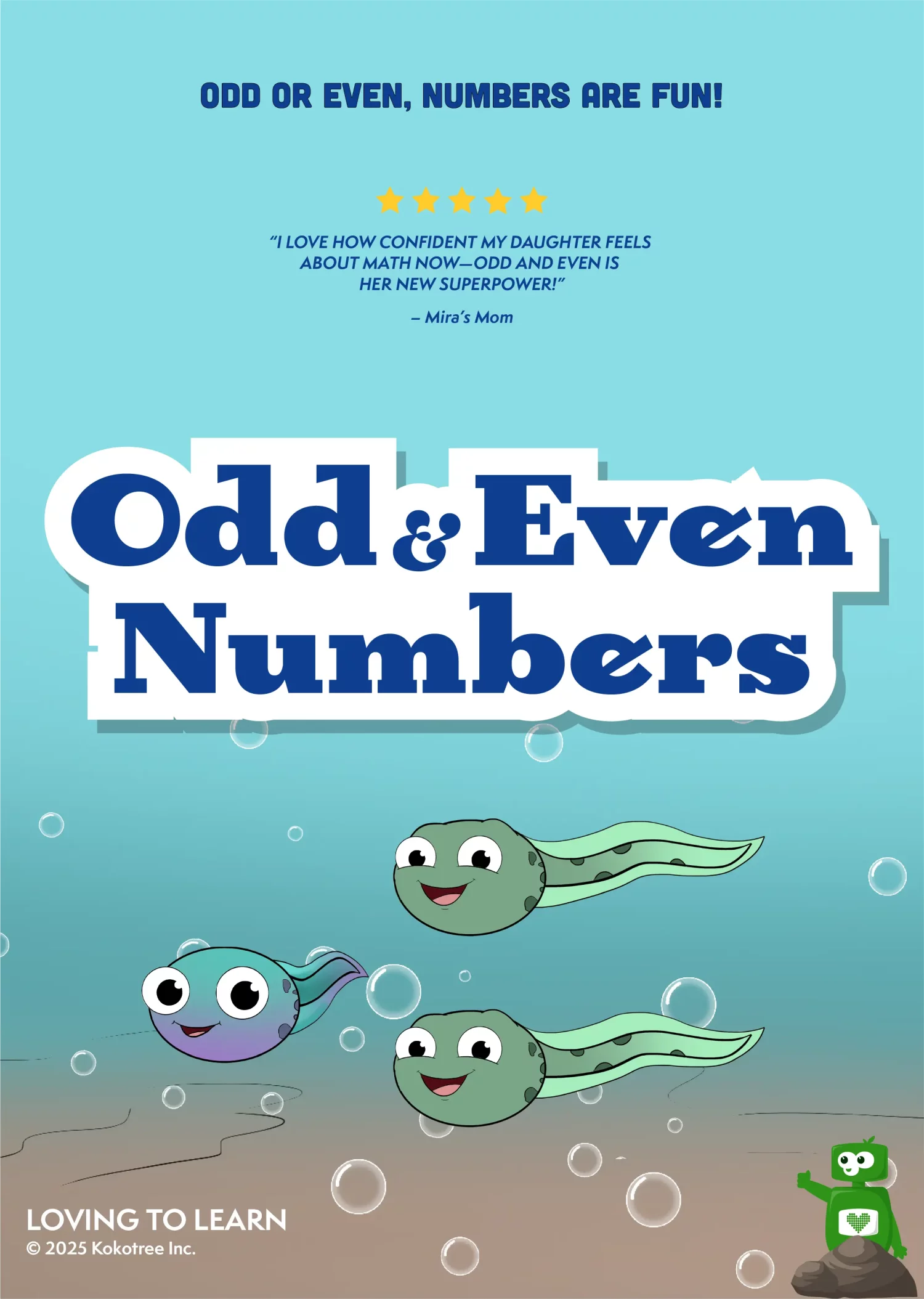
Your child joins Rocko and friends at the jungle pond to discover how numbers either pair up perfectly or leave one standing alone! They'll count tadpoles, pebbles, and flower petals while learning that odd numbers are just as wonderful as even ones.
12 minutes
Ages 3-6
Skill: Recognizing odd and even numbers through pairing
Your kid watches tadpoles pair up and pebbles find buddies. You get 12 minutes to finish that cup of coffee while it's still warm.
Rocko guides the Kokotree kids through hands-on counting activities at a sparkling jungle pond. They sort pebbles into pairs, watch tadpoles pop up from the water, and count colorful flower petals—all while discovering which numbers make perfect pairs and which always have one left over.
What your child learns:
Your child will understand the fundamental difference between odd and even numbers by physically grouping objects into pairs. They'll practice counting from 1-10 while building number sense that connects directly to future math skills like division and multiplication.
- Identifying even numbers (2, 4, 6, 8, 10) as numbers that pair up perfectly
- Recognizing odd numbers (1, 3, 5, 7, 9) as numbers with one left over
- Counting objects accurately up to 10
- Understanding that zero is the smallest even number
- Connecting math concepts to real-world objects
They'll use these skills when:
- Sharing snacks equally with a sibling ("Do we have enough for everyone to get two?")
- Setting the table and pairing up forks and spoons
- Sorting toys into groups during cleanup time
- Playing games that require taking turns or forming teams
The Story (what keeps them watching)
Rocko brings the kids to the jungle pond where wiggly tadpoles become math teachers! First, they use smooth pebbles to discover that some numbers pair up perfectly (even) while others leave one lonely (odd). Then comes the Tadpole Pop-Up game where tadpoles splash up and kids race to identify odd or even. The flower petal counting challenge adds variety—until the heartwarming story of Teddy the tiny tadpole ties it all together. Teddy feels left out for being different, but when a storm traps the bigger tadpoles, his small size saves the day! The message lands perfectly: being "odd" makes you special.
How We Teach It (the clever part)
- First 3 minutes: Rocko introduces odd and even using pebbles—visual, concrete, and touchable. Kids see four pebbles make two pairs (even), then watch what happens when a fifth pebble joins (odd!).
- Minutes 3-7: Interactive practice through the Tadpole Pop-Up game and flower petal counting. Each activity reinforces the same concept with different objects, building pattern recognition.
- Final 5 minutes: Teddy's story transforms the math lesson into an emotional anchor. Kids remember "odd" fondly because Teddy the odd-one-out became the hero.
Teaching trick: Every counting moment highlights pairs visually with colored backgrounds—so kids literally SEE the pairing happen, not just hear about it.
After Watching: Quick Wins to Reinforce Learning
- Mealtime activity: "Let's count your grapes! Can everyone at the table get the same amount, or is one grape left over?" (Practices identifying odd/even with real food sharing scenarios)
- Car/travel activity: "I spy 3 birds on that wire—odd or even? What about those 4 mailboxes?" (Reinforces quick mental pairing without physical objects)
- Bedtime activity: "How many stuffed animals are on your bed tonight? Do they all have a cuddle buddy, or is one sleeping solo?" (Connects learning to beloved comfort objects)
- Anytime activity: "Let's sort your crayons into pairs! Which colors have a buddy and which ones are the special odd ones out?" (Hands-on pairing practice with household items)
When Kids Get Stuck. And How to Help.
- "My child keeps forgetting which is odd and which is even." - Totally normal! Use the "buddy" language from the video: "Does everyone have a buddy, or is someone left out?" Physical pairing with toys helps more than memorizing definitions.
- "She can count but can't tell if it's odd or even." - Counting and pairing are two different skills! Slow down and have her physically move objects into groups of two. The "leftover" becomes obvious when she can see and touch it.
- "Is this too advanced for my 3-year-old?" - Start with just 2-5 objects and focus on the pairing action rather than the vocabulary. Even toddlers understand "everyone has a friend" versus "one is alone."
What Your Child Will Learn
Prerequisites and Building Blocks
Children watching this video should have foundational counting skills from 1-10 and basic one-to-one correspondence (pointing to objects while counting). This lesson builds on the Kokotree "Count by 2s and 5s" video, which introduces skip counting patterns. Understanding odd and even numbers creates essential scaffolding for future concepts including basic division, multiplication facts, and algebraic thinking about number properties.
Cognitive Development and Teaching Methodology
This video leverages concrete-to-abstract progression ideal for preoperational stage learners (ages 2-7). Children first manipulate physical objects (pebbles), then observe animated representations (tadpoles), before applying concepts independently (flower petals). The multi-sensory approach addresses visual learners through color-coded pairing, auditory learners through rhythmic counting, and kinesthetic processors through the implied physical grouping actions.
Alignment with Educational Standards
This lesson aligns with Common Core Math Standard 2.OA.C.3 (determining odd/even numbers) and kindergarten readiness indicators for number sense. The National Council of Teachers of Mathematics emphasizes understanding number relationships as foundational. Most kindergarten curricula expect children to identify odd/even through 10, making this video excellent preparation for school-entry assessments.
Extended Learning Opportunities
Pair this video with Kokotree's printable "Pair It Up" worksheet featuring objects to circle into groups. The in-app "Number Sort" game reinforces odd/even classification through drag-and-drop play. Extend learning with an egg carton activity: place small objects in cups and observe which numbers fill both rows evenly. Connect to the "Count by 2s" video to show how even numbers appear in skip counting.
Transcript Highlights
- "When we can split things into pairs—no one left out—that number is called even. Even numbers are like best friends who always show up in twos!"
- "When one is left out, that number is called odd. Odd numbers don't make perfect pairs."
- "Even numbers can be divided into equal groups of two. No leftovers. Odd numbers always have one left behind."
- "Zero is the smallest even number there is!"
Character Development and Story Arc
Teddy the tadpole models resilience and growth mindset beautifully. Initially excluded for being "different," Teddy doesn't give up—he remembers his grandfather's wisdom and looks for ways to contribute. When the crisis arrives, Teddy demonstrates problem-solving by recognizing his unique size as an advantage. The other tadpoles model accountability by apologizing and changing their behavior. This arc teaches children that perceived weaknesses can become strengths.
Understanding Odd and Even Numbers: Mathematical Foundations
Odd and even numbers represent one of mathematics' most fundamental classification systems, introducing children to the concept of number properties—characteristics that numbers possess regardless of context. This binary categorization (every whole number is either odd OR even, never both) builds logical thinking skills essential for later mathematical reasoning.
The pairing method used in this video connects directly to the formal mathematical definition: even numbers are divisible by 2 with no remainder, while odd numbers have a remainder of 1 when divided by 2. For young children, "divisibility" translates perfectly into "can everyone get a buddy?" This concrete representation creates neural pathways that later support abstract division concepts.
The inclusion of zero as an even number addresses a common misconception early. Mathematically, zero divided by 2 equals zero with no remainder—meeting the definition of even. The video handles this elegantly by asking if anything is "left out" when there's nothing to begin with.
Pattern recognition develops naturally as children notice even numbers always end in 0, 2, 4, 6, or 8, while odd numbers end in 1, 3, 5, 7, or 9. Though not explicitly taught here, repeated exposure to pairing activities leads children to discover this pattern independently—a more powerful learning outcome than direct instruction.
The emotional story component serves a cognitive purpose: emotional memories are stored more durably than neutral ones. By connecting "odd" to the beloved character Teddy, children form positive associations with the mathematical term, reducing anxiety around number classification tasks in formal school settings.