What's Saturn's Stolen Rings About?
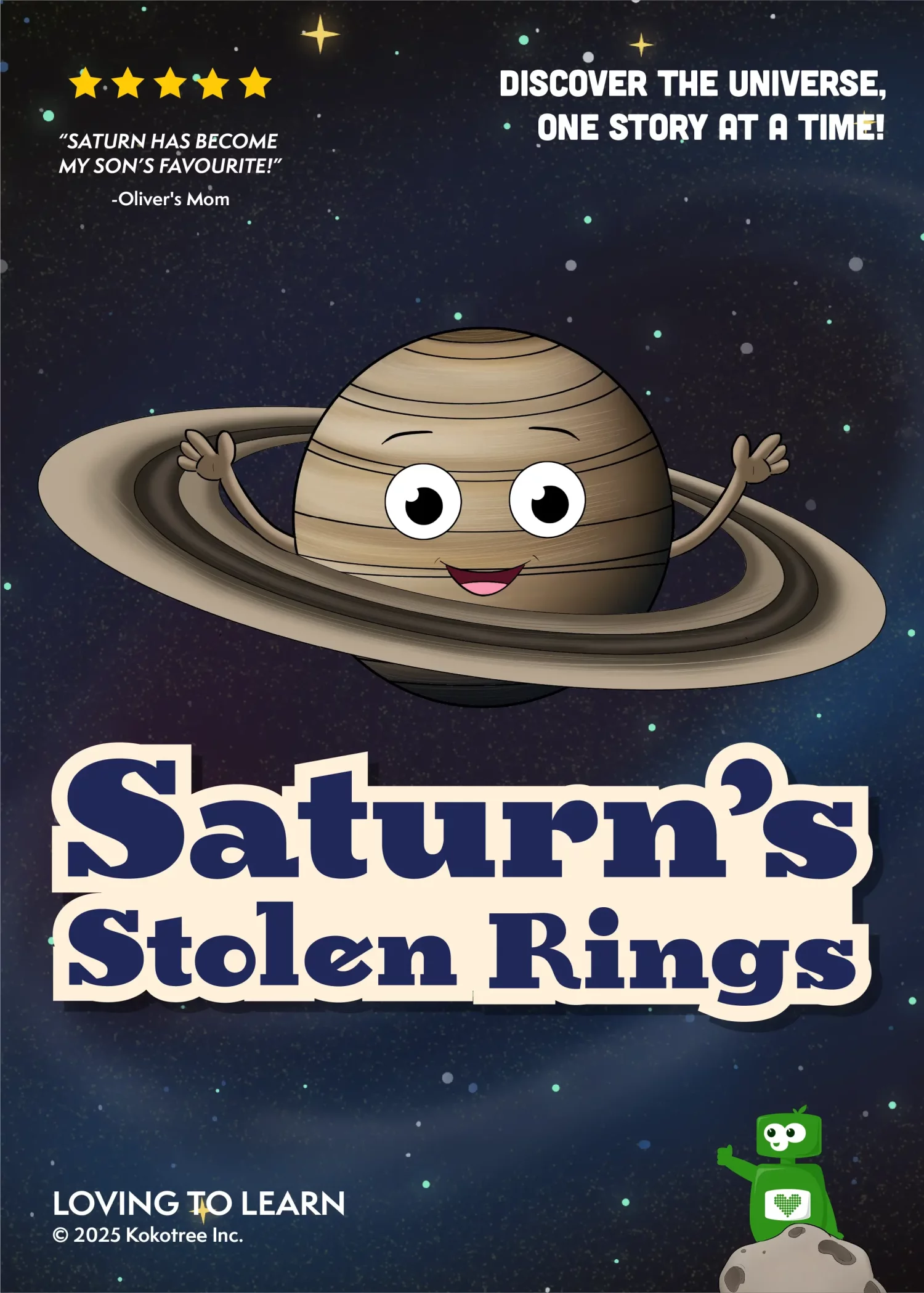
Join Miss Meera and the Kokotree kids on a cosmic adventure through our Solar System! Your child will learn planet names, discover what makes planets different from stars, and pick up an important lesson about sharing and asking permission.
9 minutes
Ages 3-6
Skill: Solar System basics & social skills
Your kid watches planets solve a ring-stealing mystery together. You get 9 minutes to finish that cup of coffee while it's still warm.
The Kokotree animal friends are stargazing in the jungle when Miss Meera arrives with a magical story. The screen transforms into a colorful solar system where friendly planets with cute faces orbit around a wise Sun. When Saturn discovers his rings are missing, all the planets work together to find the mischievous asteroid who borrowed them without asking.
What your child learns:
This video introduces foundational astronomy concepts through an engaging story format. Children absorb planet names and order naturally while following the mystery, and the social lesson about asking before borrowing is woven seamlessly into the adventure.
- Names and identifies all 8 planets in our Solar System
- Understands why Pluto is now called a "dwarf planet"
- Learns that stars twinkle but planets shine steadily
- Recognizes that Saturn has rings (and so does Uranus—they're just thin!)
- Practices the social skill of asking before borrowing
They'll use these skills when:
- Spotting Venus or Jupiter in the evening sky with you
- Reading space books at the library and recognizing planet names
- Playing with a friend's toys and remembering to ask first
- Sorting objects by size ("Jupiter is the BIGGEST!")
The Story (what keeps them watching)
The Kokotree kids are planet-hunting through a telescope when Miss Meera shares a tale about Saturn's stolen rings. In the story, Saturn wakes up to find his beautiful rings missing! With help from Jupiter, Venus, and the wise Sun, Saturn discovers that a mischievous asteroid named Zor took them to play hula hoop. Zor apologizes, learns to ask before borrowing, and Saturn happily shares his rings. The planets celebrate, and the Solar System is peaceful again. It's part space adventure, part gentle lesson about sharing—and 100% fun.
How We Teach It (the clever part)
- First 3 minutes: Kids learn the difference between stars and planets through natural conversation. Miss Meera introduces all 8 planets and explains why Pluto isn't one anymore—building vocabulary before the story begins.
- Minutes 3-7: The mystery unfolds! As Saturn searches for his rings, children meet each planet and absorb their characteristics (Jupiter is huge, Venus glows bright, Uranus has thin rings too).
- Final 2 minutes: The resolution reinforces the social lesson—Zor apologizes, Saturn shares, and the Sun reminds everyone to ask before taking. Learning sticks because it's tied to emotion.
Teaching trick: Each planet has a face and personality, making abstract space objects feel like friends. When kids care about Saturn being sad, they remember why sharing matters.
After Watching: Quick Wins to Reinforce Learning
- Mealtime activity: "Can you name the planets while I count to 8?" Point to 8 different foods on their plate and assign each one a planet name. (Practices recall and sequencing)
- Car/travel activity: "Look at the sky! Is that a star or a planet? Remember—stars twinkle, planets don't!" (Reinforces the key difference they learned)
- Bedtime activity: "What would YOU do if someone took your favorite toy without asking? What should Zor have done?" (Extends the social-emotional lesson through discussion)
- Anytime activity: Make "planet rings" with your child using paper plates. Cut out the center and decorate! Ask: "Which planet has the biggest rings?" (Kinesthetic reinforcement of Saturn's key feature)
When Kids Get Stuck. And How to Help.
- "My child can't remember all 8 planet names yet." - Totally normal! Focus on the fun ones first: Jupiter (biggest!), Saturn (rings!), and Earth (that's us!). The rest will come with repetition—try a planet song together.
- "They're confused about why Pluto isn't a planet anymore." - Keep it simple: "Pluto is really small and acts differently than the other planets, so scientists gave it a special name: dwarf planet. It's still cool!" No need for more detail at this age.
- "The sharing lesson didn't seem to stick." - One video won't transform behavior overnight! When a real sharing moment comes up, try: "Remember Zor? What did the Sun say he should do?" Connecting to the story helps.
What Your Child Will Learn
Prerequisites and Building Blocks
Children benefit most from this video if they have basic familiarity with the concepts of "big" and "small," can follow a simple narrative, and understand that the sky contains objects like the sun, moon, and stars. This video serves as an excellent introduction to astronomy—no prior space knowledge required. It builds foundational vocabulary that prepares children for more detailed explorations of individual planets, the concept of orbits, and later STEAM learning about gravity and space exploration.
Cognitive Development and Teaching Methodology
At ages 3-6, children learn best through narrative and emotional connection. This video leverages "story-based learning" by embedding factual content (planet names, characteristics) within a mystery plot that creates emotional investment. The anthropomorphized planets tap into children's natural tendency toward animism—attributing feelings to objects—which aids memory retention. Visual learning is prioritized through colorful animations, while auditory learners benefit from Miss Meera's clear, enthusiastic narration and character dialogue.
Alignment with Educational Standards
This video supports early learning standards for science inquiry and social development. It aligns with kindergarten readiness indicators including: identifying objects in the natural world, demonstrating curiosity about scientific phenomena, and practicing prosocial behaviors like sharing. The content addresses Head Start Early Learning Outcomes Framework goals for Scientific Reasoning (observing and describing natural objects) and Social-Emotional Development (understanding social expectations). Teachers expect entering kindergarteners to show curiosity about space and basic understanding of Earth's place in it.
Extended Learning Opportunities
Pair this video with Kokotree's "Counting to 8" activities to reinforce planet sequencing. Create a simple Solar System mobile using paper circles in different sizes. Visit a planetarium or use a stargazing app to spot Venus or Jupiter together—children love finding "real" versions of their animated friends! For extended screen learning, explore other Kokotree videos about day/night cycles or the moon. Print coloring pages of the planets to reinforce names through art.
Transcript Highlights
- Teaching stars vs. planets: "Stars twinkle because they're so far away that their light flickers, but planets just hang out steady and bright."
- Correcting misconceptions gently: "Pluto used to be considered the ninth planet, but it's actually a dwarf planet now. It's tiny, and it doesn't really do what the other planets do."
- Introducing visible planets: "Venus, also known as the 'Evening Star' or 'Morning Star,' pops up just after sunset or before sunrise! Mars, with its cool reddish tint, is visible when it's closest to Earth."
- Reinforcing the social lesson: "You should always ask before taking something from someone else!" and "Sharing is caring!"
Character Development and Story Arc
Miss Meera models curiosity and enthusiasm for learning, showing children that adults find science exciting too. Saturn demonstrates vulnerability when upset about losing something precious—validating children's own feelings about their belongings. Zor the asteroid represents the common childhood impulse to take something appealing without thinking, and his character arc shows that making mistakes doesn't make you "bad"—apologizing and learning makes things right. The Sun models wise, fair leadership by listening to all sides before solving the problem.
Astronomy and Early Space Science Deep Dive
Introducing astronomy to preschoolers builds foundational scientific thinking that extends far beyond memorizing planet names. When children learn that our Solar System has 8 planets orbiting one star, they're grasping their first concept of systematic organization in nature—objects following predictable patterns.
The distinction between stars and planets is particularly valuable for developing observational skills. Teaching that "stars twinkle, planets don't" gives children a testable hypothesis they can verify themselves during evening walks. This transforms passive knowledge into active scientific inquiry.
Saturn's rings offer a perfect entry point for discussing what objects are "made of." While the video doesn't dive deep into ring composition (ice and rock particles), it establishes that planets can have distinctive features—preparing children for later learning about planetary diversity.
The Pluto reclassification, handled simply in this video, introduces an important concept: science updates its understanding based on new information. Rather than confusing children, this teaches intellectual flexibility—scientists learn and change their minds, and that's good!
The scale concepts embedded throughout (Jupiter being "huge," Pluto being "tiny") support mathematical thinking about relative size. Children naturally compare and categorize, and space objects provide dramatic examples that stick in memory.
Finally, the social storyline about asking before borrowing isn't separate from the science—it's integrated. This models how STEAM learning connects to real life, showing that the same problem-solving skills (investigating, asking questions, finding solutions) work both in space mysteries and playground conflicts.