
What's Split Digraphs About?
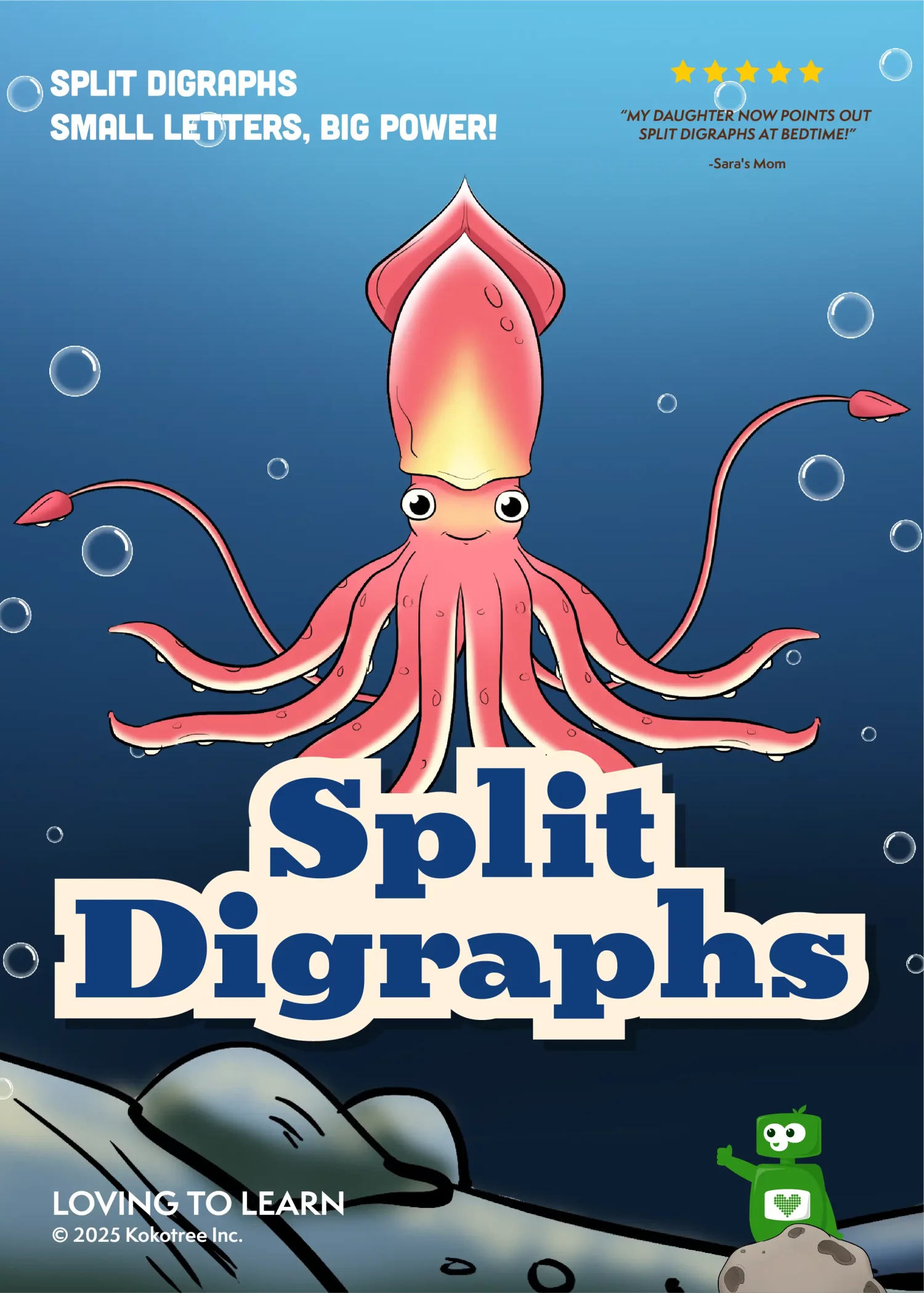
Join Ollie the Octopus on an epic underwater quest to save a coral reef—all while mastering one of phonics' trickiest concepts! Your child will discover how vowel pairs work together even when a sneaky consonant separates them.
10 minutes
Ages 4-6
Skill: Advanced phonics patterns (vowel-consonant-e words)
Your kid watches sea friends hunt for magic words underwater. You get 10 minutes to finish that coffee in peace.
Ollie and his ocean buddies—Starfish, Seahorse, and Crab—swim through coral caves, seaweed forests, and anemone reefs searching for seven hidden words. Each discovery brings the fading coral reef back to vibrant life with bursting colors and happy fish.
What your child learns:
Split digraphs are the "magic e" words that make vowels say their own name—like how 'hop' becomes 'hope' when you add that silent 'e' at the end. This video makes the abstract concept concrete through treasure-hunt storytelling.
- Identifies split digraph patterns in words (a-e, o-e)
- Recognizes long vowel sounds created by vowel-consonant-e combinations
- Sounds out and reads words like stone, hope, rope, home, note, pale, and snake
- Understands that letters can work together even when separated
- Builds confidence tackling "tricky" phonics patterns
They'll use these skills when:
- Reading picture books and spotting words like "cake," "bike," or "cute"
- Writing their own stories and spelling words correctly
- Playing word games and rhyming activities
- Sounding out new words on signs, menus, and labels during outings
The Story (what keeps them watching)
Mr. Squid arrives with urgent news—the coral reef is dying and only split digraph experts can save it! Ollie the Octopus rallies his friends Starfish, Seahorse, and Crab for an underwater treasure hunt. They explore mysterious coral caves, towering seaweed forests, and colorful anemone gardens, discovering magic words carved on shells, anchors, and driftwood. With each word found—stone, hope, rope, home, note, pale, snake—the reef bursts back to life with brilliant colors. Seven words, one saved ocean home, and a whole lot of phonics mastery along the way!
How We Teach It (the clever part)
- First 2 minutes: Miss Meera introduces split digraphs using familiar words like "cake" and "name," explaining how two vowels team up even when separated by another letter.
- Minutes 2-8: The underwater adventure unfolds as each new word discovery reinforces the pattern—kids see the word spelled out, hear it sounded out, and watch the vowel pairs identified every single time.
- Final 2 minutes: Back in the classroom, students recall all seven words and Miss Meera challenges them to find more at home, cementing the pattern recognition.
Teaching trick: Every time a word is found, a character explicitly identifies the vowel pair AND the "sneaky" consonant between them ("'o' and 'e' with 'p' in the middle!"). This repetition builds automatic pattern recognition.
After Watching: Quick Wins to Reinforce Learning
- Mealtime activity: "Can you find the split digraph in 'plate'?" Point to dishes, utensils, or foods and hunt for magic-e words together. (Practices spotting patterns in everyday objects)
- Car/travel activity: "I spy a word with a split digraph!" Look for road signs with words like 'lane,' 'zone,' or 'store.' (Practices real-world word recognition)
- Bedtime activity: "Let's read this page and tap the pillow every time we find a magic-e word." Pick any picture book and make it a gentle game. (Practices identifying patterns in text)
- Anytime activity: "Can you turn 'hop' into 'hope'? What about 'not' into 'note'?" Play the add-an-e game verbally—no materials needed! (Practices understanding how split digraphs change word sounds)
When Kids Get Stuck. And How to Help.
"My child keeps forgetting the 'e' is silent." Totally normal! Call it the "bossy e" or "magic e" that makes the other vowel say its name but stays quiet itself. Practice with word pairs like kit/kite and tap/tape to show the transformation.
"They can spot split digraphs but can't read the whole word yet." That's actually great progress! Blend the sounds slowly together: "h-ō-m... home!" The pattern recognition comes first, fluent reading follows with practice.
"This seems really advanced for my preschooler." Split digraphs are typically taught in kindergarten and first grade, so exposure now is building familiarity, not mastery. If they remember even one example word, they're ahead of the game!
What Your Child Will Learn
Prerequisites and Building Blocks
Children benefit most from this video after mastering basic letter recognition, individual letter sounds, and simple CVC (consonant-vowel-consonant) words like "cat" or "hop." This lesson builds on foundational phonics concepts including vowel sounds and blending. It's an ideal next step after learning short vowel sounds, preparing children for more complex reading patterns they'll encounter in early readers and kindergarten literacy programs.
Cognitive Development and Teaching Methodology
The narrative-based approach leverages preschoolers' natural love of stories and characters to teach abstract phonics concepts. By embedding learning within an adventure quest, the video activates emotional engagement and episodic memory—children remember "the word Ollie found on the shell" better than isolated flashcard drilling. Visual learners see words spelled out on screen, auditory learners hear each word sounded out, and the treasure-hunt format satisfies kinesthetic learners' need for action and discovery.
Alignment with Educational Standards
This video addresses Common Core State Standards for Reading Foundational Skills, specifically RF.K.3 (knowing and applying grade-level phonics) and RF.1.3c (knowing final-e conventions for long vowel sounds). It supports kindergarten readiness indicators for phonemic awareness and prepares children for first-grade decoding expectations. Teachers expect entering kindergarteners to recognize that letters represent sounds; this video advances that understanding to pattern recognition.
Extended Learning Opportunities
Pair this video with printable word-building activities featuring split digraph word families (-ake, -ope, -one). The Kokotree app offers interactive games where children drag the silent 'e' to transform short vowel words into long vowel words. Extend learning with magnetic letters on the refrigerator, creating and reading split digraph words together. Follow up with other phonics videos in the series covering different vowel patterns and digraph combinations.
Transcript Highlights
- Miss Meera explains the concept: "It's when two vowels team up to make one special sound, but they're split apart by another letter. Like in 'name'—the letters 'a' and 'e' make the 'ay' sound, but the 'm' separates them."
- Ollie's kid-friendly analogy: "It's like two best friend vowels trying to hold hands... but a cheeky letter sneaks in between them! They're tricky but super powerful!"
- Seahorse identifies the pattern: "'o' and 'e' are the best friend vowels! And 'n' sneaked right in between them!"
- Miss Meera's take-home challenge: "When you go home today, see how many more split digraph words you can find. I can't wait to hear what you discover in our next adventure!"
Character Development and Story Arc
Ollie the Octopus models confident leadership and problem-solving, rallying friends when faced with a challenge. His explanation of split digraphs to Starfish demonstrates how explaining concepts to others reinforces understanding—a peer-teaching moment children can emulate. The ensemble cast shows collaborative learning: Crab spots clues, Seahorse celebrates discoveries, and Starfish asks clarifying questions. Their collective success saving the reef reinforces that learning together makes hard things achievable.
Phonics Deep Dive: Understanding Split Digraphs and the "Magic E" Pattern
Split digraphs, commonly called "magic e" or "silent e" words, represent a crucial milestone in phonics development. In these words, a vowel and the letter 'e' work as a team to create a long vowel sound, even though they're separated by a consonant. This pattern (vowel-consonant-e or VCe) appears in thousands of common English words.
The video focuses on two split digraph patterns: 'a-e' (as in pale, snake) creating the long /ā/ sound, and 'o-e' (as in stone, hope, rope, home, note) creating the long /ō/ sound. Understanding these patterns dramatically expands a child's reading vocabulary—suddenly words like "make," "time," "cute," and "these" become decodable rather than mysterious.
Research in reading science shows that explicit, systematic phonics instruction—exactly what this video provides—is the most effective approach for developing word recognition skills. The video's method of highlighting the vowel pair and identifying the "sneaky" consonant between them helps children develop orthographic mapping: the mental process of connecting spellings to pronunciations to meanings.
The treasure-hunt narrative serves a pedagogical purpose beyond engagement. By presenting seven different words across varied underwater settings, children encounter the pattern in multiple contexts, building flexible recognition skills. The coral reef's visual transformation from grey to colorful provides immediate positive feedback, reinforcing that mastering these patterns leads to success—a powerful motivator for young learners tackling challenging content.