
What's Simon the Clever Snail About?
Watch Simon prove that slow and steady wins the day! Your child will discover how patience and creative thinking help solve problems—and learn that kindness and cleverness matter more than speed.
7 minutes
Ages 2-6
Skill: Problem-solving and helping others
Your kid watches a clever snail help garden friends solve problems. You get 7 minutes to enjoy your coffee in peace.
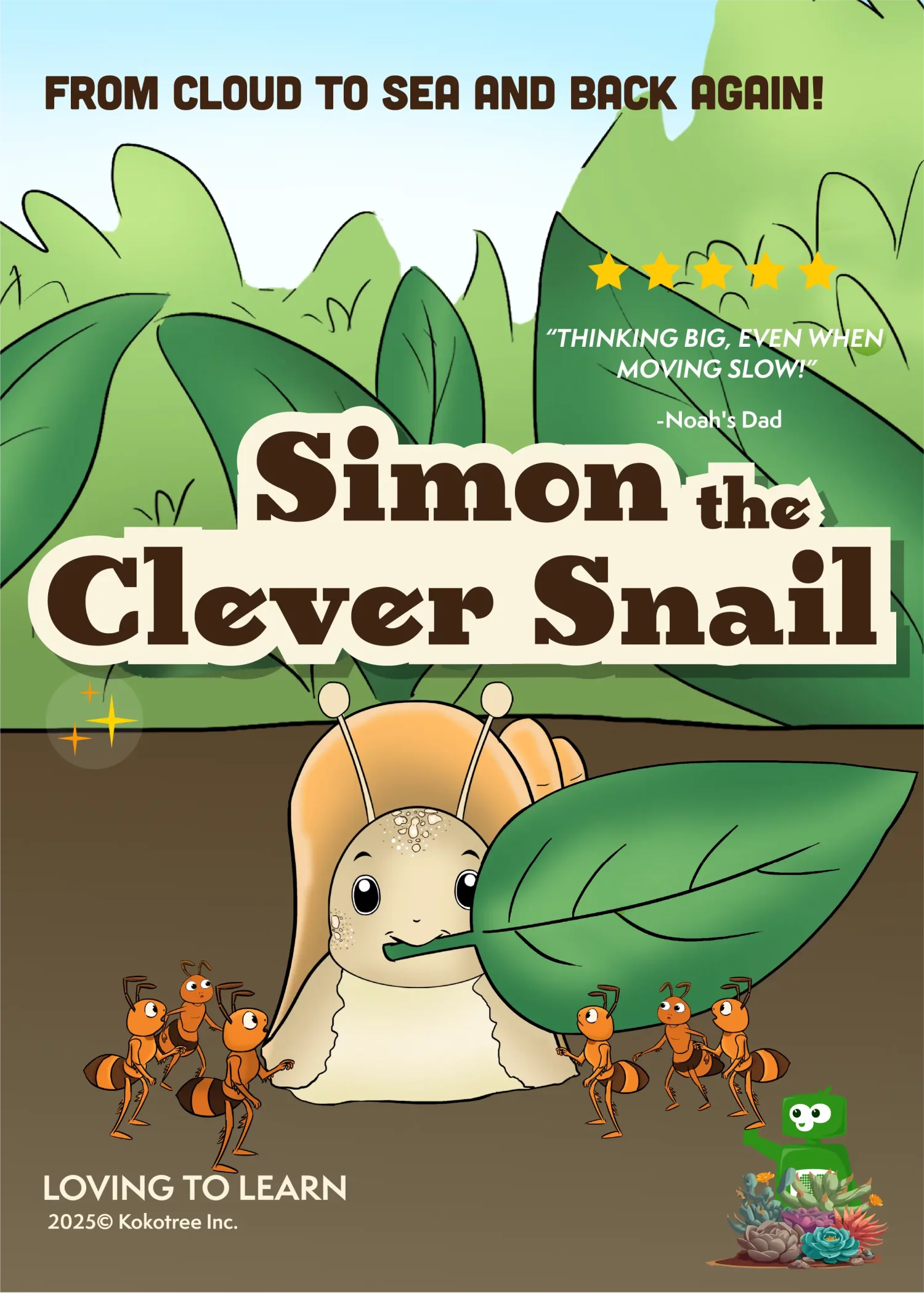
Simon the Snail moves through a beautiful garden, encountering friends who need help. He builds a leaf bridge for ants, fetches water for a butterfly's drooping flower, and rescues a dizzy caterpillar from a spinning branch on the pond. Each challenge requires creative thinking and patience.
What your child learns:
This story teaches children that everyone has unique strengths to offer. Simon shows that taking time to observe and think carefully leads to better solutions than rushing.
- Creative problem-solving using everyday objects
- Patience and persistence when facing challenges
- Empathy and helping others in need
- Confidence that being different is a strength
- Understanding cause and effect in nature
They'll use these skills when:
- Figuring out how to reach a toy that rolled under the couch
- Waiting their turn during games without getting frustrated
- Helping a friend who dropped their crayons
- Building with blocks and trying different approaches when towers fall
The Story (what keeps them watching)
Meera reads the Kokotree class an adventure about Simon, a snail with a quick mind and big heart. When a giant puddle blocks the ants from reaching their food, Simon builds a clever leaf bridge. Then he squeezes through thorny vines to fetch water for Buttercup the Butterfly's wilting flower. Finally, he pushes a lily pad to rescue a dizzy caterpillar spinning on the pond! The garden friends celebrate Simon's helpfulness, proving that being slow doesn't stop you from doing big things.
How We Teach It (the clever part)
- First 2 minutes: Meera introduces the story and sets up curiosity about how a "slow" snail could be the hero, challenging assumptions about what makes someone capable.
- Minutes 2-5: Three escalating challenges show Simon observing problems, thinking creatively, and taking action—modeling the problem-solving process step by step.
- Final 2 minutes: The classroom characters discuss what they learned, reinforcing that cleverness and kindness matter more than speed.
Teaching trick: Each problem Simon solves uses objects children recognize (leaves, twigs, lily pads), showing that solutions often come from looking at familiar things in new ways.
After Watching: Quick Wins to Reinforce Learning
- Mealtime activity: "What could we use to solve this?" Point to a small "problem" like a napkin that fell. Ask your child what Simon might do. (Practices creative thinking with everyday objects)
- Car/travel activity: "I spy something that could help!" Look for leaves, sticks, or objects outside and imagine what problems they could solve. (Builds observation skills and imagination)
- Bedtime activity: "Who did you help today?" Talk about one small way your child helped someone, just like Simon helped his garden friends. (Reinforces empathy and kindness)
- Anytime activity: "Slow and steady wins!" When your child gets frustrated with a task, say "Let's be like Simon" and pause to think of a new approach together. (Practices patience and persistence)
When Kids Get Stuck. And How to Help.
- "My child rushes through everything and won't slow down." That's completely normal at this age! Try narrating your own "slow thinking" out loud: "Hmm, let me look carefully... I see something that might work!" Kids learn patience by watching it modeled.
- "They don't understand why being slow could be good." Use concrete examples: "Remember how Simon could fit through the thorns because he was small and careful? Sometimes going slowly helps us notice things others miss."
- "My child gets upset when they can't solve problems right away." Celebrate the trying, not just the solving! Say "You're thinking just like Simon!" when they attempt solutions, even if they don't work the first time.
What Your Child Will Learn
Prerequisites and Building Blocks
Children benefit from basic story comprehension and familiarity with garden creatures like snails, ants, and butterflies. This video builds on foundational social-emotional concepts introduced in earlier Kokotree stories about friendship and cooperation. It advances the learning progression by introducing multi-step problem-solving and the concept that different abilities have different advantages. No prior videos are required, but exposure to nature-themed content enhances engagement.
Cognitive Development and Teaching Methodology
This narrative approach leverages children's natural love of stories to teach abstract concepts like patience and creative thinking. The three-problem structure provides spaced repetition of the problem-solving process: observe, think, act. Visual learners see Simon's solutions unfold; auditory learners hear Meera's narration explaining his thinking; kinesthetic learners can later act out the story. The escalating difficulty mirrors how young brains build confidence through graduated challenges.
Alignment with Educational Standards
This video supports social-emotional learning standards for preschool, including CASEL competencies in self-management (patience, persistence) and social awareness (empathy, helping others). It aligns with kindergarten readiness indicators for problem-solving and creative thinking found in most early learning frameworks. The narrative structure supports language development standards, while the cause-and-effect scenarios introduce foundational scientific reasoning expected by age 5-6.
Extended Learning Opportunities
Pair this video with nature walks to find snails, ants, or butterflies and discuss how they solve problems. The Kokotree app offers related problem-solving games and nature exploration activities. Create a "helping hands" chart at home where children track ways they helped others, like Simon. Building activities with natural materials (leaves, twigs, stones) extend the creative problem-solving concepts into hands-on play.
Transcript Highlights
- "Simon wasn't fast, but he sure was clever. He spotted a few leaves and a twig and came up with a plan." — Models observation before action
- "I might be slow, but I can squeeze through and reach the fountain for you!" — Demonstrates recognizing personal strengths
- "Sometimes a calm approach is all you need. I'm just happy you're safe now." — Teaches emotional regulation and modesty
- "Sometimes taking your time helps you see solutions others might miss." — Explicitly states the lesson for reinforcement
Character Development and Story Arc
Simon models a growth mindset by reframing his "slowness" as an advantage rather than a limitation. He demonstrates persistence across three challenges without frustration, showing children how to approach problems calmly. The garden friends model gratitude and recognition of others' contributions. Meera and the classroom characters provide metacognitive discussion, helping children understand why Simon's approach worked and how they can apply similar thinking.
Problem-Solving and Creative Thinking Deep Dive
Problem-solving is one of the most critical cognitive skills developed during early childhood, and this video introduces it through accessible, nature-based scenarios. Research shows that children ages 2-6 learn best through concrete examples rather than abstract instruction—which is exactly why Simon uses tangible objects (leaves, twigs, lily pads) to solve each challenge.
The video demonstrates the complete problem-solving cycle: identifying a problem, observing available resources, generating a solution, implementing it, and evaluating the outcome. Each of Simon's three challenges follows this pattern, providing repetition that helps cement the process in young minds.
Importantly, the story challenges the assumption that "fast is better"—a message children often absorb from competitive environments. By showing that patience and careful observation lead to better outcomes, the video builds executive function skills like impulse control and planning. These skills are among the strongest predictors of academic success and are actively developing during the preschool years.
The escalating difficulty of challenges (bridge-building → navigating obstacles → water rescue) mirrors how children's problem-solving abilities develop. Early problems have obvious solutions; later ones require more creative thinking. This scaffolded approach builds confidence while gently stretching cognitive abilities.
Finally, the social component—Simon helping others rather than solving problems for himself—introduces prosocial problem-solving. Children learn that their thinking skills can benefit their community, not just themselves. This plants early seeds for collaborative thinking and civic mindedness that will serve them throughout life.