
What's The Grasshopper & The Ants About?
Your little one joins Miss Meera's classroom to explore the four seasons through an enchanting story about a musical grasshopper who learns the value of preparation. They'll understand how seasons change and why thinking ahead is so important!
9 minutes
Ages 3-6
Skill: Seasons & Planning Ahead
Your kid watches a grasshopper learn why ants prepare for winter. You get 9 minutes to enjoy your coffee while it's still warm.
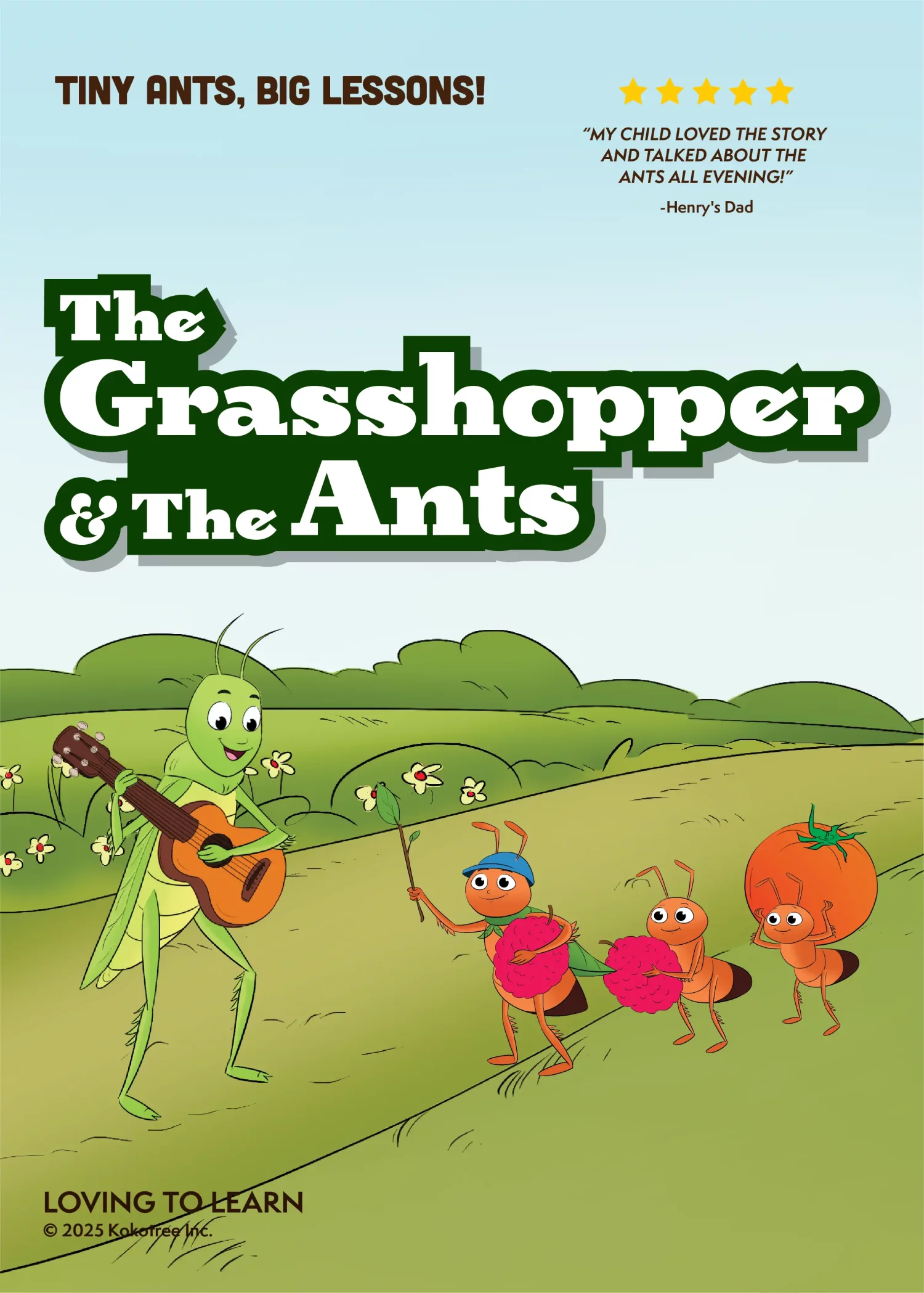
Miss Meera gathers the classroom friends around her colorful seasons chart as leaves turn golden outside. She tells the story of Gigi Grasshopper, who plays guitar all summer while the ants work hard gathering food. When winter arrives, Gigi learns an important lesson about balancing fun with responsibility.
What your child learns:
Through this timeless fable, children discover how nature changes through four distinct seasons and why animals (and people!) prepare for different weather. The story introduces cause-and-effect thinking in a gentle, age-appropriate way.
- Identifies all four seasons: Spring, Summer, Autumn, Winter
- Recognizes seasonal changes like falling leaves and snow
- Understands basic cause and effect (no preparation = no food in winter)
- Learns the value of balancing work and play
- Develops empathy through character experiences
They'll use these skills when:
- Noticing leaves changing color on a walk and naming the season
- Understanding why you pack snacks before a long car trip
- Putting toys away before starting a new activity
- Helping gather items when preparing for an outing
The Story (what keeps them watching)
Miss Meera notices the autumn chill and introduces her seasons chart to curious friends like Ruby, Ronnie, and Tiki. This sparks a story about Gigi Grasshopper, who spends sunny summer days playing guitar while Captain Ant and the ant squad gather food. "Winter's ages away!" Gigi laughs. But when snow blankets the meadow, a hungry, shivering Gigi must ask the ants for help. Captain Ant teaches him that there's a time for work and a time for play—and Gigi promises to help sort seeds in exchange for warmth. Lesson learned!
How We Teach It (the clever part)
- First 2 minutes: Miss Meera introduces the four seasons using a visual chart, connecting classroom discussion to what children see outside their own windows
- Minutes 2-7: The animated story brings abstract concepts to life—summer sunshine, autumn leaves falling, winter snow—while showing consequences of choices through Gigi's journey
- Final 2 minutes: Classroom friends discuss the story's meaning, connecting it to real-life examples like packing bags for school or preparing for trips
Teaching trick: The video uses dramatic seasonal transitions (vibrant summer → golden autumn → snowy winter) so children literally see time passing and understand why the ants' preparation mattered.
After Watching: Quick Wins to Reinforce Learning
- Mealtime activity: "What season is it right now? What foods do we eat in this season?" (Connects seasons to their daily experience and builds observational skills)
- Car/travel activity: "Let's spot signs of the season outside! Can you find something that shows it's [current season]?" (Practices identifying seasonal markers like bare trees or blooming flowers)
- Bedtime activity: "If you were an ant, what three things would you gather for winter?" (Encourages planning-ahead thinking in a playful way)
- Anytime activity: "Let's be ants! What do we need to get ready before [upcoming activity]?" (Applies the story's lesson to real preparation tasks)
When Kids Get Stuck. And How to Help.
- "My child keeps mixing up the seasons" - Totally normal! Focus on just two seasons at first (the current one and the next coming). Point out real changes you see together, like "Look, the leaves are falling—that means autumn!"
- "They felt sad when Gigi was cold and hungry" - This shows wonderful empathy developing! Reassure them that Gigi learned his lesson and the kind ants helped him. Ask what they would do to help a friend.
- "The planning-ahead concept seems too abstract" - Start super concrete: "Remember how Gigi didn't save food? Let's pack your backpack tonight so we're ready like the ants!" They'll connect the dots through doing.
What Your Child Will Learn
Prerequisites and Building Blocks
Children benefit most from this video if they have basic familiarity with weather concepts (hot, cold, sunny, snowy) and can follow a simple narrative. This video builds on foundational nature awareness and introduces more complex sequential thinking. It pairs well with videos about weather, animal behaviors, and basic time concepts. The story format scaffolds abstract ideas about future planning into concrete, visual scenarios that young minds can grasp.
Cognitive Development and Teaching Methodology
This video leverages narrative transportation—children become emotionally invested in Gigi's journey, making the lesson memorable. The three-act structure (summer fun, autumn warning, winter consequence) mirrors how young brains process cause-and-effect. Visual learners benefit from dramatic seasonal color changes; auditory learners connect with Gigi's songs and dialogue; kinesthetic understanding comes through the ants' physical work. The classroom frame story provides relatable peer discussion modeling.
Alignment with Educational Standards
This video supports early learning standards for science (seasonal changes, animal behaviors), social-emotional development (delayed gratification, responsibility), and language arts (narrative comprehension, sequencing). It aligns with kindergarten readiness indicators for understanding time concepts and demonstrating self-regulation. Teachers expect entering students to recognize seasons and understand basic preparation routines—skills this video directly develops.
Extended Learning Opportunities
Extend learning with season sorting activities using pictures of clothing, foods, and outdoor scenes. Create a simple "preparation checklist" craft where children draw what they need for different activities. The Kokotree app offers related videos on weather patterns and animal homes. Outdoor nature walks to observe current seasonal signs reinforce the video's concepts beautifully. A four-section paper plate craft showing each season makes learning tangible.
Transcript Highlights
- Introducing seasons: "There are FOUR amazing seasons that come and go. We have Spring, Summer, Autumn, and Winter!"
- Teaching preparation: "Summer is bright now, but winter is coming. We must gather food and prepare our home while we can."
- Consequence learning: "Oh... s-so cold... s-so hungry... The ants... they were right... I should have listened..."
- Lesson summary: "It's wonderful to have fun and enjoy the sunny days, but it's also important to be responsible and prepare for the future."
Character Development and Story Arc
Gigi Grasshopper models a relatable learning journey—starting confident and carefree, experiencing natural consequences, then showing genuine growth through humility and willingness to contribute. Captain Ant demonstrates firm but fair leadership, showing children that boundaries can coexist with kindness. The classroom characters (Ruby, Eddie, Maddy) model active listening and thoughtful reflection, showing children how to process and discuss stories meaningfully.
Understanding Seasons and Future-Thinking: A Developmental Deep Dive
The concept of seasons represents one of children's first encounters with cyclical time—a fundamental scientific and mathematical concept. Between ages 3-6, children transition from understanding only "now" to grasping "later" and eventually "much later." This video scaffolds that development brilliantly.
Seasons provide concrete, observable evidence of time passing. Unlike abstract calendar concepts, children can see leaves change, feel temperature shifts, and notice daylight differences. The video's dramatic visual transitions—from sunny meadow to golden autumn to snowy winter—compress months into minutes, making the passage of time visible and comprehensible.
The planning-ahead concept (called "prospective memory" in developmental psychology) typically emerges around age 4-5 but requires extensive practice. Young children live predominantly in the present moment—which is developmentally appropriate! Gigi represents this natural state without judgment. The story doesn't shame present-moment enjoyment; it simply shows that some future-thinking helps.
The ants model "if-then" reasoning: IF winter comes, THEN we need food stored. This conditional thinking is a cognitive milestone. By watching the ants succeed and Gigi struggle, children experience the logic viscerally rather than being told abstractly.
Importantly, the resolution shows redemption and contribution—Gigi doesn't just receive charity but offers to help. This models growth mindset and the social contract of community support, teaching that mistakes are learning opportunities and everyone has something valuable to contribute.