
What's Vowel Digraphs About?
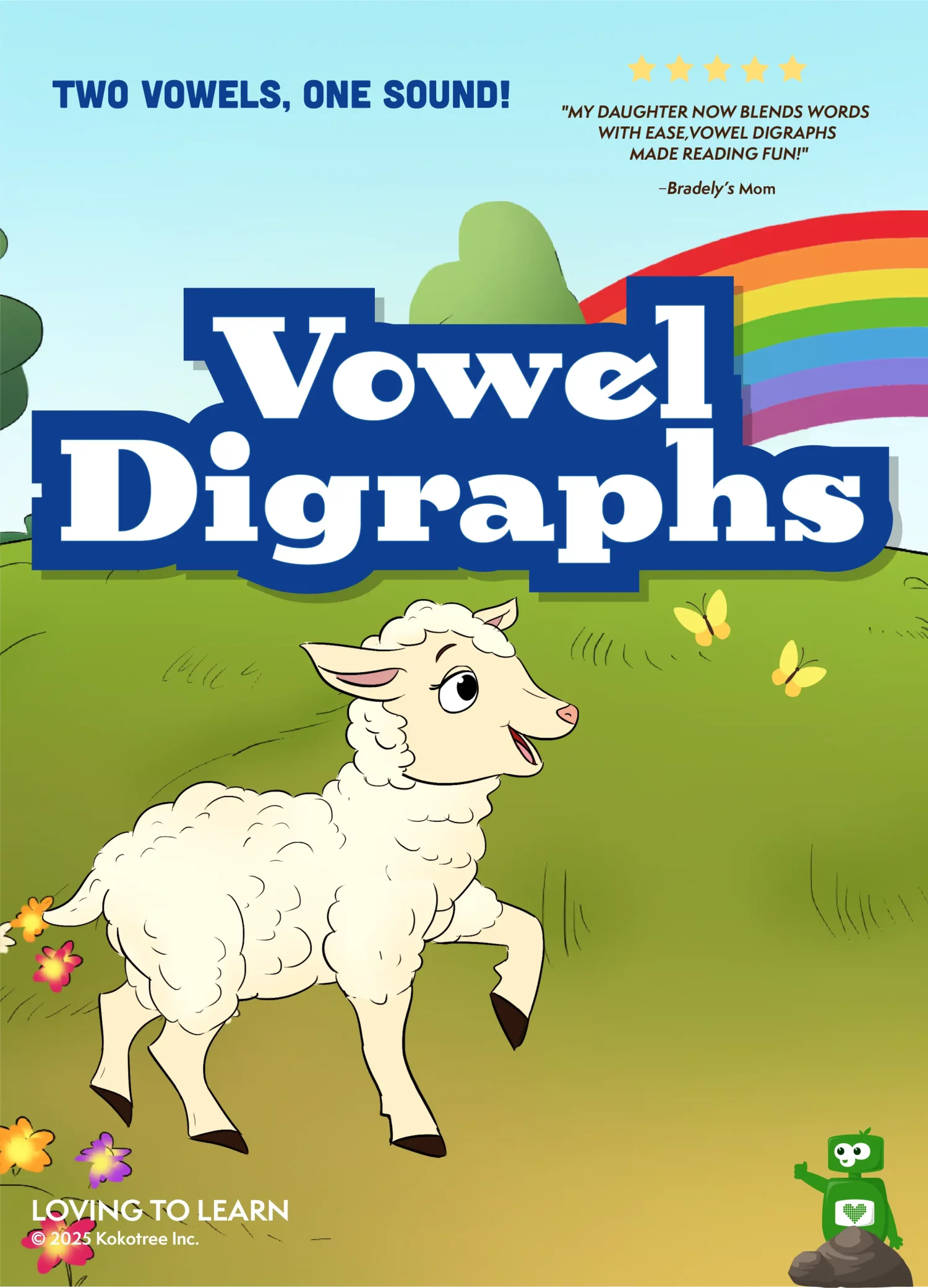
Your child joins friendly animal explorers on a magical adventure to discover how two vowels team up to make brand-new sounds! They'll spot digraphs hiding in rainbows, sheep, boats, and even a dramatic snail.
10 minutes
Ages 4-6
Skill: Recognizing vowel pairs that make one sound
Your kid watches animal friends hunt for vowel pairs in nature. You get 10 minutes to finish that cup of coffee while it's still warm.
Greg and Andy explore a colorful meadow, rolling green hills, and a sparkling lake—finding words with vowel digraphs everywhere they look. A wise owl guides them through challenges, while silly characters like a weight-conscious snail and a boastful toad keep things entertaining.
What your child learns:
This video teaches children that two vowels can work together as a team to create one new sound. They'll recognize six common vowel digraphs (ai, ei, ee, oa, ou, oo) and start spotting them in everyday words.
- Identifies the vowel digraph 'ai' in words like rain, rainbow, and snail
- Recognizes 'ei' making the long 'a' sound in weight and eight
- Spots the 'ee' digraph in sheep and knees
- Finds 'oa' words like boat and toad
- Discovers 'ou' and 'oo' sounds in mouse, house, soup, and wood
They'll use these skills when:
- Sounding out new words in picture books at bedtime
- Reading street signs and food labels at the grocery store
- Playing word games and puzzles with siblings or friends
- Writing their first stories and spelling words at school
The Story (what keeps them watching)
The adventure begins in Miss Meera's classroom where the animal students play teacher-teacher—until the real Miss Meera arrives with something better: a magical book! Greg and Andy are transported to a sunny meadow where Wise Owl challenges them to find vowel digraphs hiding everywhere. They discover 'ai' in a rainbow and a complaining snail, 'ee' in fluffy sheep, and 'oa' in a tiny boat guarded by a very proud toad. The quest ends at a cozy lakeside house where a friendly raccoon serves soup—and the kids realize even delicious food contains vowel digraphs!
How We Teach It (the clever part)
- First 2 minutes: Miss Meera's classroom introduces vowels (A, E, I, O, U) through playful role-play, activating prior knowledge before the adventure begins
- Minutes 2-8: Each new location introduces a different vowel digraph pair, with characters naturally speaking words that highlight the target sounds—the snail complains about his "w-ei-ght" being "ei-ght" kilos!
- Final 2 minutes: Back in class, the animal students share their own real-world examples, reinforcing that digraphs appear in everyday life
Teaching trick: Characters break words into chunks as they speak them ("r-ai-n-bow"), so kids hear exactly where the digraph lives inside each word—making the abstract concept visible and memorable.
After Watching: Quick Wins to Reinforce Learning
- Mealtime digraph hunt: "Can you find 'oo' sounds in our kitchen?" Point to food, spoons, or the stool they're sitting on. They're practicing sound recognition without even trying!
- Car ride challenge: "Let's spot 'ai' words outside!" Rain, trains, mailboxes—they're everywhere. This builds real-world phonics connections during travel time.
- Bedtime book bonus: While reading together, pause and ask "Which two vowels are working as a team here?" They'll love being the word detective in their favorite stories.
- Anytime sound swap: Say a digraph word and have them repeat it, stretching out the vowel sound: "boooooat" or "sheeeeeep." Silly voices make phonics practice feel like play!
When Kids Get Stuck. And How to Help.
"My child keeps saying both vowel sounds separately." Totally normal! The concept that two letters make ONE sound takes practice. Try saying the word slowly together, holding the vowel sound extra long so they hear it as one continuous sound.
"They found 'ai' in 'said' but it doesn't sound right." Great observation skills! English has tricky exceptions. Celebrate that they spotted the letter pattern, then explain some vowel teams are "rule breakers." Focus on the common patterns first.
"This seems advanced for my preschooler." Vowel digraphs build on letter recognition—if your child knows their vowels, they're ready! Start with just one digraph (like 'ee' in sheep) and add more as they gain confidence.
What Your Child Will Learn
Prerequisites and Building Blocks
Children should recognize all five vowels (A, E, I, O, U) and understand that letters represent sounds before watching. This video builds on basic phonemic awareness and single-letter sound recognition covered in earlier Kokotree phonics content. It bridges the gap between individual letter sounds and more complex phonics patterns, preparing children for consonant-vowel-consonant blending and eventually multisyllabic word decoding.
Cognitive Development and Teaching Methodology
The video leverages narrative-based learning, which research shows increases retention in 4-6 year olds by embedding abstract concepts in memorable stories. Visual learners benefit from seeing digraphs highlighted in colorful environments; auditory learners hear characters segment words aloud; kinesthetic learners can mimic the word-stretching technique. The adventure format maintains attention through novelty while repetition across multiple digraph types builds pattern recognition.
Alignment with Educational Standards
This content aligns with Common Core RF.K.3 (knowing and applying grade-level phonics) and RF.1.3 (decoding regularly spelled one-syllable words). It supports kindergarten readiness indicators for phonological awareness and prepares children for first-grade reading benchmarks. The focus on vowel teams directly addresses state standards requiring students to "distinguish long from short vowel sounds" and "decode two-syllable words."
Extended Learning Opportunities
Pair this video with Kokotree's printable digraph word cards for hands-on sorting activities. The app's "Word Builder" game reinforces these patterns through interactive play. Parents can extend learning with a "digraph journal" where children draw pictures of words containing each vowel team. Follow up with the Consonant Digraphs video to complete the digraph learning sequence.
Transcript Highlights
- "Vowel digraphs are when two vowels team up to make one sound." — Miss Meera introduces the core concept simply
- "A sn-ai-l! Another 'ai' word!" — Greg models segmenting words to identify digraphs
- "'Soup' also has 'ou,' but this time it sounds like 'oo'!" — Wise Owl addresses that same letters can make different sounds
- "Vowel sounds can be tricky, but you're all doing great!" — Encouragement normalizes the learning challenge
Character Development and Story Arc
Greg and Andy model curiosity-driven learning, actively searching their environment for examples rather than passively receiving information. The classroom scene shows students supporting each other's answers, demonstrating collaborative learning. Wise Owl embodies patient guidance, offering praise for attempts and gently correcting misconceptions. Even the silly side characters (the dramatic snail, boastful toad) show that learning happens everywhere—even grumpy animals use digraph words!
Phonics Deep Dive: Understanding Vowel Digraphs
Vowel digraphs represent a critical milestone in phonics development, bridging single-letter decoding and fluent reading. Unlike consonant digraphs where the sound is entirely new (like 'sh'), vowel digraphs typically produce a long vowel sound—usually the first vowel's name. The "two vowels go walking, the first one does the talking" rule applies to many patterns taught here: 'ai' says /ā/, 'ee' says /ē/, 'oa' says /ō/.
This video strategically introduces six digraphs across natural contexts, preventing cognitive overload while building pattern recognition. The 'ai/ei' pairing shows children that different letter combinations can produce similar sounds—essential preparation for English spelling complexity. The 'ou/oo' section cleverly addresses that identical letters sometimes make different sounds (soup vs. mouse), building phonemic flexibility.
Research in early literacy shows that explicit digraph instruction significantly improves decoding accuracy in emergent readers. Children who master vowel teams read 23% more words correctly than peers taught only single-letter sounds. The video's approach—embedding instruction in adventure narrative while having characters audibly segment words—combines the engagement of story-based learning with the precision of systematic phonics instruction. This dual-coding (visual digraph highlighting plus auditory segmentation) creates multiple memory pathways, increasing the likelihood children will recognize these patterns independently during real reading experiences.