
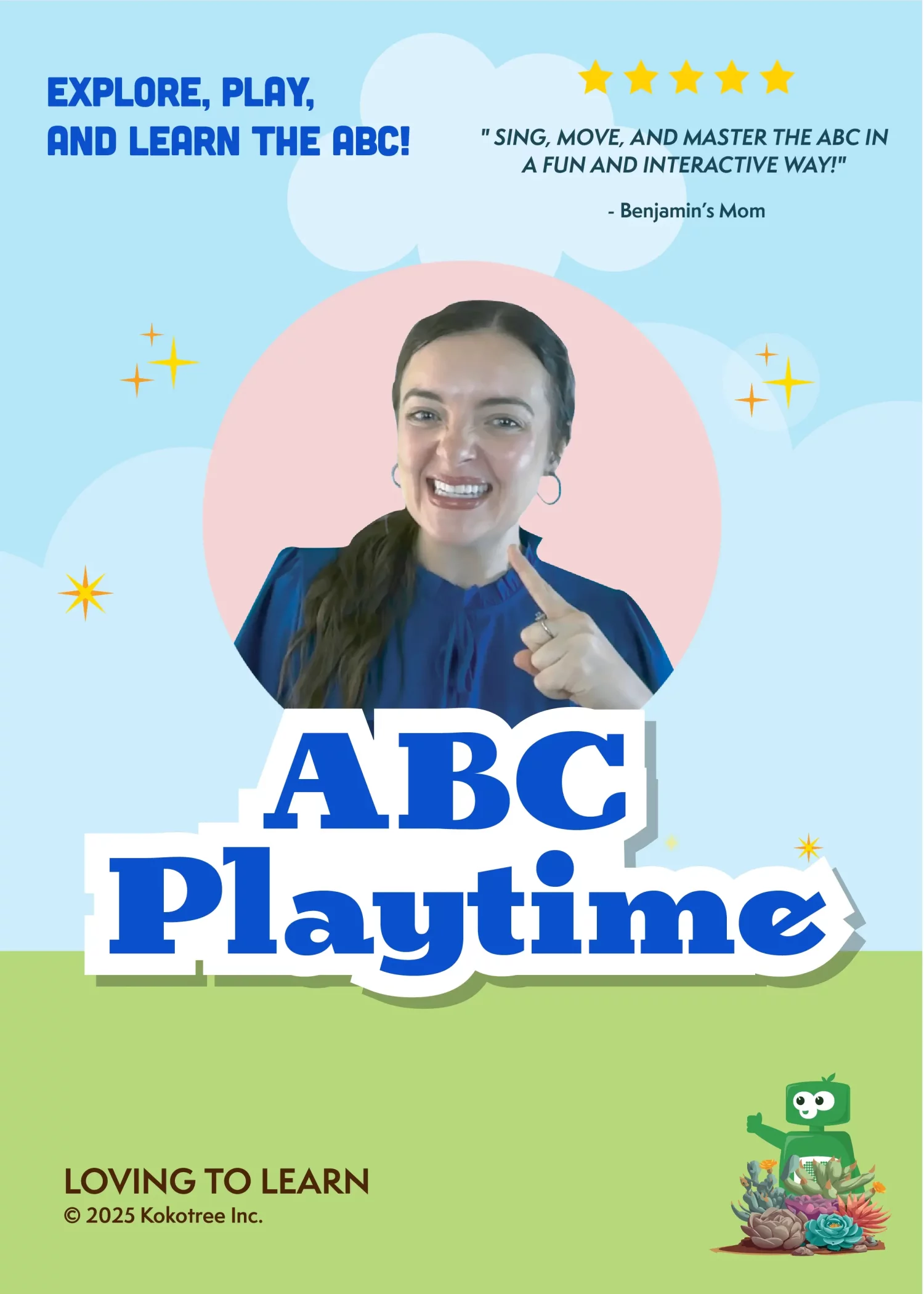
What's ABC Playtime About?
Your little learner joins Miss Terran for an energetic journey through all 26 letters of the alphabet, complete with mouth movements, animal friends, and silly surprises! After watching, they'll connect letters to sounds and spot them everywhere.
7 minutes
Ages 2-5
Skill: Letter recognition and beginning phonics
Your kid watches Miss Terran introduce each letter with sounds and actions. You get 7 minutes to finish that coffee.
Miss Terran appears on screen with each letter of the alphabet, one by one. Every letter comes with a colorful picture—A is for Apple, B is for Ball, J is for Jellyfish—and she demonstrates exactly how to make each sound by pointing to her mouth. Kids jump like kangaroos, hop to melt ice, and end with the classic ABC song.
What your child learns:
This video builds the foundation for reading by connecting letter shapes to their sounds. Your child practices phonemic awareness—the ability to hear and produce individual sounds—which research shows is the strongest predictor of early reading success.
- Recognizes all 26 uppercase letters by sight
- Connects letters to their beginning sounds (phonics foundation)
- Practices mouth positioning for clear pronunciation
- Associates letters with familiar objects and animals
- Follows along with the traditional ABC song
They'll use these skills when:
- Spotting the "M" on a McDonald's sign and shouting "M is for Mouse!"
- Recognizing the first letter of their own name on cubbies or belongings
- "Reading" picture books by identifying letters they know
- Singing along to alphabet songs at preschool circle time
The Story (what keeps them watching)
Miss Terran welcomes kids to ABC Playtime with infectious energy and a simple mission: learn every letter together! She makes each letter memorable—when H appears, a hat magically pops onto her head. During I for Ice, the screen freezes over and kids must jump to warm up and melt it away. K for Kangaroo means hopping time! The video builds momentum through the alphabet with encouraging check-ins ("Amazing! You're doing so great!") until the grand finale: singing the complete ABC song together. Balloons and fireworks celebrate their achievement.
How We Teach It (the clever part)
- First 2 minutes: Letters A through F are introduced with a consistent pattern—show letter, show picture, repeat the sound, demonstrate mouth shape. This establishes the learning routine.
- Minutes 2-5: Letters G through T include interactive movement breaks (jumping, hopping) to maintain engagement and connect physical activity to learning. Questions like "Do you like purple grapes or green grapes?" invite participation.
- Final 2 minutes: Letters U through Z complete the alphabet, followed by the traditional ABC song that ties everything together in a familiar, singable format.
Teaching trick: Miss Terran points to her mouth for every single letter, showing kids exactly how to position their lips and tongue. This visual modeling helps children who learn by watching—they can mirror her mouth shape to produce the correct sound.
After Watching: Quick Wins to Reinforce Learning
Mealtime activity: "What letter does 'banana' start with? B-b-b-banana!" Point to foods and practice the beginning sounds together, just like Miss Terran did with Apple and Grapes.
Car/travel activity: "Can you find a letter from the video on that sign?" Play alphabet hunt with billboards, license plates, and store names. Celebrate each letter they spot!
Bedtime activity: "Let's whisper the ABC song together like sleepy lions." Singing softly reinforces the letter sequence while winding down for sleep.
Anytime activity: "Show me how Miss Terran makes the 'S' sound—Ssssspider!" Practice mouth shapes in the mirror together. Kids love seeing themselves make the sounds.
When Kids Get Stuck. And How to Help.
"My child can't remember all 26 letters yet." - That's completely normal! This video is meant to be watched many times. Focus on celebrating the letters they DO recognize, and the others will click with repetition.
"They mix up similar letters like B and D." - Very common for this age! Point out the differences using the video's examples: "B has a belly like Ball, D has a back like Dog." Physical associations help.
"The video moves too fast for my child." - Pause after every few letters to practice together. You can also focus on just A-M one day and N-Z the next. Breaking it up is perfectly fine!
What Your Child Will Learn
Prerequisites and Building Blocks
This video is designed as an introduction to the alphabet, requiring no prior letter knowledge. Children benefit from basic listening skills and the ability to focus for short periods. ABC Playtime builds the foundation for future phonics videos in the Kokotree library, preparing children for letter-sound correspondence, word building, and eventually early reading. It connects naturally to videos about colors (grapes are purple or green), animals (many letter examples), and shapes (recognizing letter forms).
Cognitive Development and Teaching Methodology
The video employs multi-sensory learning proven effective for ages 2-5. Visual learners see letters and pictures simultaneously. Auditory learners hear repetitive sound patterns ("B-b-b-ball"). Kinesthetic learners participate through jumping and hopping movements. The consistent structure—letter, picture, sound repetition, mouth demonstration—builds predictability that helps young brains encode information. Movement breaks every few letters align with toddler attention spans and support memory consolidation.
Alignment with Educational Standards
ABC Playtime addresses key kindergarten readiness indicators including letter recognition (knowing all 26 uppercase letters) and phonemic awareness (identifying beginning sounds). It aligns with Common Core Foundational Skills RF.K.1d (recognize and name all uppercase letters) and supports Head Start Early Learning Outcomes for literacy. Preschool teachers expect incoming kindergarteners to recognize most letters—this video systematically builds that skill.
Extended Learning Opportunities
Pair this video with Kokotree's letter tracing activities and alphabet matching games in the app. Print alphabet flashcards featuring the same images (apple, ball, cat) for consistent reinforcement. Create a simple alphabet book together, drawing or cutting out pictures for each letter. Magnetic letters on the refrigerator let children practice matching while you cook. Alphabet puzzles reinforce letter shapes through hands-on manipulation.
Transcript Highlights
- "A is for APPLE. Ah-ah-ah-Apple! Open your mouth and say Ahhhh-pple." (Demonstrates phonemic isolation and mouth positioning)
- "Say HAT and a HAT will appear on my head. Ready?" (Interactive element that rewards participation)
- "Can you hop like a kangaroo? Hop hop hop like a kangaroo!" (Movement integration for kinesthetic learning)
- "You've practiced so many letters today! Should we try our ABC song!?" (Celebration and consolidation through song)
Character Development and Story Arc
Miss Terran models enthusiastic learning throughout the video. She celebrates every small success ("Amazing! You're doing so great!"), demonstrating growth mindset and positive reinforcement. Her playful moments—wearing a silly hat, pretending to be cold—show that learning is fun, not serious or stressful. She asks questions and pauses for responses, modeling conversational learning and showing children their participation matters. Her energy remains consistent, teaching persistence through a longer learning task.
Phonics and Early Literacy Deep Dive
Phonemic awareness—the ability to hear, identify, and manipulate individual sounds in spoken words—is the single strongest predictor of early reading success, according to decades of literacy research. ABC Playtime systematically builds this skill through a technique called "sound isolation," where Miss Terran stretches out the beginning sound of each word: "B-b-b-ball," "Sssssspider."
The video pairs this auditory training with visual mouth demonstrations, addressing the articulatory component of phonics. When children see how lips, tongue, and teeth position to create sounds, they develop phonological production skills alongside recognition. This dual approach—hearing AND seeing sounds—accelerates learning for most children.
Each letter-picture pairing uses concrete, familiar objects (apple, ball, cat, dog) rather than abstract concepts. This leverages children's existing vocabulary to anchor new letter knowledge. The consistent pattern—letter appears, object appears, sound is repeated three times, mouth is demonstrated—creates a predictable learning routine that reduces cognitive load and allows children to focus on the new information.
The video concludes with the traditional ABC song, which serves as a powerful memory consolidation tool. Music activates multiple brain regions simultaneously, and the melody provides retrieval cues that help children remember letter sequence. Research shows children who learn the alphabet through song demonstrate faster recall than those who learn through rote memorization alone.