
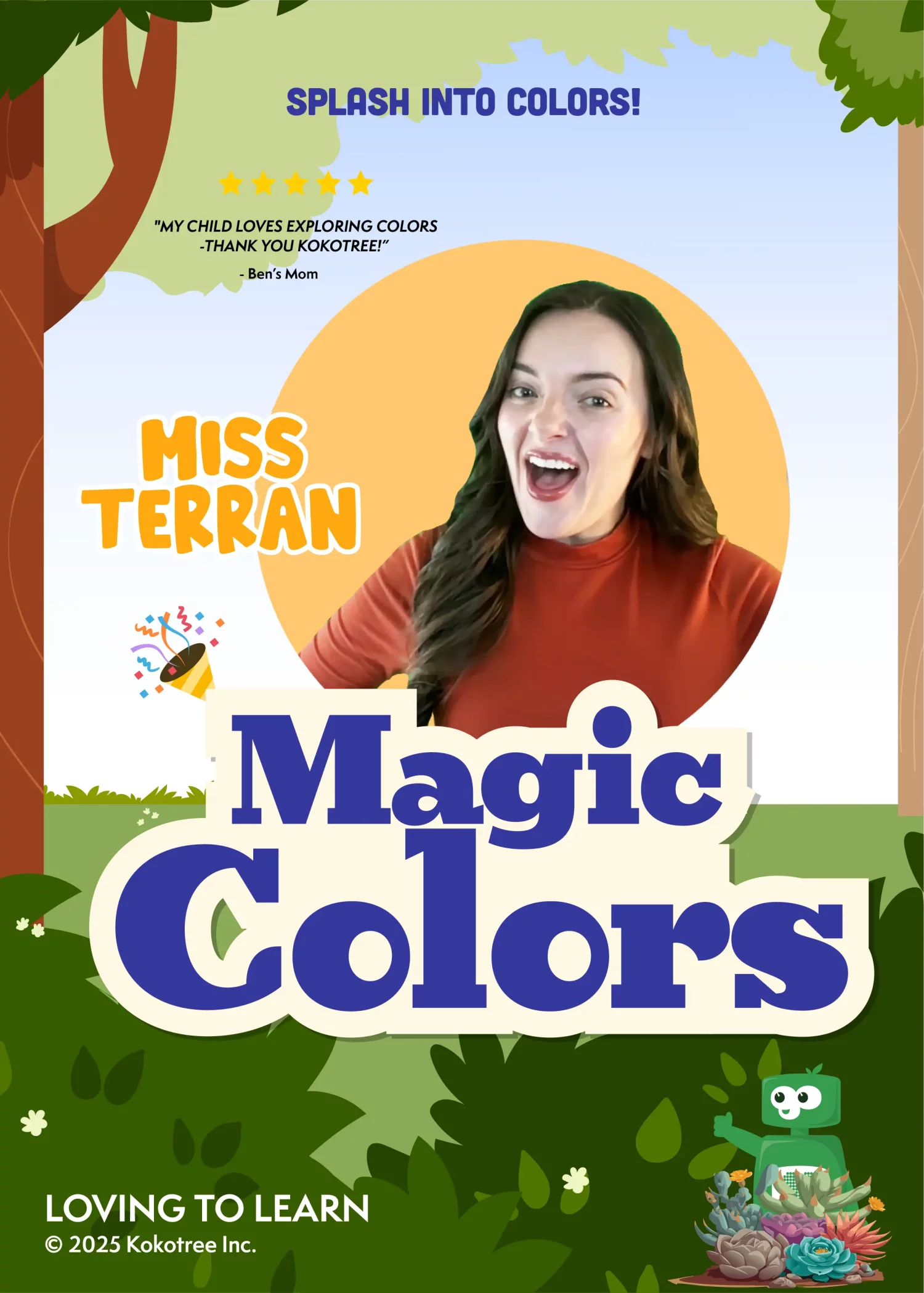
What's Magic Colors About?
Your little one joins Miss Terran on a vibrant journey through four essential colors, learning to identify green, yellow, red, and blue through familiar objects, animals, and interactive prompts. After watching, they'll confidently spot and name colors all around them!
6 minutes
Ages 1-6
Skill: Color recognition and identification
Your kid watches Miss Terran explore colors with dinosaurs and fish. You get 6 minutes to finish that coffee.
Miss Terran introduces each color with a big, bold circle, then shows real-world examples like green frogs, yellow bananas, red apples, and blue fish swimming in the ocean. Kids are encouraged to say each color name, make animal sounds, and hunt for colors in their own space.
What your child learns:
This video builds foundational color recognition through repetition and real-world connections. Each color is introduced with multiple examples, helping children generalize the concept beyond single objects.
- Identifies and names four primary colors: green, yellow, red, and blue
- Connects colors to familiar objects (bananas are yellow, apples are red)
- Practices verbal skills by repeating color names out loud
- Develops observation skills by finding colors in their environment
- Builds vocabulary through animal names and sounds
They'll use these skills when:
- Picking out their favorite colored cup at breakfast
- Pointing out fire trucks, school buses, and trees on car rides
- Sorting toys by color during playtime
- Describing their artwork to you ("I used blue!")
The Story (what keeps them watching)
Miss Terran kicks things off with a cheerful wave and a surprise rainbow that sparks the color adventure! She dives into green first—showing a roaring dinosaur, a crunchy pear, and swaying leaves. Then it's yellow's turn with a peeping chick, a banana to "peel and eat," and a stretchy sun moment. Red brings apples, vrooming cars, and a sweet heart. Finally, blue takes kids underwater with swimming fish and a silly hat surprise. The video wraps up with a catchy color song and a balloon celebration that has kids clapping along!
How We Teach It (the clever part)
- First 2 minutes: Miss Terran builds excitement with a rainbow reveal, then introduces green with a bold circle and three engaging examples (dinosaur, pear, leaves) before prompting kids to find green nearby.
- Minutes 2-4: Yellow and red follow the same proven pattern—color circle, relatable objects, animal sounds, and movement prompts keep engagement high while reinforcing each color.
- Final 2 minutes: Blue exploration leads into a full review of all four colors, followed by a memorable song that cements learning through music and rhythm.
Teaching trick: Each color gets the same "circle → objects → find it" structure, creating predictable patterns that help toddlers anticipate what's next and feel confident participating.
After Watching: Quick Wins to Reinforce Learning
- Mealtime activity: "Can you find something GREEN on your plate?" Point to peas, broccoli, or cucumbers together. This reinforces color-food connections from the video's green pear moment.
- Car/travel activity: "Let's spot something YELLOW outside!" Count yellow cars, signs, or flowers you pass. Builds observation skills and keeps little ones engaged on the go.
- Bedtime activity: "What color is your blanket? Your pajamas?" Naming colors of cozy items creates calm conversation while practicing recognition in a relaxed setting.
- Anytime activity: "Let's be color detectives!" Pick one color from the video and hunt for five things that match around the house. Celebrates their new skills with a fun challenge.
When Kids Get Stuck. And How to Help.
- "My child mixes up green and blue all the time." Totally normal! These colors sit close on the spectrum. Try comparing them side-by-side with toys or crayons, saying "This one is green like leaves, this one is blue like water."
- "She can point to red but won't say the word." Receptive language (understanding) develops before expressive language (speaking). Keep modeling the word enthusiastically—she's absorbing it even if she's not ready to say it yet.
- "He loses interest before the video ends." Six minutes can feel long for younger toddlers! Try watching one color section at a time, then hunting for that color before continuing. Short bursts work great.
What Your Child Will Learn
Prerequisites and Building Blocks
This video is perfect for children just beginning their color learning journey—no prior color knowledge required! It builds on basic visual attention skills and the ability to follow simple directions. Magic Colors serves as a foundational video in the Little Seeds program, preparing children for more advanced concepts like color mixing, sorting by multiple attributes, and pattern recognition in future Kokotree videos.
Cognitive Development and Teaching Methodology
The video leverages repetition with variation—a proven technique for toddler learning. Each color follows an identical structure (introduction, examples, search prompt), which builds predictability and confidence. Visual learners benefit from bold color displays, auditory learners from repeated verbal naming and the catchy song, and kinesthetic learners from movement prompts like stretching like the sun and pretending to swim.
Alignment with Educational Standards
Magic Colors addresses early learning standards for color recognition found in most kindergarten readiness frameworks. Children entering school are expected to identify and name basic colors—a skill assessed in kindergarten screenings. This video specifically targets the "identifies colors in the environment" benchmark and supports vocabulary development standards through object naming and descriptive language practice.
Extended Learning Opportunities
Pair this video with Kokotree's color sorting games and printable color matching worksheets available in the app. Extend learning with a simple color walk outside—bring a piece of colored paper and find natural objects that match. Follow up with the "More Colors" video in the Little Seeds program to introduce orange, purple, pink, and brown once these four colors are mastered.
Transcript Highlights
- "This is GREEN! Can you say greeeen?" — Models pronunciation with elongated vowels for clarity
- "Can you find something green around you?" — Transfers learning from screen to real environment
- "Let's pretend to peel it! Now, let's pretend to eat it! Nom nom nom!" — Engages imagination and motor skills
- "Green, yellow, red, and blue, so many colors—just for you!" — Musical reinforcement of all four colors
Character Development and Story Arc
Miss Terran models enthusiastic curiosity throughout the video, showing children that learning is exciting and celebratory. She demonstrates patience by pausing for responses, validates participation with phrases like "Wow! Good job!" and "You're so smart!" and exhibits genuine joy in discovery. Her consistent encouragement builds a growth mindset, teaching children that trying and participating matters more than perfection.
Color Recognition: The Science of Early Visual Learning
Color recognition is one of the earliest categorization skills children develop, typically emerging between 18 months and 3 years. This video strategically introduces four high-contrast, primary colors that are easiest for young eyes to distinguish. Green, yellow, red, and blue represent colors children encounter daily, making the learning immediately applicable.
The brain processes color through specialized cone cells in the retina, and children's color vocabulary develops through repeated exposure and naming. Research shows that children learn colors faster when the color word is emphasized before the object name ("the GREEN frog" rather than "the frog is green")—exactly the approach Miss Terran uses throughout.
By connecting each color to multiple objects (green = dinosaur, pear, leaves, frog, turtle, palm tree), the video helps children understand that "green" is a property that can apply to many different things—a crucial cognitive leap called generalization. The underwater blue segment and outdoor green scenes also introduce early science concepts about where colors appear in nature, laying groundwork for future lessons about habitats and environments.
The closing song serves a specific neurological purpose: musical memory activates different brain pathways than spoken memory, creating multiple "hooks" for recall. Children who struggle to remember color names in conversation often sing them perfectly—this video harnesses that power intentionally.