

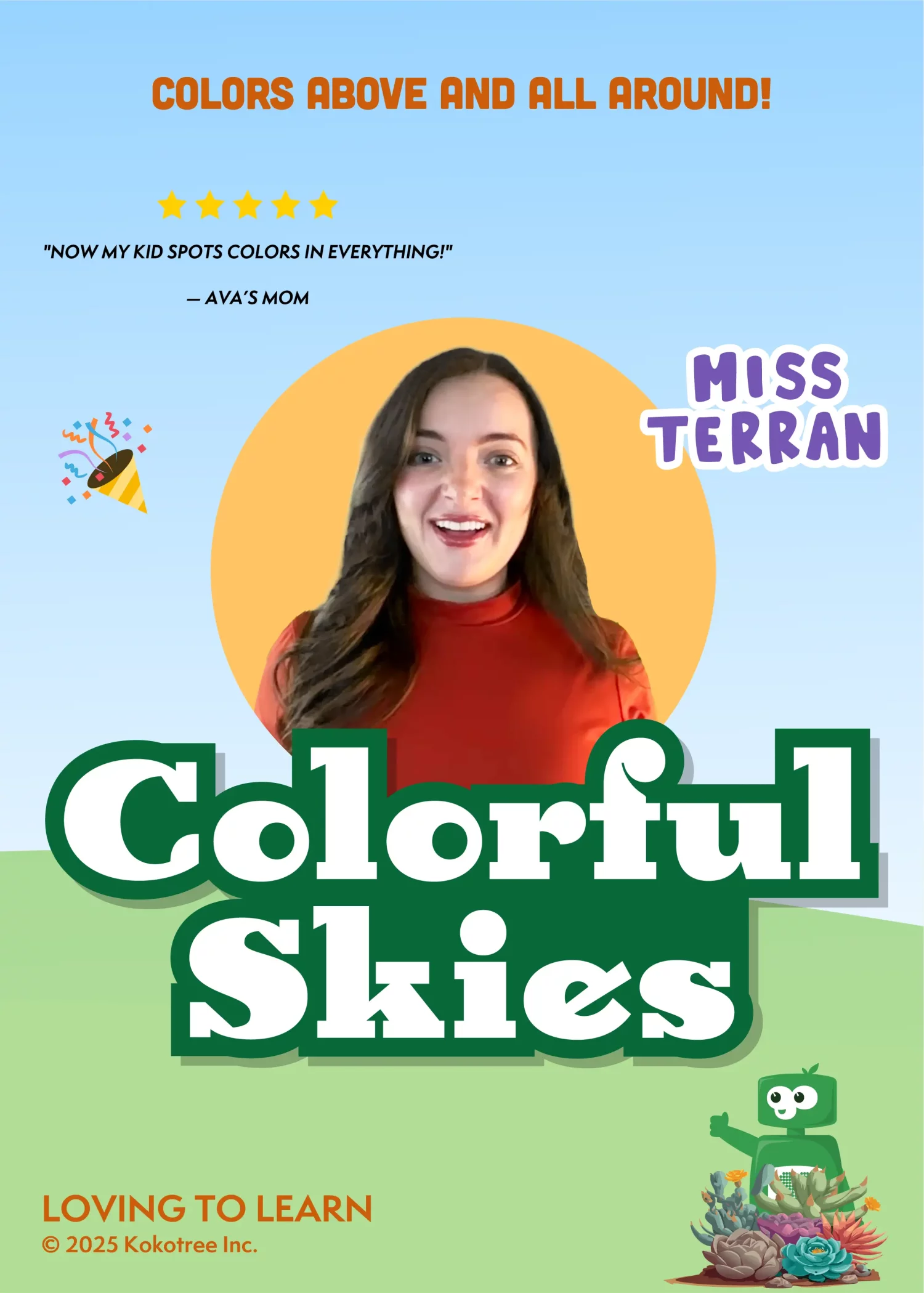
What's Colorful Skies About?
Your little one joins Miss Taryn on a vibrant journey through basic colors and weather patterns, learning to name green, yellow, red, and blue while discovering how rain and sunshine create beautiful rainbows!
4 minutes
Ages 1-4
Skill: Color recognition and weather basics
Your kid watches friendly animals demonstrate colors and weather changes. You get 4 minutes to finish that cup of coffee.
Miss Taryn introduces each color with memorable animal friends—a roaring green T-Rex, peeping yellow chicks, and a swimming blue fish. The lesson naturally flows into weather exploration as the blue sky turns gray with rain clouds, then brightens again to reveal a stunning rainbow with all its colors.
What your child learns:
This video builds foundational color vocabulary through repetition and real-world examples. Children practice saying color names aloud while connecting them to familiar objects and animals they love.
- Identifies and names four primary colors: green, yellow, red, and blue
- Connects colors to familiar objects (dinosaurs, chicks, apples, fish)
- Understands basic weather patterns (sunny, cloudy, rainy)
- Learns the colors of the rainbow in order
- Develops fine motor skills through finger-tapping activities
They'll use these skills when:
- Picking out clothes in the morning ("I want the red shirt!")
- Describing what they see on car rides ("Look, a yellow bus!")
- Understanding weather before going outside ("It's cloudy—maybe rain?")
- Drawing and painting with crayons or markers
The Story (what keeps them watching)
Miss Taryn takes little learners on a colorful adventure that starts with friendly animal introductions—a roaring green dinosaur, peeping yellow chicks, a crunchy red apple, and a swimming blue fish. But then something exciting happens! The beautiful blue sky starts changing. Clouds roll in, the sky turns gray, and pitter-patter raindrops begin to fall. Children tap along with the rain sounds. When the sun returns, a magical rainbow appears across the sky, showcasing all its beautiful colors. The journey ends with pretend rainbow painting in the air!
How We Teach It (the clever part)
- First 1.5 minutes: Each color is introduced one at a time with clear pronunciation, repetition prompts, and memorable animal associations (green dinosaur says "rawr!", yellow chick says "peep peep!")
- Minutes 1.5-2.5: Colors connect to nature and weather as the blue sky transforms—children learn that gray clouds mean rain is coming and practice tapping fingers like raindrops
- Final 1.5 minutes: All colors come together in the rainbow, reinforcing learning through the classic color sequence and imaginative "painting" movements
Teaching trick: Each color gets its own animal friend with a distinctive sound or action, creating multiple memory hooks—visual (seeing the color), auditory (hearing the animal sound), and kinesthetic (making the sounds themselves).
After Watching: Quick Wins to Reinforce Learning
Mealtime activity: "Can you find something green on your plate?" Point to vegetables, fruits, or even the plate itself. Ask them to name each color they spot before taking a bite.
Car/travel activity: "Let's play color spy! I see something blue—can you find it?" Start with the four colors from the video, then expand to rainbow colors as they master the basics.
Bedtime activity: "What color was your favorite part of today?" Whether it was a red toy or a yellow snack, connecting colors to memories strengthens recall and makes learning personal.
Anytime activity: "Let's tap like raindrops and then swoosh like we're painting a rainbow!" Recreate the video's movements to reinforce the weather-to-rainbow sequence through physical play.
When Kids Get Stuck. And How to Help.
"My child mixes up green and blue all the time." Totally normal! These colors can look similar to developing eyes. Focus on one color per day and point it out everywhere—"Look, the grass is GREEN just like the dinosaur!"
"She can point to colors but won't say the names." Receptive language (understanding) develops before expressive language (speaking). Keep naming colors enthusiastically, and one day the words will pop out. No pressure needed!
"The rainbow colors seem like too many to remember." They are! Focus on the four main colors first (green, yellow, red, blue). The full rainbow sequence is exposure for now—mastery comes with repetition over months, not days.
What Your Child Will Learn
Prerequisites and Building Blocks
This video is perfect for children just beginning their color learning journey—no prior knowledge needed! It builds on natural curiosity about the world and connects to future lessons on color mixing, sorting, and categorization. "Colorful Skies" serves as an ideal entry point in the Little Seeds program, establishing vocabulary that will be reinforced in subsequent videos about nature, animals, and art fundamentals.
Cognitive Development and Teaching Methodology
The video employs spaced repetition and multi-sensory learning—children see colors, hear names, repeat words aloud, and perform physical actions. This approach activates visual, auditory, and kinesthetic pathways simultaneously, which research shows dramatically improves retention in toddlers and preschoolers. The pacing allows processing time between concepts, respecting the 1-4 age group's developing attention spans.
Alignment with Educational Standards
This content aligns with early learning standards for color recognition, a key kindergarten readiness indicator. Children entering kindergarten are expected to identify and name basic colors. The video also touches on early science standards through weather observation (sunny, cloudy, rainy) and the natural phenomenon of rainbows, building foundational scientific vocabulary and observation skills.
Extended Learning Opportunities
Pair this video with color sorting activities using household items or the Kokotree color matching games. Create a simple rainbow craft using colored paper strips. During rainy days, observe real weather changes together. The app's color-themed episodes build progressively—after mastering these four colors, explore videos introducing orange, purple, and pink.
Transcript Highlights
- Clear pronunciation modeling: "This is green. Can you say green?" (Direct instruction with immediate practice opportunity)
- Multi-sensory connection: "Here's a green dinosaur. It's a T-Rex. He goes, rawr!" (Color + animal + sound creates memory hooks)
- Physical engagement: "Can you tap your fingers like raindrops? Tap, tap, tap." (Kinesthetic learning reinforcement)
- Sequential learning: "Red, orange, yellow, green, blue, indigo, violet." (Introducing the classic rainbow order)
Character Development and Story Arc
Miss Taryn models enthusiasm for learning and discovery, showing children that curiosity is exciting. Her warm invitation ("Will you come back and learn more colors with me?") creates connection and motivation. The animal characters—dinosaur, chick, and fish—demonstrate that colors exist throughout the natural world, encouraging children to become observant explorers in their own environments.
Color Recognition and Early Visual Discrimination: A Developmental Deep Dive
Color recognition is a fundamental cognitive milestone that typically develops between ages 2-4, though exposure should begin much earlier. This video strategically introduces four high-contrast colors (green, yellow, red, blue) that are easiest for young eyes to distinguish.
The teaching sequence follows developmental best practices: first isolating each color against a neutral background, then connecting it to a concrete, familiar object. The green dinosaur, yellow chick, red apple, and blue fish aren't random choices—they're items children encounter in books, toys, and daily life, creating immediate real-world connections.
The transition to weather and rainbows serves a dual purpose. First, it contextualizes colors in nature, showing children that color isn't just in crayons—it's everywhere in the world around them. Second, it introduces early scientific observation: noticing that the sky changes color based on weather conditions.
The rainbow sequence (red, orange, yellow, green, blue, indigo, violet) plants seeds for future learning about color spectrums and light. While toddlers won't memorize this immediately, repeated exposure builds familiarity. The "swoosh" painting motion adds proprioceptive input, helping the brain encode the learning through physical movement.
Importantly, the video uses consistent, simple language ("This is [color]. Say [color].") that supports language development alongside color learning, building vocabulary through clear modeling and repetition opportunities.