
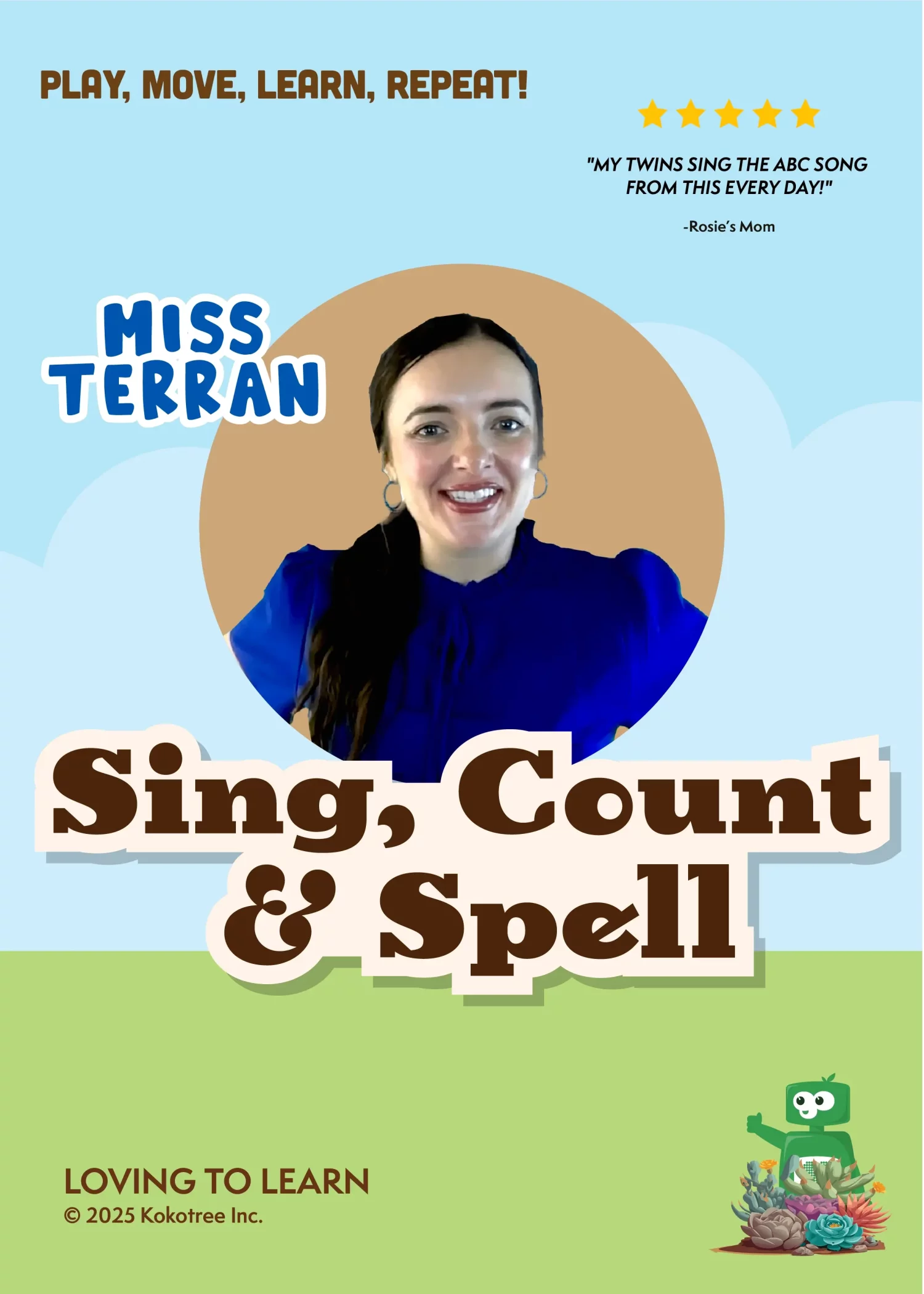
What's Sing, Count & Spell About?
Your little one joins Miss Taryn for an energetic journey through the alphabet and early counting—complete with animal friends who hop, stomp, and wiggle alongside them! They'll practice letter sounds, connect numbers to movement, and build the foundation for reading and math.
6.5 minutes
Ages 1-6
Skill: Letter recognition, phonics, and counting 1-5
Your kid watches letters come alive with sounds and movement. You get 6 minutes to finish that coffee.
Miss Taryn introduces letters A through K, showing each letter with a familiar object (apple, ball, cat) and breaking down the sounds. Then the counting fun begins—numbers 1-5 paired with actions like clapping, stomping, and jumping. Friendly Kokotree animals like Eddie the Elephant and Ruby Rabbit pop in to join the movement fun.
What your child learns:
This video builds essential pre-reading skills by connecting letters to their sounds and real objects. The counting section strengthens number recognition while the movement activities help cement learning through physical engagement.
- Letter recognition for A through K
- Beginning phonics sounds ("B-b-b-ball")
- Counting 1-5 with one-to-one correspondence
- Following multi-step directions ("Jump three times")
- Connecting abstract concepts to physical movement
They'll use these skills when:
- Spotting the letter "A" on a stop sign or cereal box
- Counting crackers on their plate at snack time
- Recognizing the first letter of their own name
- Following directions like "clap two times" during playtime
The Story (what keeps them watching)
Miss Taryn takes little learners on a fast-paced alphabet adventure, introducing each letter with its sound and a familiar word. "A is for apple—ah, ah, ah, apple!" Kids get silly surprises like a hat magically appearing and ice that needs jumping to melt. Then the Kokotree animal friends arrive! Eddie the Elephant stomps for number two, Kango the Kangaroo hops for three, and Ruby Rabbit spins for four. The combination of movement breaks and friendly faces keeps wiggly toddlers engaged while sneaking in serious learning.
How We Teach It (the clever part)
- First 3 minutes: Letters A-K are introduced one by one, each paired with a word, the isolated sound, and visual reinforcement. Kids hear the sound broken down ("C-c-c-cat") and practice saying it.
- Minutes 3-5: Numbers 1-5 appear with corresponding actions—one clap, two stomps, three jumps. Each number gets physical practice so kids feel the quantity in their bodies.
- Final 1.5 minutes: Animal characters reinforce each number while kids wiggle, spin, and celebrate their learning with positive encouragement.
Teaching trick: Every letter sound is stretched out and repeated ("F-f-f-flower") so kids can isolate the beginning sound—this phonemic awareness is the #1 predictor of reading success.
After Watching: Quick Wins to Reinforce Learning
- Mealtime activity: "Can you find something on your plate that starts with the 'B' sound?" (Practices connecting letter sounds to real objects—bread, banana, beans)
- Car/travel activity: "Let's count the red cars we see—one, two, three!" (Reinforces counting with one-to-one correspondence in a real-world context)
- Bedtime activity: "Let's stomp like Eddie the Elephant—how many stomps should we do?" (Connects numbers to movement, great for burning off last bits of energy)
- Anytime activity: "What sound does your name start with? Is it like 'D-d-d-dog' or 'C-c-c-cat'?" (Personalizes phonics learning and builds letter-sound awareness)
When Kids Get Stuck. And How to Help.
- "My child just wants to do the movements, not say the letters." - That's actually perfect! Movement helps cement learning in young brains. Keep practicing the actions and casually say the letters/numbers yourself. They're absorbing more than you think.
- "She mixes up similar letters like B and D." - Totally normal until age 6-7! Focus on the sounds rather than perfect letter recognition. When she hears "B-b-b-ball," she's building phonics skills that matter more than visual letter ID right now.
- "He can only count to three consistently." - Counting is a gradual skill! Celebrate the numbers he knows and keep practicing. Rewatch the video focusing just on 1-3, then add 4-5 when he's ready.
What Your Child Will Learn
Prerequisites and Building Blocks
This video is ideal for children just beginning their literacy and numeracy journey—no prior letter or number knowledge required. It builds on basic listening skills and the ability to imitate sounds and movements. "Sing, Count & Spell" serves as a foundational introduction that prepares children for more advanced phonics work (blending sounds) and counting beyond five. It connects naturally to other Kokotree videos focusing on individual letter deep-dives or extended counting sequences.
Cognitive Development and Teaching Methodology
The multi-sensory approach addresses how toddlers and preschoolers actually learn—through repetition, movement, and play. By pairing abstract symbols (letters and numbers) with concrete actions (jumping, clapping) and familiar objects (apple, ball), the video leverages embodied cognition. Visual learners see the letters; auditory learners hear the sounds repeated; kinesthetic learners move their bodies. This whole-child approach aligns with developmentally appropriate practice for ages 1-6.
Alignment with Educational Standards
This video addresses multiple kindergarten readiness indicators including: recognizing and naming upper-case letters (CCSS.ELA-LITERACY.RF.K.1.D), isolating initial sounds in words (CCSS.ELA-LITERACY.RF.K.2.D), and counting to 5 with one-to-one correspondence (CCSS.MATH.CONTENT.K.CC.B.4). Teachers expect incoming kindergarteners to recognize most letters and count objects to 10—this video builds those exact foundations in an age-appropriate, engaging format.
Extended Learning Opportunities
Pair this video with Kokotree's letter tracing activities for tactile reinforcement. The counting section connects to number recognition games in the app. Extend learning with a simple "letter hunt" around your home—find three things that start with "B." Create a counting jar with small objects for daily practice. Print simple dot-to-dot worksheets (1-5) to reinforce number sequence. The movement activities can become a daily routine: "Let's do our Kango jumps!"
Transcript Highlights
- Phonics instruction: "B is for ball. B-b-b-ball. B-all. B." (Isolates the initial sound, stretches it, then segments the word)
- Interactive engagement: "Say hat and a hat will appear on my head. Ready? Hat. Yay, how silly." (Creates cause-and-effect motivation for speaking)
- Movement integration: "Let's jump three times. Ready? Jump, jump, jump. Stop." (Pairs quantity with physical action)
- Positive reinforcement: "Wow, you did such a great job today. You counted all the way to five. I'm so proud of you." (Celebrates achievement)
Character Development and Story Arc
The Kokotree animal friends model enthusiastic participation in learning. Eddie the Elephant demonstrates that even big creatures practice counting. Kango the Kangaroo shows that movement and learning go together naturally. Ruby Rabbit brings joy to number practice through spinning. Each character appears briefly but memorably, showing children that learning is a shared, fun experience. Miss Taryn models patience, encouragement, and genuine excitement about each small success.
Phonemic Awareness and Early Numeracy Deep Dive
This video targets two foundational pillars of early education: phonemic awareness and number sense. The phonics instruction uses a research-backed technique called "sound stretching"—elongating the initial consonant sound ("F-f-f-flower") helps children isolate and identify the phoneme. This skill is the strongest predictor of future reading success, more important than letter naming alone. By connecting each sound to a concrete, familiar object, children build the mental hooks needed for later decoding.
The counting section employs "one-to-one correspondence"—matching one number word to one action. When children clap once for "one" and stomp twice for "two," they're internalizing that numbers represent actual quantities, not just a memorized sequence. This cardinality principle is essential for all future math learning.
The movement integration serves a dual purpose: it maintains engagement for young attention spans AND activates the motor cortex, which research shows strengthens memory formation. When a child's body "knows" that three means three jumps, the concept becomes embodied knowledge rather than abstract information. The strategic use of animal characters at each number creates memorable anchors—children often remember "Eddie stomps two times" long after the video ends, giving them a mental reference point for the number two.