
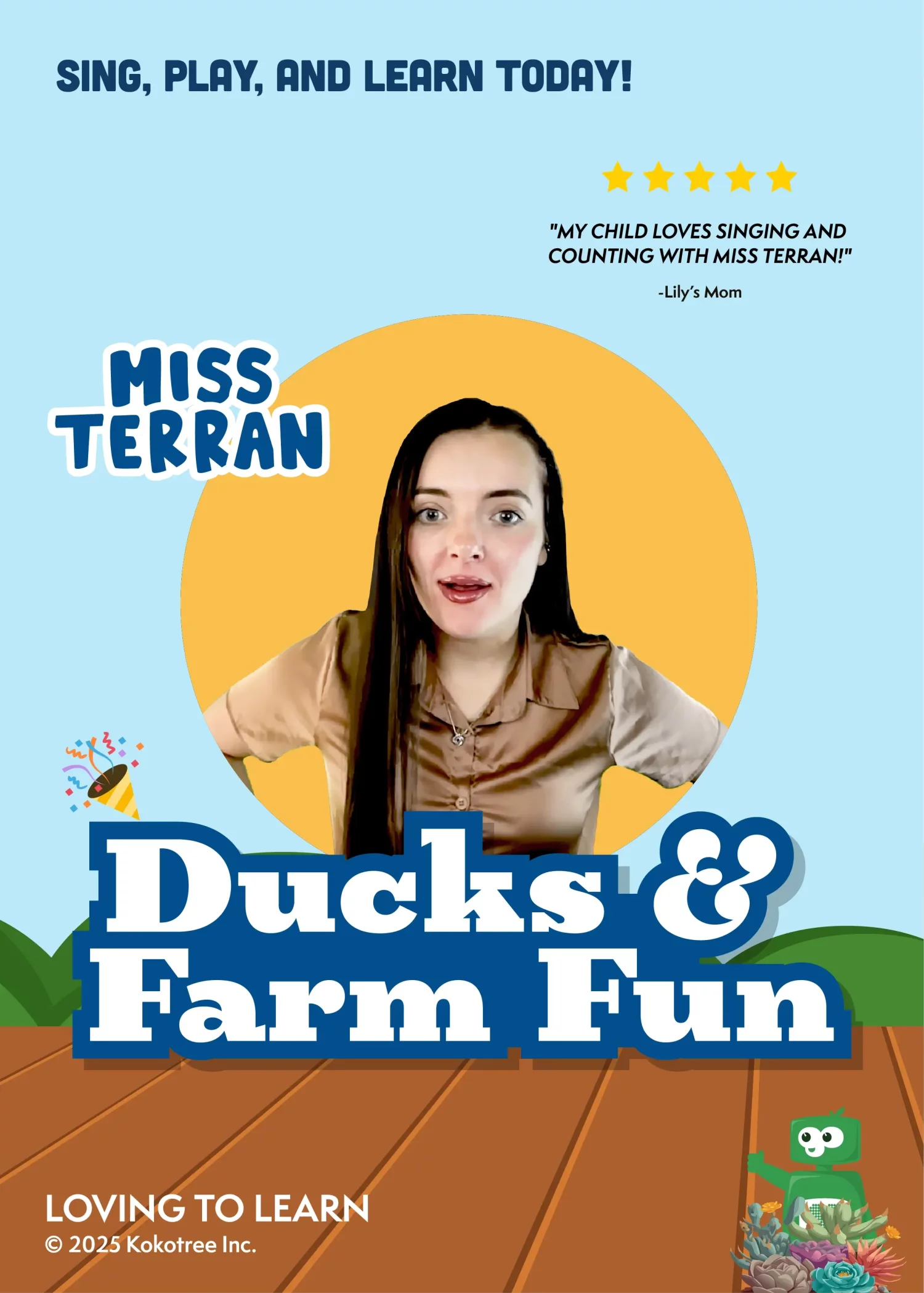
What's Ducks and Farm Fun About?
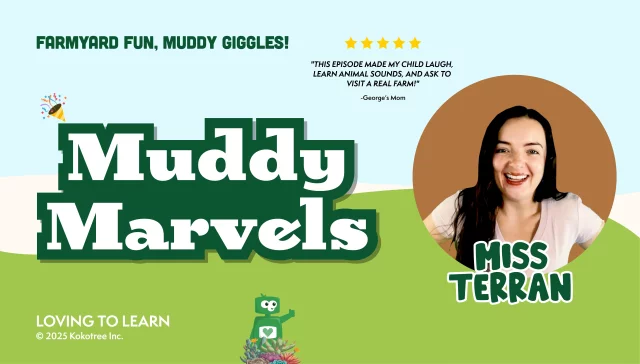
Your little farmer joins Miss Taryn for a counting song with five little ducks, then explores a cheerful farm meeting animals and mimicking their sounds and movements. After watching, they'll count backwards, identify farm animals, and proudly demonstrate animal sounds!
4 minutes
Ages 1-6
Skill: Counting & Animal Recognition
Your kid watches ducks waddle away while learning to count backwards. You get 4 minutes to [finish your coffee/fold laundry/breathe].
The video opens with a beloved counting song featuring five little ducks going over the hills, with one fewer returning each verse. Then Miss Taryn takes your child on a virtual farm tour, introducing sheep, pigs, ducks, bees, and cows—complete with their signature sounds and fun movement breaks like flapping and buzzing.
What your child learns:
This video builds early math skills through countdown practice while expanding vocabulary with farm animal names. Your child also develops listening skills by matching animals to their sounds and gets wiggles out with simple movement activities.
- Counting backwards from 5 to 1 (foundational subtraction concept)
- Identifying 5 farm animals by sight and name
- Matching animals to their sounds (sheep says "baa," cow says "moo")
- Following simple movement instructions (flap, hop, buzz)
- Vocabulary building with animal-related words
They'll use these skills when:
- Counting down fingers before jumping off the last step
- Pointing out cows and sheep during car rides past farms
- Playing pretend farm with stuffed animals or toys
- Reading picture books and naming animals they recognize
The Story (what keeps them watching)
Miss Taryn spots five little ducks and invites your child to count them together before launching into the classic "Five Little Ducks" song. Each verse, one duck disappears over the hills—building suspense! Where did they go? Relief arrives when all five return safely. Then the adventure shifts to a muddy, silly farm tour where your child meets a fluffy sheep, a pink snorting pig, splashing ducks, buzzing bees, and a gentle mooing cow. Movement breaks keep little bodies engaged, and Miss Taryn celebrates their learning with a cheerful "moo you later!"
How We Teach It (the clever part)
- First 2 minutes: Counting is introduced through the familiar "Five Little Ducks" song, where each verse removes one duck—making subtraction concrete and visual. Children count along as the number decreases.
- Minutes 2-3: Farm animals are introduced one at a time with clear naming, sound identification, and movement activities. Each animal gets its own moment, preventing overwhelm.
- Final minute: Learning is celebrated with a recap of what they accomplished, plus encouragement to use their new knowledge in the real world.
Teaching trick: The video pairs each animal with a distinct sound AND a physical movement (flapping like ducks, buzzing like bees). This multi-sensory approach helps the brain create stronger memory connections—your child literally embodies what they're learning!
After Watching: Quick Wins to Reinforce Learning
- Mealtime activity: "Can you count your chicken nuggets backwards like the ducks?" Start with however many pieces they have and count down as they eat. Delicious subtraction practice!
- Car/travel activity: "Let's play animal sounds! I'll make a sound, you guess the animal." Try moo, baa, oink, quack, and buzz. Switch roles and let them stump you.
- Bedtime activity: "How many stuffed animals are on your bed? Let's count them, then take one away. How many now?" Gentle countdown practice that winds down energy.
- Anytime activity: "Can you flap like a duck three times? Now buzz like a bee!" Quick movement breaks that reinforce the video's animals while burning energy.
When Kids Get Stuck. And How to Help.
- "My child can count up but gets confused counting backwards." Totally normal! Backwards counting is actually harder for developing brains. Use fingers as visual aids—hold up 5, then fold one down for each number. Physical props make abstract concepts click.
- "They mix up the animal sounds." No worries—that's part of learning! Focus on just two animals at a time. "Does the cow say moo or baa?" Making it a silly guessing game removes pressure and builds confidence.
- "My toddler just wants to watch, not participate." That's learning too! Young children often absorb passively before actively participating. Keep watching together, and one day they'll surprise you by quacking along. No pressure needed.
What Your Child Will Learn
Prerequisites and Building Blocks
This video works best for children who can recognize quantities up to 5 and have basic exposure to counting forward. It builds on number recognition concepts and introduces the more complex skill of counting backwards—a precursor to subtraction. Children who've watched basic counting videos will find this a natural next step. The farm animal segment requires no prerequisites and serves as vocabulary expansion, making this video accessible to a wide developmental range.
Cognitive Development and Teaching Methodology
The teaching approach leverages procedural memory through song repetition and kinesthetic learning through movement activities. The countdown structure in "Five Little Ducks" makes subtraction tangible—children see quantity decrease with each verse. Multi-sensory engagement (hearing sounds, saying words, moving bodies) addresses visual, auditory, and kinesthetic learners simultaneously. The pacing allows processing time between new concepts, respecting the 1-6 age group's attention and working memory limitations.
Alignment with Educational Standards
This video supports Common Core Math standards for Counting and Cardinality (K.CC.A.1 - count to 100 by ones) and builds toward understanding subtraction as "taking away." It aligns with Head Start Early Learning Outcomes for Mathematics and Science Exploration. Kindergarten readiness indicators include counting objects, understanding that numbers represent quantities, and expanding vocabulary—all addressed here. The animal identification supports early science standards for living things.
Extended Learning Opportunities
Pair this video with printable farm animal flashcards for matching games. The Kokotree app's counting games reinforce backwards counting with interactive challenges. Parents can extend learning with a "farm sounds" scavenger hunt during outdoor walks—listening for birds (similar to animal sound identification). Simple subtraction with snacks ("You have 5 crackers, eat 1, how many now?") bridges screen learning to real-world math application.
Transcript Highlights
- "One, two, three, four, five." - Clear, paced counting establishes the starting quantity before the countdown begins.
- "Can you say sheep? Sheep! And what do sheep say? Baa, baa!" - Call-and-response technique invites active participation and reinforces vocabulary.
- "Let's all flap like ducks three times. Ready? Flap, flap, flap." - Movement integration keeps bodies engaged while reinforcing the animal concept.
- "You learned new animals, their silly sounds, and even got to hop, flap and buzz." - Explicit learning summary helps children recognize their own accomplishments.
Character Development and Story Arc
Miss Taryn models enthusiastic curiosity and celebrates effort throughout the video. Her warm greeting establishes connection, and her excitement about each animal demonstrates that learning is joyful. When the ducks disappear, she wonders aloud "Where do you think they went?"—modeling curiosity and inviting children to think critically. Her closing message "be proud of who you are" reinforces growth mindset, while "moo you later" adds playful humor that makes learning feel like an adventure rather than a lesson.
Early Numeracy and Animal Science Deep Dive
Counting backwards represents a significant cognitive leap for young children. While forward counting follows a memorized sequence, backwards counting requires understanding that numbers represent quantities that can increase or decrease. The "Five Little Ducks" song makes this abstract concept concrete—children watch the group shrink visually while hearing the number decrease verbally. This dual-coding (visual + auditory) creates stronger neural pathways for mathematical understanding.
The song structure also introduces the concept of one-to-one correspondence in reverse. Each verse, exactly one duck leaves, and the total decreases by exactly one. This precision matters for later subtraction skills. Research shows that children who understand "one less" through concrete examples transition more smoothly to formal subtraction in kindergarten.
The farm animal segment builds scientific classification skills at an age-appropriate level. Children learn to categorize animals by observable characteristics (the fluffy sheep, the muddy pig) and by sounds they produce. This is early taxonomy—sorting living things by attributes. The movement activities (flapping, buzzing) add proprioceptive learning, where children's bodies help encode information. When a child physically flaps while learning "duck," they're creating a motor memory that reinforces the verbal label.
Sound discrimination—distinguishing "moo" from "baa" from "oink"—develops auditory processing skills that transfer to phonemic awareness, a critical pre-reading skill. Children who can hear differences between animal sounds are practicing the same auditory discrimination they'll need to hear differences between letter sounds.