
What's Farm Animals About?
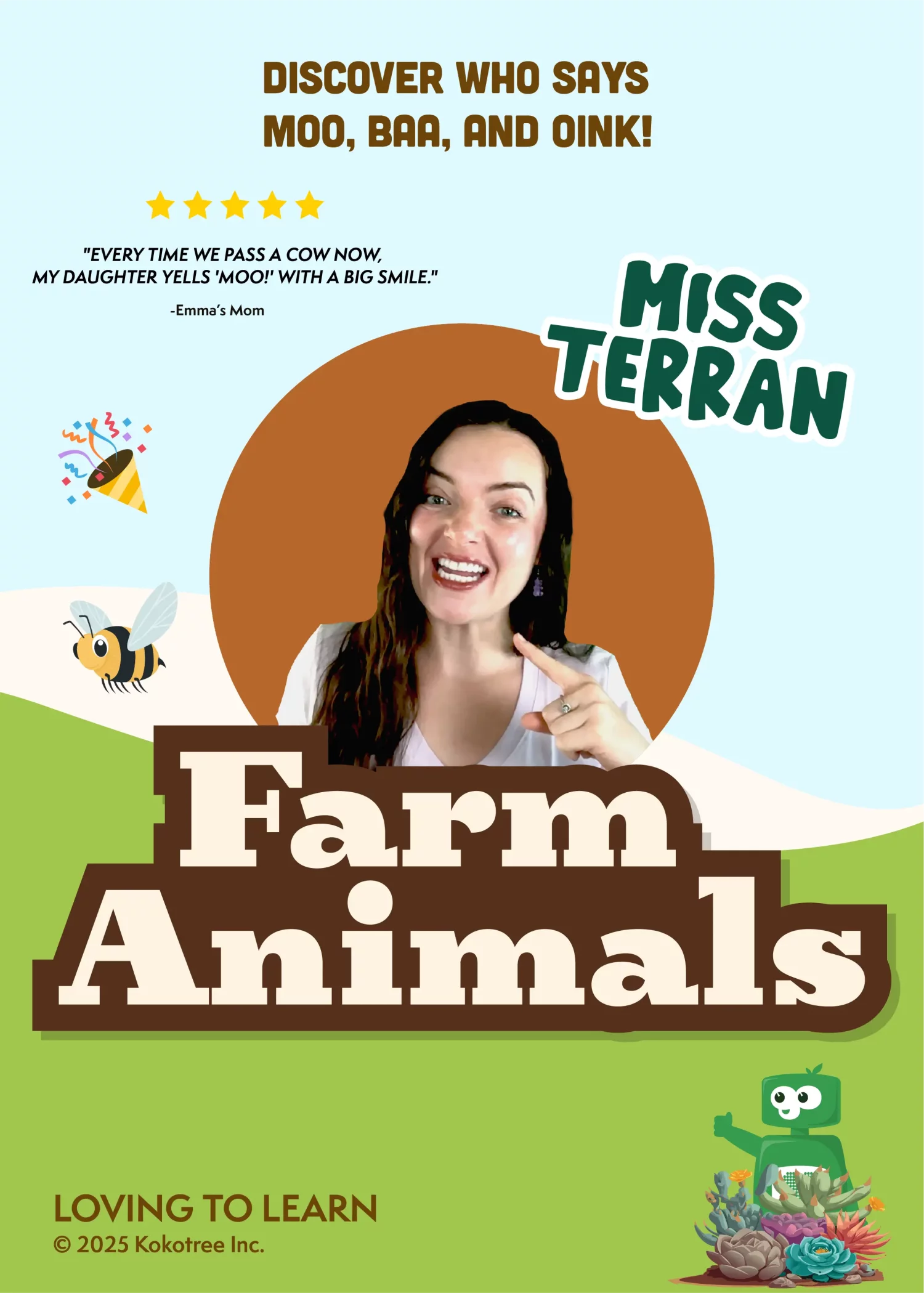
Your little one becomes a junior farmer, learning to identify animals by sight and sound while hopping, flapping, and buzzing along! After watching, they'll recognize farm animals everywhere and confidently make their sounds.
6 minutes
Ages 1-6
Skill: Animal identification, sounds, and movement
Your kid watches Miss Terran introduce 10 farm animals with sounds and movements. You get 6 minutes to [finish that coffee/fold laundry/breathe].
Miss Terran visits a colorful farm where friendly animals pop up one by one. Each animal gets its own introduction with its name displayed on screen, its signature sound, and a fun movement for kids to copy. The video ends with a catchy song that reviews all the animals together.
What your child learns:
This video builds vocabulary, listening skills, and body awareness through active participation. Children learn to connect animal names with their appearances and sounds—a foundational categorization skill.
- Identifies 10 farm animals by name (sheep, pig, duck, bee, cow, horse, rooster, chicken, mouse, frog, owl)
- Matches each animal to its correct sound (moo, oink, quack, buzz, etc.)
- Follows movement instructions (galloping, hopping, flapping)
- Recognizes written animal words on screen
- Understands basic animal facts (bees make honey from flower nectar)
They'll use these skills when:
- Visiting a petting zoo or farm and naming animals they see
- Reading picture books about animals and making the sounds
- Playing pretend farm with toy animals
- Pointing out animals during car rides ("Look, cows! Moooo!")
The Story (what keeps them watching)
Miss Terran arrives at a cheerful farm and invites kids to meet all the animals living there. Starting with the classic "Old MacDonald" song, she introduces each animal one by one—from fluffy sheep to squeaky mice to wise owls. Kids aren't just watching; they're flapping like ducks, galloping like horses, and hopping like frogs. The adventure builds to a fun barn dance song where all the animals celebrate together, reinforcing every name and sound learned. It's active, silly, and surprisingly educational!
How We Teach It (the clever part)
- First 2 minutes: Miss Terran sets the farm scene with "Old MacDonald" and introduces the first animals (sheep, pig, duck), pairing each with its written name, sound, and a movement cue.
- Minutes 2-4: More animals join the fun (bee, cow, horse, rooster, chicken, mouse, frog, owl), each with unique sounds and interesting facts like "bees make honey from flowers."
- Final 2 minutes: A comprehensive review flashes all animals with their sounds, followed by an original song that reinforces learning through music and a celebratory barn dance.
Teaching trick: Every animal introduction follows the same pattern—see it, say its name, hear its sound, move like it. This multi-sensory repetition (visual + auditory + kinesthetic) helps the learning stick without feeling repetitive.
After Watching: Quick Wins to Reinforce Learning
- Mealtime activity: "What animal says the sound I make?" Make animal sounds and let your child guess which farm friend you are. They practice recall and listening skills.
- Car/travel activity: "Farm animal I-spy!" When you spot cows, horses, or birds outside, ask "What does that animal say?" Real-world connections cement learning.
- Bedtime activity: "Goodnight, farm!" Name each animal from the video and whisper its sound together as a calming review. "Goodnight cow... moooo."
- Anytime activity: "Move like a..." Call out an animal and have your child move like it—gallop like a horse, hop like a frog, flap like a duck. Great for burning energy AND learning!
When Kids Get Stuck. And How to Help.
- "My child mixes up similar animals like sheep and cow." Totally normal! Focus on one obvious difference: "Sheep are fluffy and small, cows are big with spots." Comparing two at a time is easier than remembering all ten.
- "They can make the sounds but can't remember the animal names." Sounds come first developmentally—that's progress! Keep using the names yourself: "Yes, that's the moo sound! That's a cow." Names will click with repetition.
- "My toddler just wants to watch the song part over and over." Perfect! The song reviews ALL the animals. Repetition is exactly how little brains learn. Let them replay it—they're studying.
What Your Child Will Learn
Prerequisites and Building Blocks
This video works beautifully as an introduction to animal vocabulary—no prior knowledge needed! Children who have basic attention skills (can watch for 2-3 minutes) are ready. It builds on any previous exposure to animals in books or real life and connects to future learning about animal habitats, life cycles, and classification. This foundational vocabulary supports later science concepts and reading comprehension when farm animals appear in stories.
Cognitive Development and Teaching Methodology
The multi-sensory approach (see-say-hear-move) aligns perfectly with how toddlers and preschoolers process new information. At ages 1-6, children learn through whole-body engagement, not passive observation. The consistent introduction pattern (name → sound → movement) creates predictable structure that reduces cognitive load while building confidence. Visual word display introduces early literacy concepts through incidental exposure.
Alignment with Educational Standards
This video supports kindergarten readiness standards for science (identifying living things and their characteristics) and language development (vocabulary acquisition, following multi-step directions). It aligns with early learning benchmarks for categorization skills and auditory discrimination. Teachers expect incoming kindergarteners to identify common animals—this video covers that comprehensively.
Extended Learning Opportunities
Pair this video with Kokotree's animal sorting games and sound-matching activities in the app. Print simple farm animal coloring pages for quiet reinforcement. Create a "farm sounds" guessing game at home. Visit a local farm or petting zoo to see these animals in person. Read picture books featuring farm settings to extend vocabulary in new contexts.
Transcript Highlights
- "Bees do so much hard work collecting nectar from these flowers and making honey for us!" — Introduces cause-and-effect thinking and appreciation for nature.
- "Let's gallop like horses—gallop, gallop, gallop!" — Kinesthetic learning invitation that builds gross motor skills alongside vocabulary.
- "Shhh… who's that teeny tiny one in the hay? It's a MOUSE!" — Models curiosity and observation skills through dramatic discovery.
- "Next time you see a cow or a duck—say hi and remember what they say!" — Explicitly connects screen learning to real-world application.
Character Development and Story Arc
Miss Terran models enthusiastic curiosity throughout the video, showing children that learning is exciting and fun. She demonstrates active listening ("Hmm... what's that sound?"), encourages participation without pressure, and celebrates discoveries with genuine joy. Her silly sound effects and movements give children permission to be playful learners. The progression from individual animals to group song models how individual knowledge combines into bigger understanding.
Animal Vocabulary and Early Science Concepts Deep Dive
Learning animal names and sounds is far more than memorization—it's foundational categorization that builds the brain's filing system for all future learning. When children learn that "cow" is a large animal that says "moo" and eats grass, they're creating mental categories (farm animals, large animals, plant-eaters) that will later help them understand ecosystems, food chains, and biological classification.
The video introduces 10 animals strategically: familiar ones first (sheep, pig, duck) build confidence before introducing less common vocabulary (rooster, owl). Each animal comes with multiple data points—appearance, sound, movement, and sometimes function (bees make honey). This layered information creates rich mental representations rather than shallow word-picture associations.
The movement component isn't just for fun—it activates the cerebellum and motor cortex, creating additional neural pathways to the vocabulary being learned. Research shows that words learned with accompanying movements are retained significantly better than words learned passively. When your child gallops while learning "horse," they're literally building stronger memory traces.
Sound discrimination (distinguishing "moo" from "baa" from "oink") develops the same auditory processing skills needed for phonics. Children who can hear the difference between animal sounds are practicing the same listening precision they'll need to distinguish "bat" from "pat" when learning to read. This video is secretly pre-reading practice disguised as farm fun!
The inclusion of "bee" introduces basic pollination concepts (bees visit flowers, make honey) at an age-appropriate level—planting seeds for future STEAM learning about ecosystems and interdependence.