
What's Bubble Gum & Monkeys! About?
Your child will bounce, wiggle, and sing their way through action words and body parts—then practice counting backwards from five with some very silly monkeys! By the end, they'll be following directions like a pro and pointing to body parts on command.
7+ minutes
Ages 1-5
Skills: Action Words, Body Parts, Counting
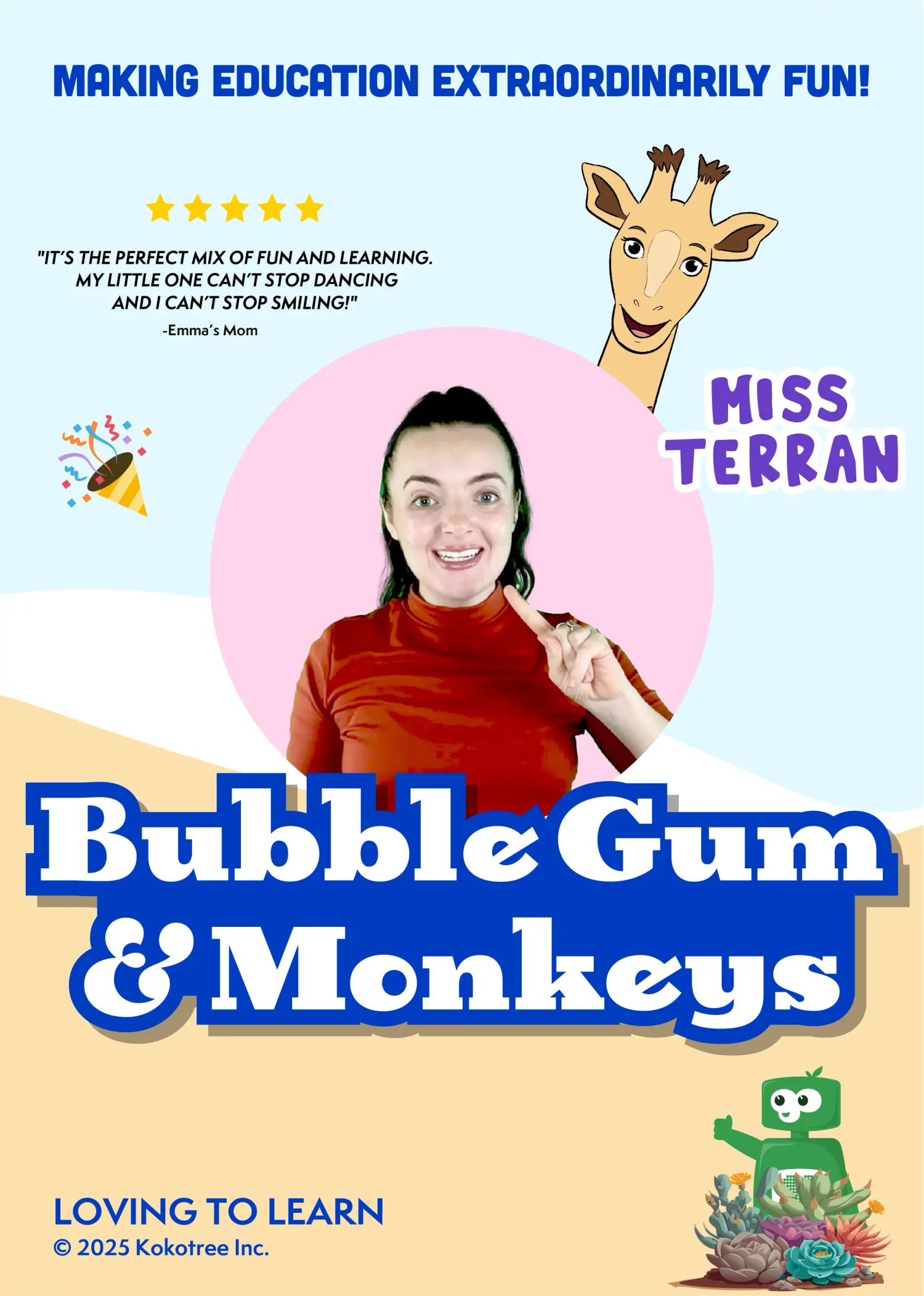
Your kid watches Miss Terran dance, sing, and get hilariously sticky. You get 7 minutes to finish that coffee.
Miss Terran introduces four action words—come, go, sit, and stand—with big movements and friendly animal friends like Eddie Elephant and Bobby Bear. Then things get silly with a sticky bubble gum song that names body parts from hands to head to knees. The video wraps up with a beloved counting song featuring bouncing monkeys.
What your child learns:
This video builds vocabulary through movement, helping kids connect words to actions they can do with their own bodies. The repetition and music make new words stick—just like that bubble gum!
- Action word comprehension (come, go, sit, stand)
- Following simple verbal directions
- Body part identification (hands, head, eyes, ears, shoulders, knees, mouth)
- Counting backwards from 5 to 0
- Gross motor coordination through dance movements
They'll use these skills when:
- Following instructions at home ("Come here, please!" actually works)
- Playing Simon Says or other direction-following games
- Getting dressed and naming body parts ("Put your arms through!")
- Counting toys during cleanup or snacks at the table
The Story (what keeps them watching)
Miss Terran welcomes little learners with wiggles and introduces four action words with help from Eddie Elephant, a zooming toy car, Bobby Bear, and a tall giraffe. Each animal friend demonstrates the word in action! Then—uh oh—Miss Terran gets imaginary bubble gum stuck everywhere, and kids help her "pull" it off each body part through song. The grand finale features five mischievous monkeys bouncing on a bed until they're all tucked in and sleeping. It's silly, active, and perfectly paced for tiny attention spans.
How We Teach It (the clever part)
First 2 minutes: Each action word (come, go, sit, stand) is introduced one at a time with clear demonstrations, pauses for kids to repeat, and animated animal friends modeling the action. Words appear on screen for early print awareness.
Minutes 2-5: The bubble gum song layers body part vocabulary through repetitive lyrics and physical movement. Each body part word appears on screen with matching images, reinforcing word-picture connections.
Final 2 minutes: The monkey counting song practices backwards counting (5 to 0) with visual number displays and one-by-one subtraction as each monkey disappears. Ends with a calm, cozy goodbye.
Teaching trick: Every new word appears on screen exactly when Miss Terran says it, while an animated character demonstrates the meaning—so kids see, hear, AND understand simultaneously.
After Watching: Quick Wins to Reinforce Learning
Mealtime activity: "Can you COME to the table? Now SIT in your chair!" Practice the four action words naturally during meal transitions. Kids love showing off what they just learned!
Car/travel activity: "Where's your nose? Where are your knees?" Play a quick body parts pointing game using the same parts from the bubble gum song. No props needed!
Bedtime activity: Count stuffed animals or fingers backwards from 5 to 0, just like the monkeys. Then tuck them in "sleeping instead"—a perfect wind-down routine.
Anytime activity: Play "Sticky Bubble Gum" anywhere! Pretend gum is stuck to different body parts and let your child "pull" it off. Silly giggles guaranteed while reinforcing vocabulary.
When Kids Get Stuck. And How to Help.
"My child just watches but won't do the movements." Totally normal! Many kids need several viewings before joining in. They're still learning by watching. Try doing the movements yourself nearby—monkey see, monkey do!
"She mixes up 'come' and 'go' constantly." These are genuinely tricky opposites! Practice with a favorite toy: "Make teddy COME to you... now make teddy GO away." Physical practice with objects helps it click.
"Counting backwards seems too hard for my toddler." Backwards counting develops later than forward counting—that's expected! Focus on enjoying the song and let the number recognition build naturally. Even just recognizing "5 is a lot, 0 is none" is a win.
What Your Child Will Learn
Prerequisites and Building Blocks
This video works beautifully as an introduction to action words and doesn't require prior vocabulary knowledge. Children who have basic receptive language skills (understanding simple words) will get the most from the direction-following segments. It pairs well with other movement-based videos in the Kokotree library and builds a foundation for more complex instruction-following later. The counting segment assumes no prior number knowledge—visual supports help complete beginners.
Cognitive Development and Teaching Methodology
The multi-sensory approach here is developmentally perfect for ages 1-5. Toddlers and preschoolers learn best through whole-body movement (kinesthetic learning), which is why every vocabulary word includes a physical action. The pause-and-repeat structure supports language development, while on-screen text introduces print awareness for pre-readers. Repetitive song structures leverage how young brains encode information through pattern and melody.
Alignment with Educational Standards
This video addresses multiple kindergarten readiness indicators: following two-step directions, identifying body parts, and demonstrating one-to-one correspondence in counting. It aligns with early learning standards for receptive/expressive language development and gross motor skills. The action word vocabulary directly supports the kind of classroom direction-following teachers expect from incoming kindergarteners.
Extended Learning Opportunities
Pair this video with printable body part labeling worksheets or a "Simon Says" game guide available in the Kokotree app. The counting segment connects to other number videos in the library. For extended play, create a simple "action word" obstacle course at home: run TO the couch (come), run AWAY from the door (go), SIT on a pillow, STAND by the window. Physical repetition cements learning.
Transcript Highlights
- "Come means—move toward me! Like this!" (Clear definition paired with demonstration)
- "Go means—move away, like this!" (Opposite concept introduced with contrasting movement)
- "Sitting means we rest our legs like this… Sit! Sit! Sit down like a teddy bear!" (Relatable comparison helps comprehension)
- "Stand like a tall giraffe! Stand straight and proud!" (Vivid imagery supports word meaning)
Character Development and Story Arc
Eddie Elephant, Bobby Bear, and the giraffe friend each model the target behavior perfectly—they "come" when called, "sit" when it's time to rest, and "stand" tall when asked. This peer modeling is powerful for young learners who naturally imitate. The monkeys in the counting song demonstrate cause-and-effect (jumping leads to falling) and the resolution shows them peacefully sleeping—modeling how active play transitions to rest time.
Language Development Deep Dive: Action Words and Body Part Vocabulary
Action words (verbs) are foundational to language development because they allow children to communicate needs and understand instructions. The four words in this video—come, go, sit, stand—are among the earliest and most useful verbs in a child's vocabulary. Research shows that children typically understand action words before they can produce them, which is why the video emphasizes receptive practice ("Can you say it?") alongside physical demonstration.
The body part vocabulary segment leverages a powerful learning technique: embodied cognition. When children touch their own head while hearing "head," they create stronger neural connections than hearing the word alone. The sticky bubble gum premise adds emotional engagement (silly = memorable) and gives children a reason to repeat the action multiple times.
Backwards counting (5 to 0) introduces the concept of subtraction in its most concrete form—one less each time. The visual of monkeys disappearing one by one provides the concrete-to-abstract bridge that young mathematicians need. Children may not understand "5 minus 1 equals 4" yet, but they absolutely understand "one monkey fell off, now there are fewer monkeys." This conceptual foundation supports formal math instruction later.
The combination of movement, music, and visual supports means this video reaches children across different learning preferences and developmental stages—making it effective for the wide 1-5 age range.