
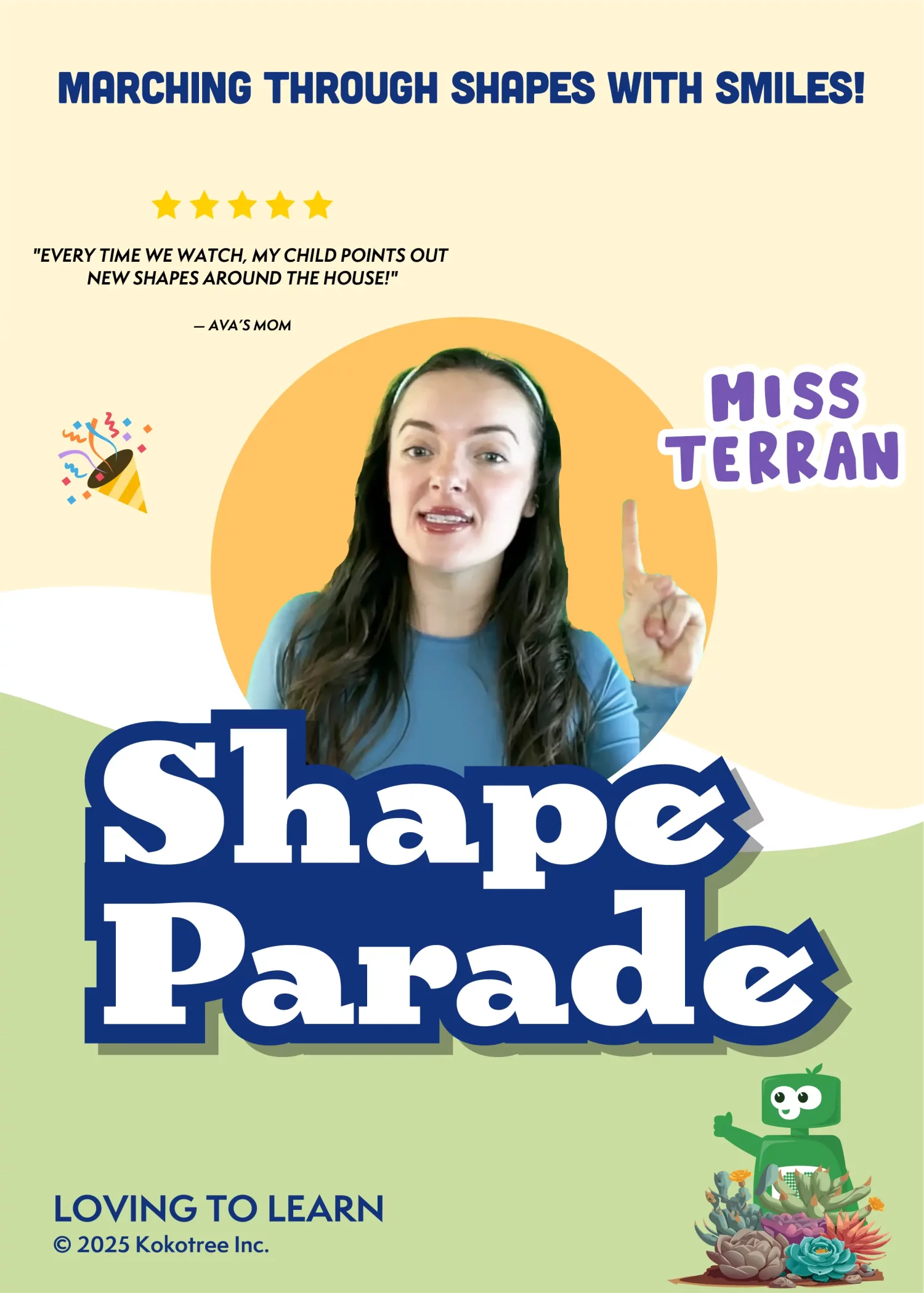
What's Shape Parade About?
Your little one joins Miss Taryn for an interactive journey through circles and colors, complete with catchy songs that make learning stick! After watching, they'll proudly point out round shapes and name colors during everyday moments.
3 minutes
Ages 1-4
Skill: Shape and color recognition
Your kid watches circles spin and colors pop on screen. You get 3 minutes to finish that cup of coffee.
Miss Taryn introduces circles by showing things that roll—bicycle wheels and school bus tires spin across the screen. Then the video transitions into a colorful world where green, yellow, red, and blue come alive through familiar objects like grass, sunshine, apples, and sky.
What your child learns:
This video builds foundational visual recognition skills that prepare children for reading and math. Through songs and real-world examples, kids connect abstract shapes and colors to objects they see every day.
- Identifies circles as round shapes with no corners
- Connects circles to real objects (wheels, balls)
- Names four primary colors: green, yellow, red, blue
- Associates colors with familiar objects (grass, sun, apples, sky)
- Practices verbal repetition through interactive prompts
They'll use these skills when:
- Sorting toys by color during cleanup time
- Spotting wheels on cars, bikes, and strollers during walks
- Choosing colored crayons for drawing
- Playing with shape sorters and puzzles
The Story (what keeps them watching)
Miss Taryn kicks things off with a friendly greeting and gets kids excited about shapes. First up: the circle! She explains it's round with no corners, then asks kids to think about wheels. Bicycles have them. School buses have them. And what do wheels do? They go round and round! Cue the beloved "Wheels on the Bus" song. Then the adventure shifts to colors—green, yellow, red, and blue each get their moment to shine with a catchy original song connecting each color to something kids know and love.
How We Teach It (the clever part)
- First minute: Miss Taryn introduces circles using clear, simple language ("round, no corners") and immediately connects to familiar objects kids can picture.
- Minutes 1-2: The classic "Wheels on the Bus" reinforces the circle concept through movement and music—repetition that sticks!
- Final minute: Colors are introduced one by one, then woven into an original song with vivid imagery (grass, sun, apples, sky) that creates lasting mental connections.
Teaching trick: Each concept gets paired with something tangible kids already know. Circles aren't just shapes—they're the wheels on their favorite vehicles. Blue isn't just a color—it's the sky they see every day. This anchoring technique helps abstract concepts click.
After Watching: Quick Wins to Reinforce Learning
- Mealtime activity: "Can you find something round on your plate?" (Kids practice identifying circles in food—cheerios, orange slices, the plate itself!)
- Car/travel activity: "Let's count how many wheels we see on other cars!" (Reinforces circles in motion while keeping little ones engaged during drives)
- Bedtime activity: "What color is your blanket? Your pillow?" (Quick color identification practice that winds down into cozy conversation)
- Anytime activity: "Point to something green like grass!" (Turns any room into a color scavenger hunt using the song's examples)
When Kids Get Stuck. And How to Help.
- "My child just watches but won't repeat the words." - Totally normal! Receptive language (understanding) develops before expressive language (speaking). Keep watching together and they'll surprise you one day with "CIRCLE!" out of nowhere.
- "They mix up colors constantly." - Color recognition takes time and lots of repetition. Focus on one color at a time during daily activities: "Let's find ALL the red things today!" Mastery typically happens between ages 3-4.
- "Circles seem too easy—should we skip ahead?" - Circles are the foundation for recognizing more complex shapes later. Plus, finding circles in unexpected places (clock faces, buttons, coins) builds observation skills that transfer to reading and math.
What Your Child Will Learn
Prerequisites and Building Blocks
This video is perfect for early learners with no prior shape knowledge required. It builds on natural curiosity about everyday objects and serves as an introduction to the Kokotree shape curriculum. Children who can focus on short videos and respond to simple questions are ready. This lesson creates the foundation for learning squares, triangles, and eventually comparing and sorting multiple shapes together.
Cognitive Development and Teaching Methodology
The teaching approach leverages multimodal learning—visual examples, auditory songs, and kinesthetic prompts ("Can you say circle?"). At ages 1-4, children learn through repetition and association, which is why each concept connects to familiar objects. The call-and-response format activates participation, while music triggers memory consolidation. This methodology respects short attention spans while maximizing engagement.
Alignment with Educational Standards
This video addresses early learning standards for mathematics (geometry and spatial sense) and language development. It aligns with kindergarten readiness indicators requiring children to identify basic shapes and colors. The content supports Head Start Early Learning Outcomes Framework goals for perceptual, motor, and physical development through visual discrimination of shapes and colors.
Extended Learning Opportunities
Pair this video with circle tracing worksheets and color sorting activities available in the Kokotree app. Create a "shape walk" around your home, photographing circles together. Use colored construction paper to cut out circles for a collage project. The Kokotree color mixing games extend learning, and shape-sorting toys reinforce recognition through hands-on play.
Transcript Highlights
- "Let's start with something round that has no corners." - Clear, child-friendly definition that distinguishes circles from other shapes.
- "What has wheels? A bicycle has wheels. What else has wheels?" - Models inquiry-based thinking and invites participation.
- "Green like grass, so fresh and bright. Yellow like the sun, shining with light." - Anchors abstract colors to concrete, universal imagery.
- "Point to one. What have you found?" - Direct call to action that transforms passive watching into active learning.
Character Development and Story Arc
Miss Taryn models enthusiastic curiosity throughout the video, demonstrating that learning is exciting and fun. She asks questions and pauses for responses, showing children that their participation matters. Her celebratory "Yay! You did an amazing job!" reinforces effort and builds confidence. The promise to "come back and learn more" creates anticipation and establishes learning as an ongoing, enjoyable journey.
Shape and Color Recognition: The Building Blocks of Visual Literacy
Shape and color recognition form the cornerstone of visual literacy—the ability to interpret and make meaning from what we see. When children learn to identify circles, they're developing figure-ground perception, the cognitive skill that allows them to distinguish objects from their backgrounds. This same skill is essential for letter recognition when reading begins.
Circles are typically the first shape children master because they appear frequently in nature and manufactured objects. The video brilliantly connects this abstract concept to wheels, giving children a functional understanding: circles roll, they move, they're useful. This functional approach to geometry helps children understand that shapes aren't just academic concepts—they're tools for understanding how the world works.
Color recognition follows a predictable developmental trajectory. Most children can match colors (pointing to two red objects) before they can name them. The video supports both skills by showing colors, naming them, and then connecting them to familiar objects. The song's imagery—grass, sun, apples, sky—provides mental "hooks" that help children remember color names.
Research shows that children who enter kindergarten with strong shape and color vocabulary demonstrate better early math and reading outcomes. These foundational concepts support pattern recognition, sorting and classification, and visual discrimination—all critical pre-academic skills. By making this learning joyful through music and interaction, children develop positive associations with educational content that support lifelong learning.