
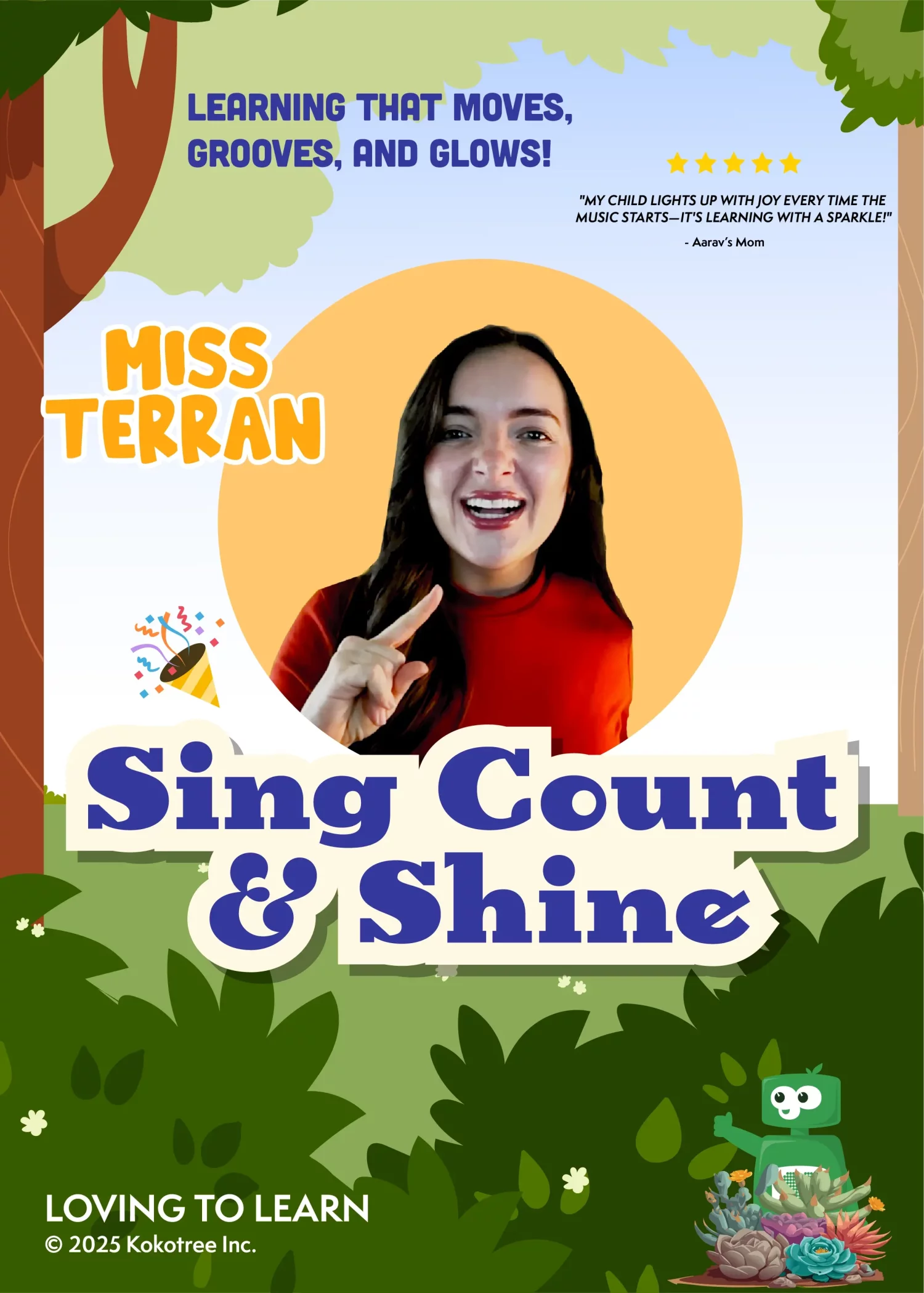
What's Sing, Count & Shine! About?
Your little one joins Miss Taryn for an interactive journey through colors, numbers, and letter sounds—complete with animal friends, movement breaks, and the beloved Itsy Bitsy Spider! They'll finish feeling proud, energized, and ready to spot yellow bananas and red apples everywhere.
5 minutes
Ages 1-4
Skill: Colors, counting 6-7, and letter sounds L, M, N
Your kid watches Miss Taryn teach colors, numbers, and letters with fun movements. You get 5 minutes to finish your coffee or fold that laundry pile.
Miss Taryn introduces yellow and red through everyday objects like bananas, suns, apples, and hearts. She counts ladybug spots to six and hops with Sammy the Squirrel to seven. Letters L, M, and N come alive with lion roars, mouse squeaks, and cozy nap sounds—plus everyone's favorite spider song with hand motions.
What your child learns:
This video builds color recognition, number sense, and early phonics awareness through multi-sensory engagement. Your child practices identifying colors in real objects, counting with one-to-one correspondence, and hearing the distinct sounds that letters make at the beginning of words.
- Identifies yellow and red in everyday objects (chicks, bananas, apples, hearts)
- Counts to six and seven with purpose (ladybug spots, squirrel hops)
- Connects letters L, M, N to their sounds and starter words
- Follows movement instructions (stretching, hopping, hand motions)
- Builds listening skills through call-and-response prompts
They'll use these skills when:
- Sorting laundry by color or picking out a red shirt to wear
- Counting crackers on their plate or toys in the bathtub
- Recognizing the first letter of their name or a sibling's name
- Following simple directions during playtime or at the park
The Story (what keeps them watching)
Miss Taryn welcomes little learners with a wave and dives straight into yellow—showing a fluffy chick (peep peep!), a banana they pretend to peel and eat, and a bright sun they stretch up to match. Red brings apples to crunch, cars to vroom, and hearts to love. Then numbers take the stage: a ladybug lands with six spots to count, and Sammy the Squirrel leads seven bouncy hops. Letters L, M, and N get their moment with lion roars, mouse squeaks, and sleepy nap sounds. The Itsy Bitsy Spider song adds familiar fun, and a final jump-and-stop game celebrates all their hard work!
How We Teach It (the clever part)
- First 2 minutes: Colors come to life through concrete objects kids already know—yellow chicks, bananas, and suns; red apples, cars, and hearts. Each item includes a sound effect or movement to anchor the learning.
- Minutes 2-4: Numbers 6 and 7 are introduced through counting with purpose (ladybug spots) and full-body movement (hopping with Sammy). Letters L, M, N are paired with animal sounds and relatable words.
- Final minute: The Itsy Bitsy Spider song provides a familiar, joyful break, followed by a jump-stop game that reinforces listening skills and celebrates effort.
Teaching trick: Every color and number is paired with a physical action—stretching like the sun, pretending to peel a banana, hopping seven times. This kinesthetic approach helps toddlers encode new information through their bodies, not just their ears.
After Watching: Quick Wins to Reinforce Learning
- Mealtime activity: "Can you find something yellow on your plate? What about something red?" (Reinforces color recognition with real food like corn, strawberries, or tomatoes)
- Car/travel activity: "Let's count red cars! One, two, three..." (Practices counting and color identification in a moving environment)
- Bedtime activity: "N is for nap, just like Miss Taryn said. What sound does N make? Nnnnn-night night!" (Connects letter sounds to bedtime routine)
- Anytime activity: "Can you hop six times like the ladybug spots? Now seven times like Sammy the Squirrel!" (Reinforces number sense through movement anywhere in the house)
When Kids Get Stuck. And How to Help.
- "My child mixes up six and seven." - Totally normal! These numbers look and sound similar. Use fingers to show the difference: hold up six fingers, then add one more for seven. Counting real objects helps too.
- "She can't make the letter sounds yet." - Letter sounds develop gradually between ages 2-4. Focus on the listening part first—exaggerate the sounds yourself ("L-l-l-lion!") and celebrate any attempts she makes.
- "He won't sit still for the whole video." - That's actually perfect! This video is designed for movement. If he's hopping during the hopping part and stretching during the sun part, he's learning exactly as intended.
What Your Child Will Learn
Prerequisites and Building Blocks
This video is ideal for children who can follow simple verbal instructions and have basic exposure to a few colors. It builds on foundational attention skills developed through earlier Kokotree videos. "Sing, Count & Shine!" serves as an introduction to numbers 6-7 and letters L-M-N, making it perfect for learners ready to expand beyond numbers 1-5 and early alphabet letters. It bridges color recognition with counting and phonemic awareness.
Cognitive Development and Teaching Methodology
The multi-sensory approach aligns with how toddler brains process information—through seeing, hearing, AND doing. Each concept is introduced visually, reinforced verbally through repetition, and anchored kinesthetically through movement. The call-and-response format ("Can you say yellow?") activates expressive language pathways, while the varied pacing between calm learning and active movement maintains engagement within typical toddler attention spans.
Alignment with Educational Standards
This video addresses multiple kindergarten readiness indicators: color recognition (identifying primary colors), rote counting and cardinality (counting to 7 with one-to-one correspondence), and phonological awareness (isolating beginning sounds). These align with Common Core Math standards K.CC.A.1 (counting to 100) foundations and ELA standards RF.K.2 (demonstrating understanding of spoken words and sounds). The content prepares children for preschool color sorting and early literacy activities.
Extended Learning Opportunities
Pair this video with Kokotree's color sorting games and number tracing activities in the app. Print simple coloring pages featuring yellow and red objects for fine motor practice. Create a "color hunt" around your home using sticky notes. For letter reinforcement, look for L, M, and N in picture books or on food packaging during grocery trips. The ladybug counting activity extends beautifully to counting spots on dalmatians or stripes on zebras.
Transcript Highlights
- "This is yellow. Say yellow." — Direct instruction with immediate practice opportunity
- "Let's count the spots on the ladybug. Ready? One, two, three, four, five, six." — Modeling one-to-one correspondence counting
- "L is for lion. L-l-l-lion." — Explicit phoneme isolation connecting letter to sound to word
- "Let's hop seven times with him. Ready? Hop, hop, hop..." — Kinesthetic counting reinforcement
Character Development and Story Arc
Miss Taryn models enthusiasm for learning and genuine celebration of effort ("You're doing so great!" "I'm so proud of you!"). Sammy the Squirrel demonstrates playful energy and invites participation rather than passive watching. The ladybug encounter shows wonder and curiosity—pausing to make a wish adds magic to the learning moment. These characters demonstrate that learning is joyful, active, and worth celebrating.
Multi-Domain Learning Integration: Colors, Numbers, and Letters Working Together
This video exemplifies integrated early learning, where seemingly separate domains reinforce each other. Color recognition isn't just about naming—it's categorical thinking, a precursor to sorting, classifying, and eventually understanding that letters belong to an alphabet "category" too.
The progression from counting ladybug spots (6) to hopping with Sammy (7) demonstrates two critical math concepts: cardinality (understanding that the last number counted represents the total) and the counting sequence (knowing what comes next). Physical movement during counting creates muscle memory that supports later abstract number work.
Letter-sound introduction follows the phonics principle of explicit instruction—isolating the phoneme (/l/, /m/, /n/), connecting it to a familiar word (lion, mouse, nap), and repeating the sound multiple times. These three letters were strategically chosen: L and N are continuous consonants (you can hold the sound), making them easier for young learners to hear and produce. M adds a nasal sound that children can feel vibrating.
The Itsy Bitsy Spider serves a pedagogical purpose beyond entertainment—it's a "brain break" that allows consolidation of new learning while maintaining engagement. Research shows that movement and music activate memory encoding, making the preceding content more likely to stick. The final jump-stop game reinforces impulse control and listening skills, which are executive function foundations critical for all future learning.