
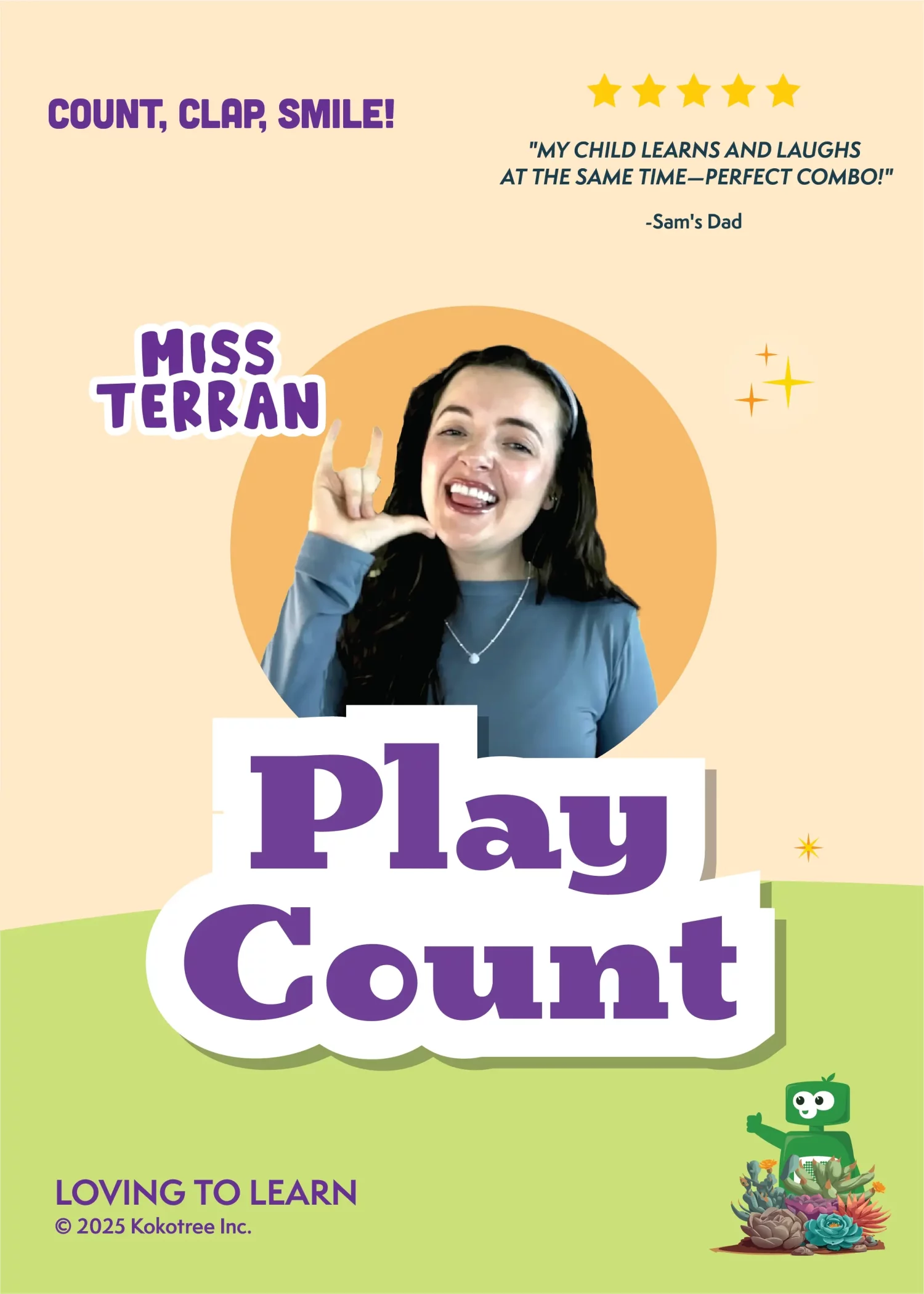
What's Play Count About?
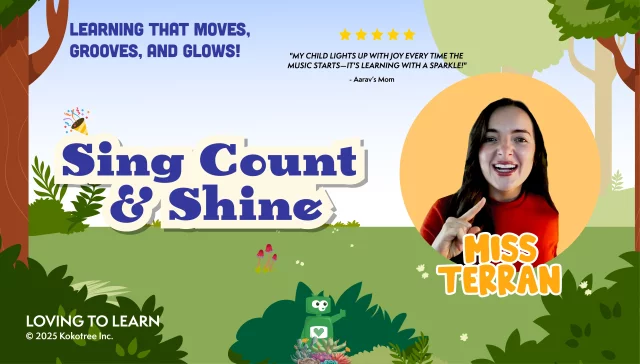
Your little one joins Miss Taryn for an interactive learning adventure that combines letter recognition, counting practice, and whole-body movement! They'll master new letter sounds while hopping, spinning, and wiggling along.
5 minutes
Ages 1-6
Skill: Letters, Numbers & Movement
Your kid watches Miss Taryn teach letters and numbers through movement. You get 5 minutes to [drink your coffee while it's still warm].
Miss Taryn introduces letters H through K with fun vocabulary words like hat, ice, jellyfish, and kangaroo. Then Ruby Rabbit hops in to help count from four to five with spinning and wiggling movements. Every concept comes with an action—clapping, jumping, hopping, or wiggling.
What your child learns:
This video builds foundational literacy and numeracy skills through active participation. Children practice letter sounds, expand vocabulary, and reinforce number recognition—all while developing gross motor skills and following multi-step directions.
- Recognizes letters H, I, J, and K and their sounds
- Identifies numbers 4 and 5 through counting movements
- Connects letters to vocabulary words (hat, ice, jellyfish, kangaroo)
- Follows verbal instructions for physical movements
- Practices one-to-one correspondence when counting
They'll use these skills when:
- Spotting the letter K on a cereal box at breakfast
- Counting four crackers on their snack plate
- Noticing jellyfish at the aquarium and saying "J is for jellyfish!"
- Following directions like "jump three times" during playtime
The Story (what keeps them watching)
Miss Taryn invites your child to a playful learning session that starts with a warm "I love you" greeting. Toys magically appear on screen when children say "play!" Then the real fun begins—each letter comes with a silly surprise (a hat appears on Miss Taryn's head!) and movement challenges. Ruby Rabbit bounces in to help with counting, and together they spin four times and wiggle five times. The session wraps with celebration and encouragement to keep practicing.
How We Teach It (the clever part)
- First 2 minutes: Warm connection-building with greetings, the word "play," and clapping to get little bodies engaged and ready to learn
- Minutes 2-3: Letter introduction (H, I, J, K) with vocabulary, phonics sounds, and movement breaks like jumping and hopping
- Final 2 minutes: Number practice (4-5) with Ruby Rabbit, counting through spinning and wiggling movements, ending with praise and encouragement
Teaching trick: Each letter and number is paired with a physical action—children spin exactly four times and wiggle exactly five times. This kinesthetic approach helps numbers "stick" because kids literally feel the quantity in their bodies.
After Watching: Quick Wins to Reinforce Learning
- Mealtime activity: "Can you find four pieces of pasta on your plate?" Count them together, then add one more and count to five. (Practices counting real objects)
- Car/travel activity: "Let's play the H game—what do you see that starts with H?" Look for hats, houses, or hills out the window. (Reinforces letter-sound connection)
- Bedtime activity: "Let's wiggle five times like a caterpillar, then hop four times like a kangaroo to get our sleepy wiggles out!" (Connects counting to movement)
- Anytime activity: Put a silly hat on a stuffed animal and say "H is for hat! Ha-ha-ha!" Let your child try putting hats on toys too. (Practices letter sounds with play)
When Kids Get Stuck. And How to Help.
- "My child just watches and won't do the movements." - Totally normal! Some children are observers first. Try doing the movements yourself—they often join in after a few viewings when they feel confident.
- "They mix up the numbers 4 and 5." - These numbers are close together and tricky! Use fingers to show the difference: "Four is like this hand without the thumb. Five is your whole hand waving hello!"
- "The letter sounds all seem the same to them." - Focus on one letter at a time throughout your day. Pick "K" and point out kangaroos, keys, and kites everywhere. Repetition in real life builds recognition.
What Your Child Will Learn
Prerequisites and Building Blocks
This video is ideal for children who have some exposure to letters A-G and numbers 1-3. It builds on foundational listening skills and basic ability to follow simple directions. Within the Little Seeds program, "Play Count" extends letter knowledge into the middle alphabet while introducing numbers beyond the earliest counting sequence. Children benefit from prior experience with call-and-response activities and basic gross motor movements like clapping and jumping.
Cognitive Development and Teaching Methodology
The multi-sensory approach in this video aligns with how toddlers and preschoolers naturally learn—through movement, repetition, and play. By pairing abstract concepts (letters and numbers) with concrete physical actions, the video activates kinesthetic learning pathways. The predictable structure (letter → sound → word → movement) reduces cognitive load while building pattern recognition. Frequent pauses for child response support active engagement rather than passive viewing.
Alignment with Educational Standards
This content supports pre-K literacy standards for letter recognition and phonemic awareness, specifically identifying letters and their most common sounds. The counting segment addresses early math standards for number recognition and one-to-one correspondence (counting objects/movements accurately). These skills are foundational kindergarten readiness indicators, preparing children to recognize letters in print and count with understanding.
Extended Learning Opportunities
Pair this video with Kokotree's letter tracing activities for H, I, J, and K. Printable counting worksheets featuring Ruby Rabbit reinforce the 4-5 number sequence. The app's "Animal Alphabet" game extends letter-animal connections. For screen-free practice, create a simple obstacle course: "Hop 4 times, then wiggle 5 times!" This transforms the video's movements into active play that reinforces counting.
Transcript Highlights
- "H is for hat. Ha, ha, ha. Hat." — Clear phonics instruction with sound repetition
- "Let's jump, jump, jump to warm back up... Yay! We melted the ice." — Connects movement to vocabulary concept
- "Spin four times. One. Two. Three. Four. Stop." — Models counting with one-to-one correspondence
- "You are amazing at counting. I'm so proud of you." — Growth mindset reinforcement and celebration
Character Development and Story Arc
Miss Taryn models enthusiastic learning and warm encouragement throughout, showing children that making mistakes (like getting dizzy from spinning) is part of the fun. Ruby Rabbit's surprise appearance demonstrates that learning is better with friends. The progression from greeting to celebration models a complete learning cycle—children see that effort leads to success and praise, reinforcing persistence and positive associations with educational activities.
Phonics and Numeracy Integration: A Developmental Deep Dive
This video employs a powerful educational strategy: integrating literacy and numeracy instruction within a single, movement-based framework. Research in early childhood education consistently shows that young children learn abstract concepts most effectively when those concepts are embodied—literally felt in the body through physical action.
The phonics instruction follows the synthetic phonics approach, isolating individual letter sounds (phonemes) before connecting them to vocabulary. When Miss Taryn says "J, j, j, jellyfish," she's demonstrating the phoneme-grapheme connection that forms the foundation of reading. The alliterative repetition ("Ha, ha, ha, hat") helps children isolate and remember the target sound.
The counting sequence (4-5) strategically introduces numbers that many young children find challenging. Four and five represent a cognitive leap from the earliest counting numbers, requiring children to maintain one-to-one correspondence across more items. By counting movements rather than static objects, the video helps children internalize the cardinal principle—understanding that the last number counted represents the total quantity.
The movement integration serves multiple developmental purposes: it maintains attention spans appropriate for this age group, provides proprioceptive input that aids memory formation, and gives children a physical reference point for abstract quantities. When a child spins exactly four times, the number "four" becomes associated with a specific bodily experience, creating stronger neural pathways than visual recognition alone.
This approach also supports executive function development—children must listen, remember the target number, count their movements, and stop at the right moment. These self-regulation skills are among the strongest predictors of kindergarten success.