
What's Splash & Learn About?
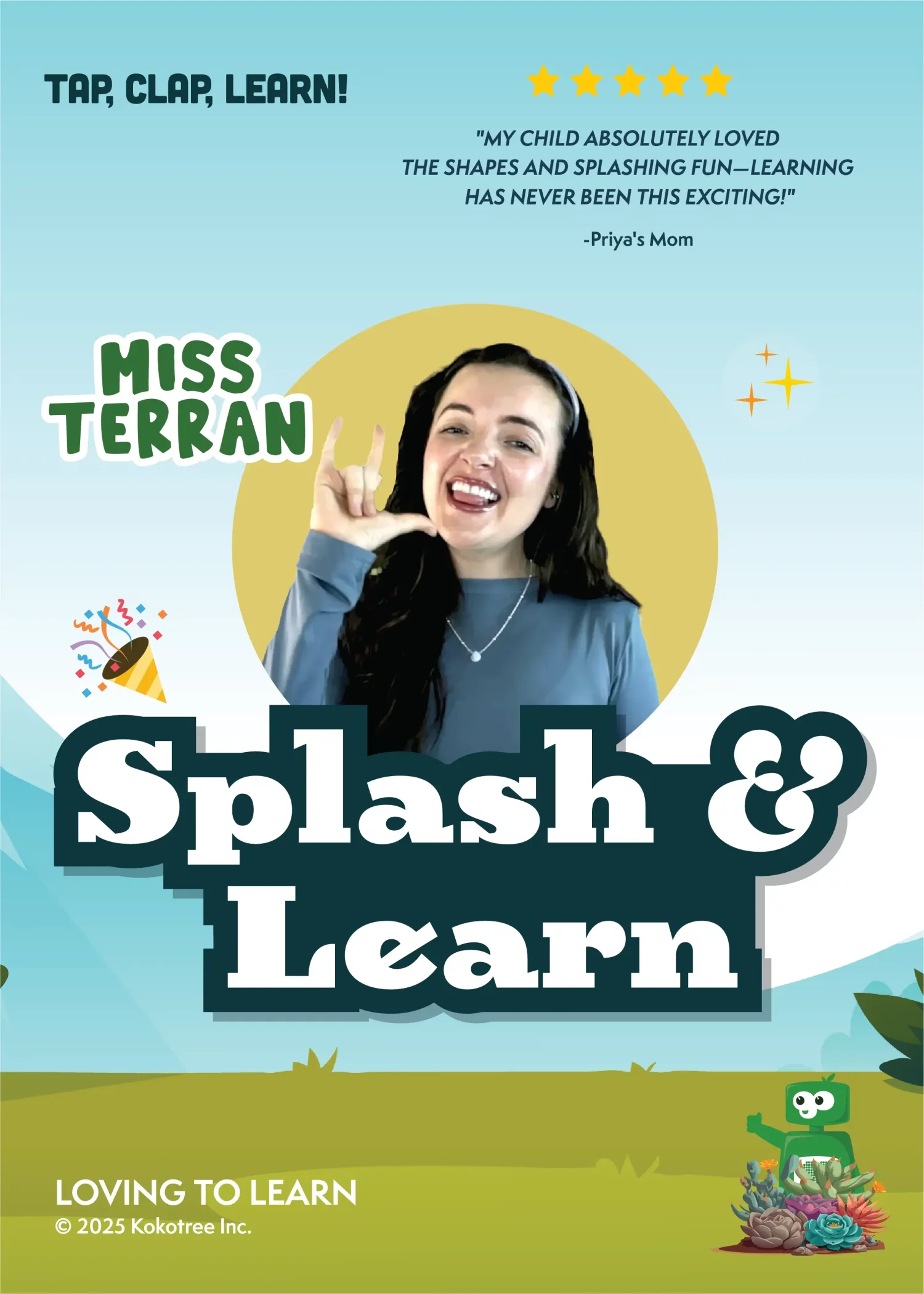
Your little one will explore shapes, practice letters, and discover the magic of turning things on and off—all while splashing in imaginary puddles! After watching, they'll spot circles and squares everywhere and know their letters from U to Z.
5 minutes
Ages 1-6
Skill: Shape recognition, letter identification, and understanding on/off concepts
Your kid watches shapes appear with a magic switch. You get 5 minutes to finish that cup of coffee.
Miss Taryn guides children through an interactive lesson where shapes magically appear and disappear with a flip of a switch. Little learners tap their fingers like raindrops, splash in pretend puddles, and practice saying letters aloud with fun vocabulary words.
What your child learns:
This video builds foundational math and literacy skills through playful interaction. Children discover that circles have no corners while squares have four, and they practice the last six letters of the alphabet with memorable vocabulary words.
- Identifies circles and squares by counting corners
- Understands the concept of on and off
- Recognizes letters U, V, W, X, Y, and Z
- Associates letters with vocabulary words (umbrella, volcano, whale, xylophone, yak, zebra)
- Follows movement instructions (tapping, splashing, clapping)
They'll use these skills when:
- Pointing out circle wheels on cars and square windows on buildings during walks
- Flipping light switches and understanding cause and effect
- Recognizing letters on signs, books, and packaging at the store
- Playing with shape sorters and building blocks at home
The Story (what keeps them watching)
Miss Taryn invites children to discover shapes using a magical on/off switch! First, circles appear everywhere when the switch flips on—then squares take over the screen in all sizes. But wait—the sky gets cloudy and rain starts falling! Children tap their fingers like raindrops and splash in puddles before the sun returns. The adventure wraps up with a letter parade from U to Z, featuring umbrellas, volcanoes, whales, xylophones, yaks, and zebras. Every moment invites participation, keeping little hands and minds busy throughout.
How We Teach It (the clever part)
- First 2 minutes: Introduces circles as shapes with no corners, then uses the magic switch to make them appear—teaching cause and effect while reinforcing shape recognition
- Minutes 2-4: Squares are introduced by their four corners, followed by a weather transition that incorporates movement (tapping raindrops, splashing in puddles) to reset attention
- Final 1.5 minutes: Rapid letter practice from U to Z with memorable vocabulary words and animal/object associations to cement learning
Teaching trick: The "magic switch" transforms abstract concepts (on/off, cause/effect) into something children can visualize and pretend to control with their own fingers—making them active participants rather than passive viewers.
After Watching: Quick Wins to Reinforce Learning
Mealtime activity: "Can you find something circle-shaped on your plate?" Point to round foods like peas, orange slices, or the rim of their cup. Ask them to count the corners (zero!) to confirm it's a circle.
Car/travel activity: "Let's play the shape hunt! I see a square window—can you find a circle?" Take turns spotting shapes through the car window. Wheels, signs, and windows are everywhere!
Bedtime activity: "Let's turn the light switch off together—just like the magic switch!" Practice the on/off concept with real switches. Ask what happens when it's on versus off.
Anytime activity: "Can you tap your fingers like raindrops on the table?" Recreate the raindrop tapping and puddle splashing from the video. Add letters: "U is for umbrella—what do we use umbrellas for?"
When Kids Get Stuck. And How to Help.
"My child can't tell circles from squares yet." Totally normal! Focus on one shape at a time. Trace circles together with your finger on plates, balls, and coins before introducing squares. Repetition builds recognition.
"They mix up the letters U, V, and W." These letters look similar, especially for young eyes. Point out that U is like a cup, V is pointy at the bottom, and W looks like two V's holding hands. Use the vocabulary words as memory anchors.
"The video moves too fast for my toddler." Pause and replay! Younger children (ages 1-2) benefit from watching sections multiple times. Focus on just the shapes portion today and save letters for tomorrow.
What Your Child Will Learn
Prerequisites and Building Blocks
This video works best for children who can follow simple verbal instructions and point at objects on screen. It builds on basic attention skills and introduces formal shape vocabulary. "Splash & Learn" connects to earlier Kokotree content about basic concepts and prepares children for more complex geometry like triangles and rectangles. The on/off switch concept lays groundwork for understanding opposites and cause-effect relationships used throughout the Little Seeds program.
Cognitive Development and Teaching Methodology
The multi-sensory approach addresses visual learners through shape displays, auditory learners through repetition and songs, and kinesthetic learners through finger tapping and splashing movements. The "magic switch" leverages children's natural desire for agency and control, increasing engagement. Transitions between concepts (shapes to weather to letters) prevent cognitive fatigue while the call-and-response format activates working memory and verbal processing centers appropriate for ages 1-6.
Alignment with Educational Standards
This video addresses Common Core Kindergarten Geometry Standard K.G.A.2 (correctly naming shapes regardless of size) and CCSS.ELA-LITERACY.RF.K.1.D (recognizing and naming all upper-case letters). The on/off concept supports NGSS science practices around cause and effect. These skills appear on kindergarten readiness assessments nationwide, and teachers expect incoming students to identify basic shapes and recognize most alphabet letters.
Extended Learning Opportunities
Pair this video with Kokotree's printable shape sorting worksheets and letter tracing pages for U-Z. The app's "Shape Safari" game reinforces circle and square recognition through interactive play. Extend learning with real-world shape hunts using household items. Create a simple weather chart to track sunny and rainy days, connecting to the video's weather transition. Letter magnets on the refrigerator help practice U through Z during kitchen time.
Transcript Highlights
- "Let's start with something round that has no corners. Wow, what's that? It's a circle." — Introduces defining characteristics before naming the shape
- "How about something that has four corners? Do you know what has four corners? A square." — Uses questioning to activate prior knowledge
- "Use your finger to flip the magic switch on. Ready?" — Transforms passive viewing into active participation
- "When the sun hides behind the clouds and the sky gets gray and darker, that means rain is coming." — Connects visual observations to real-world weather patterns
Character Development and Story Arc
Miss Taryn models enthusiastic learning behavior throughout, celebrating every small success with clapping and dancing. She demonstrates patience by waiting for children to respond and repeating key words multiple times. Her excitement when shapes appear ("Wow, look at all the circles!") shows children that discovery is joyful. The progression from shapes to weather to letters models how learners can stay curious across different topics, building persistence and love of learning.
Shape Recognition and Early Geometry Deep Dive
Shape recognition forms the foundation of geometric thinking and spatial reasoning—skills that predict later math success. When children learn that circles have "no corners" and squares have "four corners," they're developing attribute-based classification, a critical cognitive skill that extends far beyond geometry.
The video's approach of introducing shapes by their defining properties (corners/no corners) aligns with research showing that children learn shapes more effectively when taught attributes rather than just memorizing names. This prevents the common misconception that a rotated square is a "diamond"—children who understand "four equal corners" recognize squares in any orientation.
The size variation shown ("Are there big squares? Yes. Are there little squares?") teaches size constancy—understanding that a shape remains the same shape regardless of scale. This concept transfers to letter recognition, where children must recognize that a large "A" and small "a" represent the same letter.
The on/off switch mechanism introduces binary thinking (two states: on or off) which underlies computer science concepts and logical reasoning. Children who grasp on/off readily understand other opposites: open/closed, start/stop, yes/no.
The weather transition serves a dual purpose: it provides a cognitive break between shape learning and letter practice while introducing basic meteorology concepts. Children learn to observe environmental cues (clouds gathering, sky darkening) and predict outcomes (rain coming)—early scientific reasoning in action.
The letter segment uses the proven technique of pairing abstract symbols (letters) with concrete, memorable images (umbrella, volcano, whale). This dual-coding approach—storing information both verbally and visually—significantly improves recall. The animal and nature vocabulary (yak, zebra, whale) connects to children's natural fascination with the living world while building the vocabulary foundation essential for reading comprehension.