
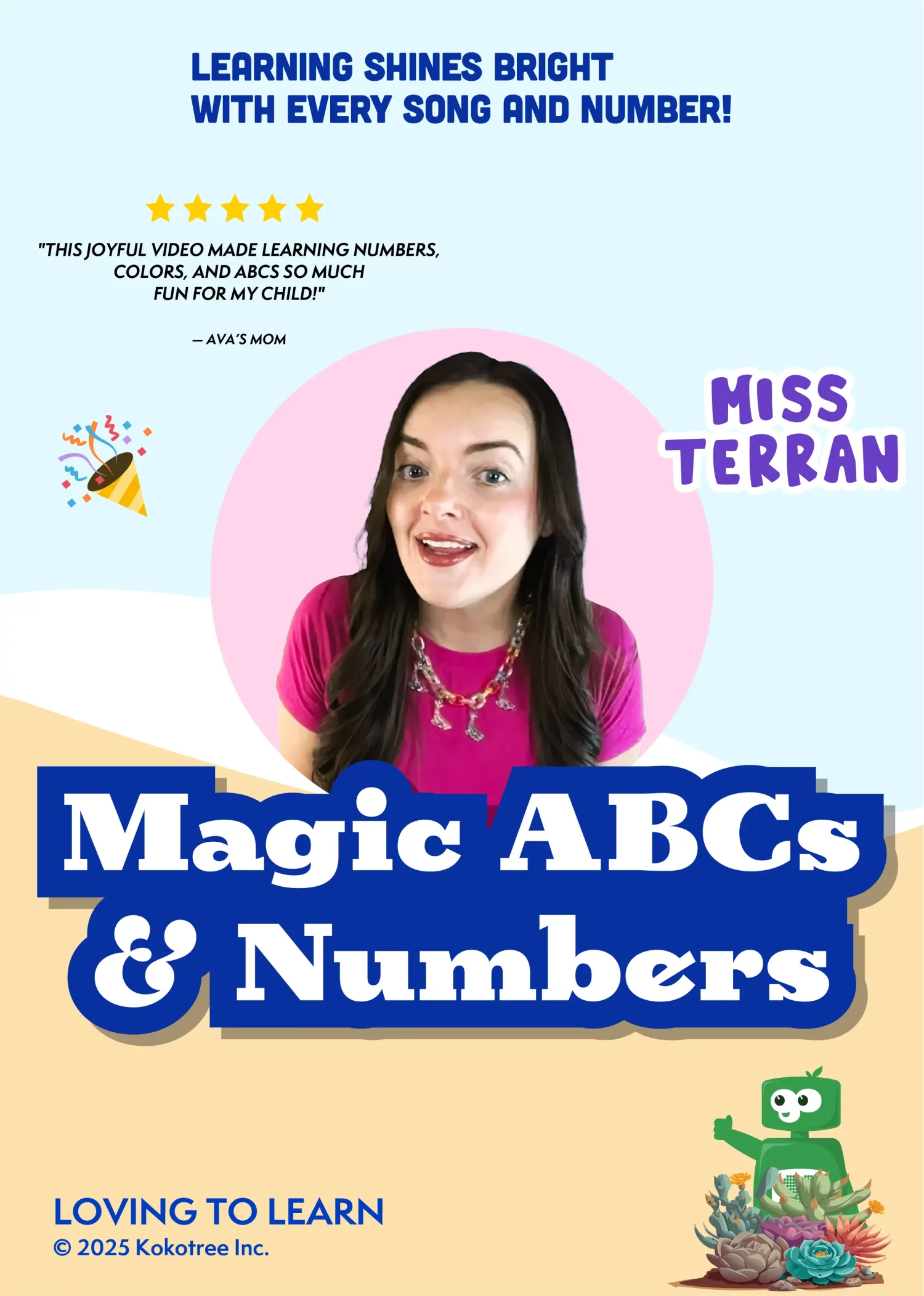
What's Magic ABCs and Numbers About?
Your little one joins Miss Taryn on a colorful adventure through rainbows, ladybug spots, and squirrel hops—building number sense and letter recognition along the way. After watching, they'll count objects up to seven and recite rainbow colors like a pro!
3 minutes
Ages 1-6
Skill: Early numeracy, color recognition, and alphabet basics
Your kid watches rainbows appear and ladybugs land on hands. You get 3 minutes to finish that cup of coffee.
Miss Taryn guides children through a gentle, nature-filled lesson. They'll watch rainbow colors sweep across the screen, see a ladybug with exactly six spots land softly, and hop along with Sammy the squirrel seven times. The classic ABC song wraps everything up with familiar, singable fun.
What your child learns:
This video introduces the numbers six and seven through real-world counting (ladybug spots and squirrel hops). Children also practice naming all seven rainbow colors in sequence and reinforce letter recognition through the ABC song.
- Counts objects up to seven with one-to-one correspondence
- Names rainbow colors in order (red, orange, yellow, green, blue, indigo, violet)
- Recognizes and says the numbers six and seven
- Sings the complete alphabet song
- Follows movement instructions (pretend painting, hopping)
They'll use these skills when:
- Counting snacks on their plate at lunch ("You have six crackers!")
- Spotting rainbows after a rain shower and naming the colors
- Pointing out letters on cereal boxes at the grocery store
- Hopping or jumping during playground games and counting along
The Story (what keeps them watching)
Miss Taryn welcomes little explorers to a magical journey that starts with a question: what happens after the rain? A beautiful rainbow appears, and children swoosh their arms to "paint" it in the sky. Then a ladybug lands—and those six spots become a perfect counting opportunity. Next, Sammy the squirrel arrives for seven energetic hops. The adventure wraps up with the beloved ABC song, leaving kids feeling accomplished and excited to practice again soon.
How We Teach It (the clever part)
- First minute: Miss Taryn builds curiosity with the rainbow question, then guides children through naming all seven colors while making painting motions—connecting movement to memory.
- Minutes 1-2: Numbers six and seven are introduced through nature (ladybug spots, squirrel hops), making abstract numbers concrete and countable.
- Final minute: The familiar ABC song reinforces letter sequence through music, ending with celebration and a promise to practice again.
Teaching trick: Each number is paired with a physical action—counting spots slowly, hopping seven times—which helps young brains lock in the learning through movement.
After Watching: Quick Wins to Reinforce Learning
- Mealtime activity: "Can you count six pieces of pasta onto your plate?" (Practices one-to-one counting with the new number six)
- Car/travel activity: "Let's look for colors outside—can you spot something red? Now orange?" (Reinforces rainbow color sequence in the real world)
- Bedtime activity: "Let's hop like Sammy! Can you do seven tiny hops before you climb into bed?" (Connects counting to gross motor movement)
- Anytime activity: "Let's draw a rainbow together—what color comes first?" (Practices color sequence and fine motor skills with crayons)
When Kids Get Stuck. And How to Help.
- "My child keeps saying 'six' for every number after five." - Totally normal! New numbers need lots of repetition. Try counting six toys, then adding one more and emphasizing "six... SEVEN!" The contrast helps it click.
- "They can't remember all the rainbow colors in order." - Seven colors is a lot! Start with just three (red, yellow, blue) and add more as they master each. The swooshing motion from the video helps—try it while saying the colors.
- "The ABC song is too fast for them to follow." - Slow it way down! Sing just A-B-C-D at first, then add more letters each day. The goal is recognition, not speed.
What Your Child Will Learn
Prerequisites and Building Blocks
Children benefit most from this video if they can already count to five and recognize a few basic colors. This episode builds on foundational counting skills introduced in earlier Kokotree videos and extends number knowledge to six and seven. It fits perfectly in a learning progression that moves from concrete counting (objects they can touch) to more abstract number recognition, while reinforcing the alphabet sequence they've been practicing.
Cognitive Development and Teaching Methodology
This video leverages multi-sensory learning—children see the numbers, hear them spoken, and move their bodies (painting rainbows, hopping). For ages 1-6, this kinesthetic reinforcement is crucial because working memory is still developing. The pacing allows processing time between concepts, and the familiar ABC song provides a comforting anchor that builds confidence before introducing new material.
Alignment with Educational Standards
This content aligns with Common Core Kindergarten standards K.CC.A.1 (count to 100 by ones) and K.CC.B.4 (understand counting and cardinality). It also supports Head Start Early Learning Outcomes for mathematics and approaches to learning. Kindergarten teachers expect incoming students to count to at least 10 and recognize basic colors—this video directly builds those readiness skills.
Extended Learning Opportunities
Pair this video with Kokotree's printable ladybug counting worksheet or the "Rainbow Colors" matching game in the app. Extend learning by creating a nature walk scavenger hunt: find six leaves, seven rocks, or spot rainbow colors in flowers. The "Counting Collection" activity—gathering small objects and sorting by quantity—reinforces the hands-on counting practiced here.
Transcript Highlights
- "This is six. Can you say six?" — Direct instruction with invitation to participate
- "Let's count the spots on the ladybug. Ready? One. Two. Three. Four. Five. Six." — Slow, deliberate counting with visual anchor
- "Let's hop seven times with him. Ready? Hop. Hop. Hop. Hop. Hop. Hop. Hop." — Kinesthetic counting reinforcement
- "Let's pretend to paint a rainbow in the sky. Swoosh. Swoosh. Swoosh." — Movement-based color learning
Character Development and Story Arc
Miss Taryn models enthusiasm and patience throughout, celebrating each small success with genuine warmth. Sammy the squirrel demonstrates playful energy and invites children to move their bodies—showing that learning can be active and joyful. The ladybug moment teaches gentle observation ("Let's see if it lands on my hand"), modeling curiosity and care for nature. These characters show children that learning is an adventure worth taking.
Early Numeracy and Color Science Deep Dive
The numbers six and seven represent a critical milestone in early mathematics. While children often master one through five relatively quickly, six and seven require more abstract thinking—the quantities become harder to "subitize" (recognize instantly without counting). This video addresses that challenge by anchoring each number to a concrete, memorable image: six ladybug spots, seven squirrel hops.
The rainbow color sequence (ROYGBIV) introduces children to a scientific concept—the visible light spectrum—in an accessible way. While preschoolers don't need to understand wavelengths, learning that colors appear in a specific, predictable order builds foundational scientific thinking: the world follows patterns we can observe and name.
The physical movements embedded throughout (swooshing arms for painting, hopping for counting) activate the cerebellum and motor cortex alongside language centers, creating stronger neural pathways for memory. Research consistently shows that young children learn numerical concepts more effectively when movement is involved—each hop becomes a physical "marker" for the number seven.
The ABC song serves a dual purpose: it provides familiar comfort (reducing cognitive load) while reinforcing letter sequence through melody. Music activates multiple brain regions simultaneously, making the alphabet easier to store in long-term memory. The invitation to "sing with me next time" builds anticipation and positions repetition as something to look forward to rather than a chore.