
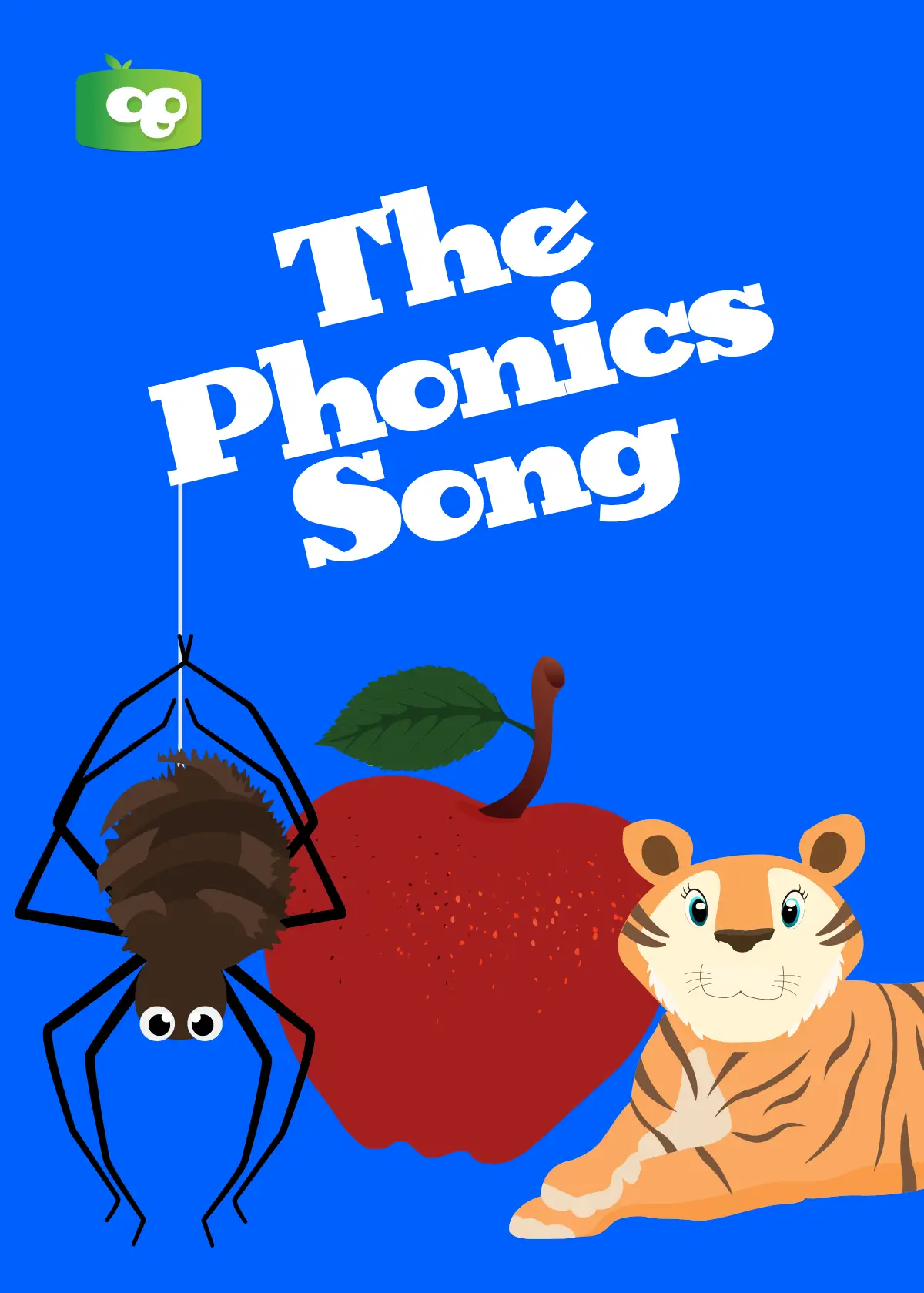
What's The Phonics Song About?
Your little one will sing through the entire alphabet while connecting each letter to its sound and a fun word they already know! By the end, they'll be matching letters to beginning sounds like a pro.
4 minutes
Ages 1-6
Skill: Letter sounds and phonemic awareness
Your kid watches friendly animals sing letter sounds A to Z. You get 4 minutes to [finish that coffee/check your emails/take a breath].
Colorful animal friends guide your child through each letter of the alphabet, one by one. Each letter gets paired with a familiar word—like "A is for Apple" and "D is for Dog"—while the catchy tune repeats the sound over and over so it really sticks.
What your child learns:
This video builds the foundation for reading by teaching phonemic awareness—the understanding that letters represent sounds. Through musical repetition, children naturally absorb letter-sound connections that they'll use when they start sounding out words.
- Recognizes all 26 letters of the alphabet
- Connects each letter to its beginning sound
- Associates letters with familiar vocabulary words
- Develops phonemic awareness through repetition
- Builds auditory memory through musical patterns
They'll use these skills when:
- Spotting the first letter of their name on a birthday card
- Pointing out letters on cereal boxes at breakfast
- Sounding out simple words in picture books
- Playing alphabet games with friends at preschool
The Story (what keeps them watching)
This isn't just a song—it's a musical journey through the entire alphabet! Each letter gets its moment to shine with a fun, familiar word. From Apple to Zebra, kids meet animals like Cat, Dog, Elephant, Frog, and Kangaroo along the way. The catchy repetition ("B-B-Ball, B-B-Ball") turns learning into a game where kids can't help but sing along. By the time they reach Z for Zebra, they've practiced every single letter sound!
How We Teach It (the clever part)
- First 1.5 minutes: Letters A through I introduce the pattern—each letter paired with a word, repeated rhythmically so kids catch on to the format and start anticipating what comes next.
- Minutes 1.5-3: Letters J through S continue building momentum. Kids are now singing along, reinforcing sounds through active participation rather than passive watching.
- Final minute: Letters T through Z bring it home with satisfying closure. Kids feel accomplished completing the whole alphabet!
Teaching trick: The triple repetition pattern ("B-B-Ball, B-B-Ball, B-Ball") uses spaced repetition—a proven memory technique. Hearing each sound multiple times in quick succession helps it move from short-term to long-term memory.
After Watching: Quick Wins to Reinforce Learning
Mealtime activity: "What sound does your apple start with? A-A-Apple!" Point to foods on their plate and practice the beginning sounds together. They're connecting the song to real objects.
Car/travel activity: "I spy something that starts with B-B-B..." Play a simplified I Spy using letter sounds instead of colors. They're practicing phonemic awareness without realizing it.
Bedtime activity: "Let's find three things in your room that start with the same sound as your name!" Hunt for objects together and emphasize the beginning sound. They're building sound-to-object connections.
Anytime activity: "Can you move like the animals from the song? Show me a hopping K-K-Kangaroo!" Combine movement with letter sounds for kinesthetic learning. They're reinforcing through whole-body engagement.
When Kids Get Stuck. And How to Help.
"My child just hums along but doesn't say the letters." - Totally normal! Humming means they're absorbing the melody and rhythm first. Keep watching together and emphasize the letter sounds yourself—they'll start joining in when ready.
"They mix up similar sounds like B and D." - These are tricky for developing ears! Focus on one letter at a time during daily activities. "Look, a ball! B-B-Ball, just like the song!" Repetition in context helps them differentiate.
"My toddler seems too young for letters." - Even 1-year-olds benefit from exposure! They're absorbing patterns, rhythms, and sounds that build the foundation for later letter recognition. There's no pressure—just enjoy the music together.
What Your Child Will Learn
Prerequisites and Building Blocks
This video works beautifully as a first introduction to phonics—no prior letter knowledge required! Children who have exposure to nursery rhymes and songs will find the musical format familiar. The Phonics Song builds foundational skills that connect to future Kokotree videos on letter writing, word families, and beginning reading. It's an essential early step in the literacy learning progression, preparing children for more advanced phonemic awareness activities.
Cognitive Development and Teaching Methodology
The musical repetition format leverages how young brains naturally learn—through pattern recognition and rhythmic encoding. Research shows songs activate multiple brain regions simultaneously, strengthening memory formation. The video addresses auditory learners through melody, visual learners through on-screen letters and images, and kinesthetic learners who naturally move and clap along. The predictable A-to-Z structure provides cognitive scaffolding that helps children anticipate and participate.
Alignment with Educational Standards
This video directly supports Common Core Foundational Skills for Reading (RF.K.1-3), specifically letter recognition and phonemic awareness. It addresses kindergarten readiness indicators for literacy, including identifying letters and their corresponding sounds. Teachers expect incoming kindergarteners to recognize most letters—this video provides the repetitive exposure research shows children need (15-20 encounters with each letter) for mastery.
Extended Learning Opportunities
Pair this video with Kokotree's letter tracing activities to connect sounds with letter formation. Print alphabet flashcards featuring the same vocabulary words (Apple, Ball, Cat) for consistent reinforcement. The Kokotree app includes letter-matching games that extend this learning through interactive play. For screen-free extension, create a simple alphabet book together using magazine cutouts of objects from the song.
Transcript Highlights
- "A is for Apple, A-A-Apple, A-A-Apple, A-Apple" — The triple repetition pattern reinforces the letter-sound connection through spaced practice.
- "E is for Elephant, E-E-Elephant" — Using longer words shows children that the beginning sound matters regardless of word length.
- "X is for Xylophone, X-X-Xylophone" — Even tricky letters like X get memorable, musical treatment.
- "Z is for Zebra, Z-Z-Zebra" — The satisfying conclusion gives children a sense of accomplishment for completing the alphabet.
Character Development and Story Arc
The friendly animal characters featured throughout—Cat, Dog, Elephant, Frog, Gorilla, Horse, Kangaroo, Lion, Monkey, Owl, Pig, Rabbit, Spider, Tiger, Whale, and Zebra—model enthusiasm for learning. Each animal appears with its corresponding letter, demonstrating that learning can be found everywhere in nature. The progression from A to Z mirrors a learning journey, showing children that working through challenges step-by-step leads to completion and mastery.
Phonics and Early Literacy Deep Dive
Phonemic awareness—the ability to hear and manipulate individual sounds in words—is the single strongest predictor of early reading success. This video targets the most foundational phonemic skill: identifying beginning sounds. When children hear "B-B-Ball" repeated rhythmically, their brains are doing sophisticated work: isolating the /b/ sound, connecting it to the visual letter B, and associating both with a familiar object.
The vocabulary choices are intentional. Words like "apple," "ball," "cat," and "dog" are high-frequency words that children likely already know, reducing cognitive load so they can focus on the new information: the letter-sound connection. More complex words like "elephant" and "xylophone" stretch vocabulary while maintaining the same teaching pattern.
Musical encoding is particularly powerful for phonics instruction. The melody creates a "hook" that helps children retrieve letter sounds from memory. This is why adults can still sing the ABC song decades later! The rhythmic repetition (hearing each sound 3-4 times per letter) aligns with research on optimal spacing for memory formation in young children.
Importantly, this video teaches letter sounds rather than just letter names. While both matter, sound knowledge is more directly connected to decoding—the ability to sound out unfamiliar words. Children who master letter sounds have a significant advantage when they begin formal reading instruction, as they can immediately apply this knowledge to blend sounds into words.