
What's Old MacDonald Had a Farm About?
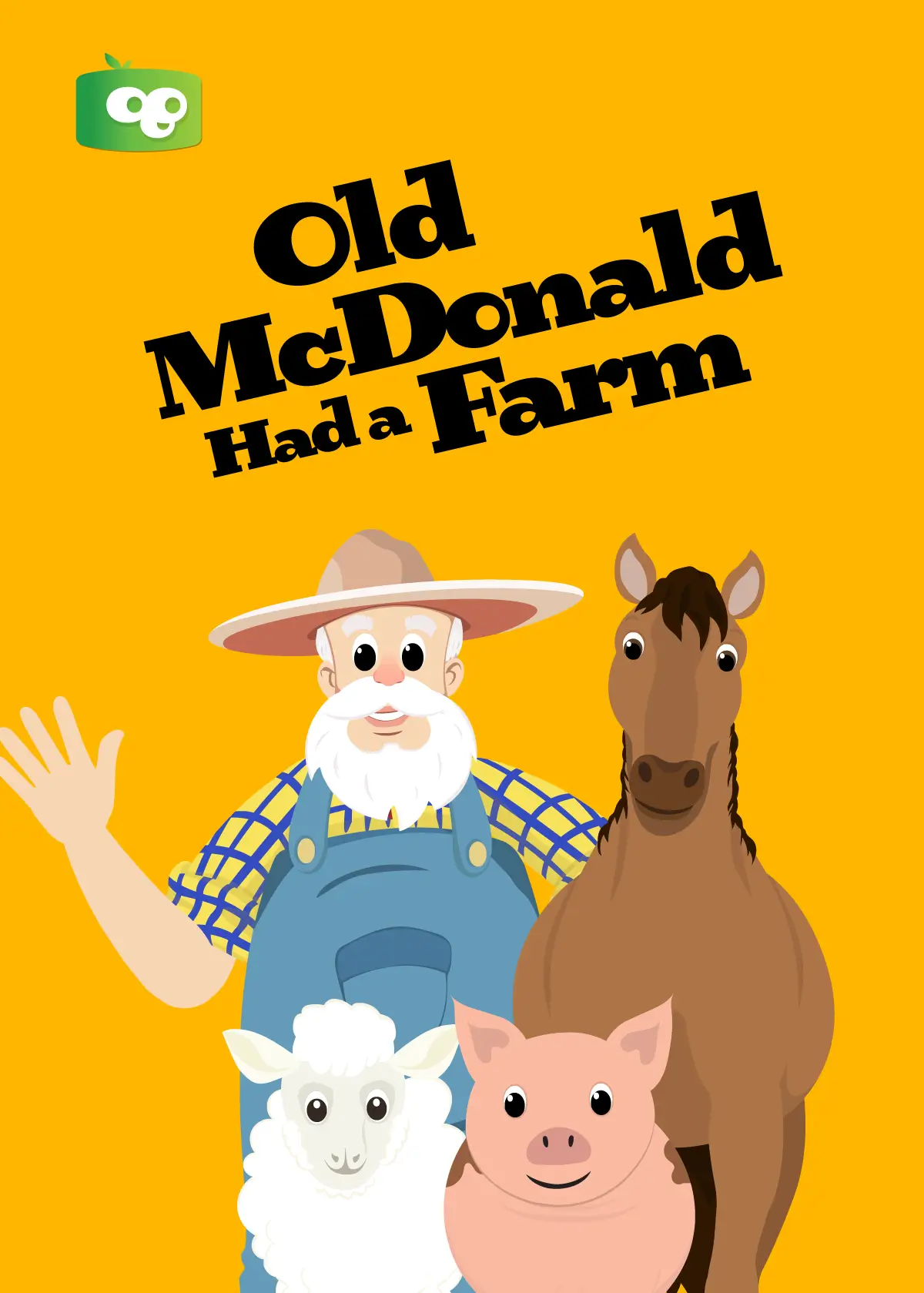
Sing along with friendly farm animals and discover the wonderful sounds they make! Your child will confidently identify six different farm animals and match each one to its unique sound.
3 minutes
Ages 1-6
Skill: Animal recognition and sound matching
Your kid watches animated farm animals sing their sounds. You get 3 minutes to finish that cup of coffee.
Colorful farm animals appear one by one on Old MacDonald's cheerful farm. Each animal—cow, pig, duck, horse, lamb, and chicken—introduces itself with its signature sound. The catchy, repetitive melody invites little ones to sing along and practice each animal sound.
What your child learns:
This classic song teaches animal identification through memorable sound associations. The repetitive structure helps little learners predict what comes next, building early pattern recognition and memory skills.
- Identifies 6 farm animals by sight (cow, pig, duck, horse, lamb, chicken)
- Matches each animal to its correct sound (moo, oink, quack, neigh, baa, cluck)
- Develops listening skills through sound discrimination
- Builds vocabulary with animal names and onomatopoeia
- Strengthens memory through repetitive song patterns
They'll use these skills when:
- Pointing out animals in picture books and naming what sound they make
- Visiting a farm, petting zoo, or seeing animals at the park
- Playing with toy farm sets and acting out animal sounds
- Sharing what they know about animals with friends and family
The Story (what keeps them watching)
Welcome to Old MacDonald's bustling farm! One by one, friendly animals pop up to show off their special sounds. First, a happy cow says "moo moo!" Then a playful pig oinks along. A cheerful duck quacks, a proud horse neighs, a fluffy lamb baas, and finally, busy chickens cluck-cluck their way into the song. Each animal gets its moment to shine while the catchy "E-I-E-I-O" chorus keeps tiny toes tapping. By the end, your little one will be ready to lead the whole barnyard choir!
How We Teach It (the clever part)
- First minute: Introduces the farm setting and first two animals (cow and pig) with clear, repeated sounds that establish the song pattern
- Minutes 1-2: Builds on the pattern with duck, horse, and lamb—each new animal reinforces the predictable structure while adding new vocabulary
- Final minute: Culminates with chickens and a special recap section layering multiple animal sounds, challenging memory recall
Teaching trick: Each animal sound is repeated six times per verse ("moo moo here, moo moo there, here a moo, there a moo, everywhere a moo moo"). This strategic repetition helps sounds stick in memory without feeling like drill work.
After Watching: Quick Wins to Reinforce Learning
- Mealtime activity: "What sound does a cow make?" Point to different foods and ask what animal they came from. Milk? Moo! Eggs? Cluck cluck! (Practices animal-product connections)
- Car/travel activity: "I hear an animal... MOO! What am I?" Take turns making animal sounds for others to guess. (Reinforces sound-animal matching)
- Bedtime activity: "Let's say goodnight to all the farm animals. Goodnight cow... moo moo. Goodnight pig..." Let your child fill in each sound. (Reviews all animals learned)
- Anytime activity: Gather stuffed animals or toy figures and line them up for a "farm parade." March them along while singing each animal's verse. (Combines physical play with recall)
When Kids Get Stuck. And How to Help.
- "My child mixes up the animal sounds." Totally normal! Focus on just two animals at first (cow and duck have very different sounds). Once those click, add one more. Repetition over days works better than cramming all six at once.
- "They won't sing along, just watches." Listening IS learning at this age. Many toddlers absorb for weeks before performing. Try making the sounds yourself during the video—modeling invites participation without pressure.
- "The song seems too simple for my older preschooler." Challenge them! Ask "What OTHER animals could live on a farm?" and make up new verses together. A rooster goes cock-a-doodle-doo! A cat goes meow! This extends learning beautifully.
What Your Child Will Learn
Prerequisites and Building Blocks
This video works beautifully as an entry point—no prerequisites needed! Children benefit from basic exposure to music and rhythm. "Old MacDonald Had a Farm" builds foundational animal knowledge that connects to later nature and science content about animal habitats, what animals eat, and animal families. It prepares children for more complex categorization skills (farm animals vs. wild animals vs. pets) introduced in future videos.
Cognitive Development and Teaching Methodology
The call-and-response structure leverages how toddler and preschooler brains naturally learn—through predictable patterns and joyful repetition. Each verse follows identical structure, reducing cognitive load while introducing new content. Auditory learners absorb through the melody; visual learners connect with on-screen animals; kinesthetic learners engage by clapping, stomping, or acting out sounds. This multi-sensory approach ensures all learning styles are activated.
Alignment with Educational Standards
This video supports early learning standards for language development (vocabulary acquisition, phonological awareness through onomatopoeia) and science (identifying living things, animal characteristics). Kindergarten readiness indicators include categorizing objects by attribute and demonstrating knowledge of the natural world. The repetitive text structure aligns with early literacy benchmarks for pattern recognition and predictive skills.
Extended Learning Opportunities
Pair this video with printable farm animal matching cards or a "sort the animals" worksheet (farm vs. forest). The Kokotree app features interactive games where children tap animals to hear their sounds. Extend learning with play-dough farm animals, barn-building with blocks, or reading picture books about farms. A nature walk to spot birds connects "cluck cluck" learning to real-world observation.
Transcript Highlights
- "With a moo moo here and a moo moo there, here a moo, there a moo, everywhere a moo moo" — demonstrates spatial language concepts (here/there/everywhere)
- "And on that farm he had a duck, E-I-E-I-O" — clear animal introduction pattern that children learn to anticipate
- "With a baa baa here and a baa baa there" — softer sounds contrast with louder ones, teaching sound discrimination
- "Everywhere a cluck cluck" — final animal adds complexity as the song layers multiple sounds together
Character Development and Story Arc
While this traditional song doesn't feature narrative characters, each animal models enthusiastic participation. The cow confidently shares its "moo," the pig proudly oinks, and the duck happily quacks—each demonstrating that every voice matters and belongs in the group. The cumulative ending, where multiple animal sounds layer together, shows how different contributions create something wonderful together—a gentle lesson in community and belonging.
Animal Sound Recognition and Early Language Development Deep Dive
Onomatopoeia—words that imitate sounds—plays a crucial role in early language acquisition. When children learn that "moo" represents a cow's vocalization, they're grasping a fundamental concept: symbols (words) represent real things. This symbolic understanding is the foundation of all literacy.
Animal sounds are among the first "words" many children produce because they're phonetically simple and highly rewarding (adults respond enthusiastically to a toddler's "moo!"). The sounds in this video span different phonetic patterns: "moo" uses a long vowel, "oink" introduces a diphthong, "quack" practices the challenging /kw/ blend, "neigh" models the long /a/ sound, "baa" is an open syllable, and "cluck" ends with a consonant cluster.
Research shows that children who can identify and produce animal sounds demonstrate stronger phonological awareness—the ability to hear and manipulate sounds in language—which directly predicts reading success. The repetitive structure ("here a moo, there a moo") also builds pattern recognition essential for understanding language rules.
Beyond language, animal sound recognition develops auditory discrimination—the ability to distinguish between similar sounds. A child who can differentiate "moo" from "baa" is training their brain for the more subtle distinctions between letter sounds like /b/ and /d/. This makes "Old MacDonald Had a Farm" not just a fun sing-along, but genuine preparation for phonics instruction.