
What's Early Reader: The Red Cot About?
Your child becomes a real reader by following along with simple sentences featuring words they already know! By the end, they'll understand how words work together to tell a story—a huge milestone on the path to independent reading.
2 minutes
Ages 4-6
Skill: Reading simple sentences with short vowel words
Your kid watches Meera read a mini-book about Tim and Tom. You get 2 minutes to finish that cup of coffee.
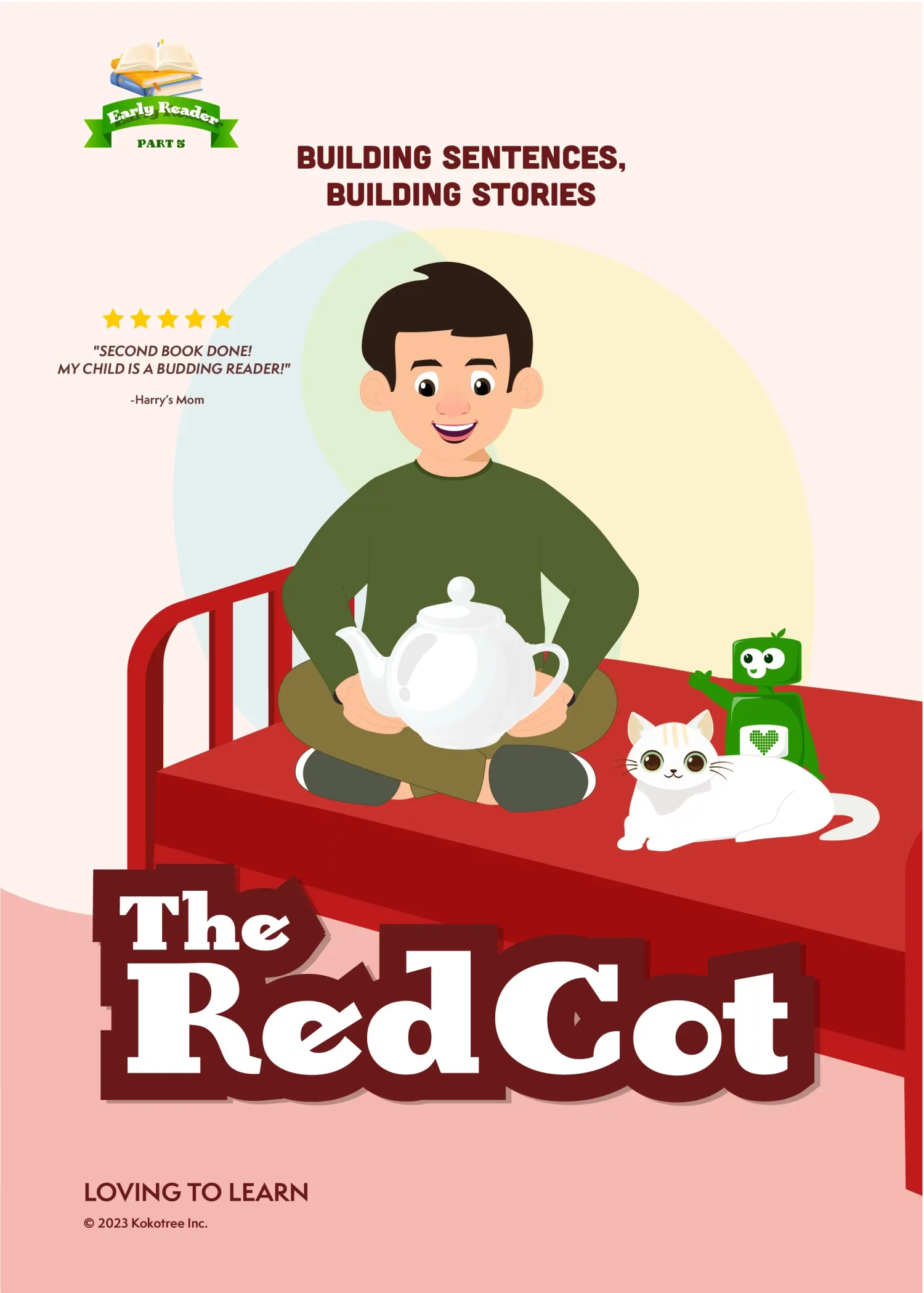
Meera, your child's cheerful animal English teacher, pops out from behind jungle bushes to guide your little one through a sweet, simple story. Together, they read sentences about Tim getting a pot and a cot, and Tom the cat joining in. Each sentence appears with a pause, giving your child time to process and follow along.
What your child learns:
This lesson takes individual words your child has practiced and shows them how those words combine into meaningful sentences. They'll see familiar CVC (consonant-vowel-consonant) words in action and begin understanding that reading is about making sense of connected ideas—not just sounding out isolated words.
- Reads complete simple sentences independently
- Recognizes short 'o' words in context (pot, cot, hot, Tom)
- Understands basic sentence structure (subject + verb + object)
- Tracks text from left to right across a sentence
- Builds reading fluency through repetition and patterns
They'll use these skills when:
- Reading simple signs at the store ("Hot dogs" or "Stop")
- Following along with bedtime picture books
- Recognizing familiar words on food packaging or toys
- Writing their own simple sentences during play
The Story (what keeps them watching)
Meera welcomes your child back to Part 4 of the Early Reader Program from her cozy jungle spot, complete with curious monkeys and wiggling caterpillars. Together, they read a mini-book about Tim, who gets a pot (it's hot!) and a red cot. Then Tom the cat shows up and hops on the cot too. By the end, pot, Tom, AND the cot are all together—and your child has just read seven whole sentences! Meera celebrates their progress and reminds them that practice makes perfect.
How We Teach It (the clever part)
- First 30 seconds: Meera reconnects with your child, building familiarity and excitement. She introduces the goal: reading a book and building sentences together.
- Seconds 30-100: The mini-book unfolds one sentence at a time with deliberate pauses. Each sentence builds on the last, using repetitive vocabulary (pot, cot, Tom) so children gain confidence through recognition.
- Final 25 seconds: Meera celebrates their achievement enthusiastically and reinforces the key message: practice leads to reading success.
Teaching trick: The story uses only 6 unique words repeated in different combinations. This strategic repetition means your child isn't overwhelmed—they're recognizing familiar friends in new arrangements, which builds both confidence and comprehension.
After Watching: Quick Wins to Reinforce Learning
- Mealtime activity: "Can you find something hot on the table?" Point to warm food and say "The soup is hot" together—just like the book! (Practices connecting words to real objects)
- Car/travel activity: "Let's play the 'ot' game! I say pot, you say another word that rhymes." Try cot, hot, dot, lot. (Reinforces word families from the video)
- Bedtime activity: "Tell me about Tom the cat. What was Tom on?" Let them retell the story in their own words. (Builds comprehension and sequencing)
- Anytime activity: Grab three toys and narrate like the book: "Bear got a block. The block is red. Bear is on the bed." Invite your child to make their own sentences! (Practices sentence building)
When Kids Get Stuck. And How to Help.
- "My child just repeats after Meera instead of reading independently." - That's exactly how it starts! Repetition is the first stage of reading. After a few watches, pause the video before Meera reads and see if your child can try first.
- "They mix up similar words like 'pot' and 'cot.'" - These words differ by just one letter, which is tricky! Point to the first letter and emphasize the sound: "This one starts with /p/—pot. This one starts with /c/—cot." The more they see the pattern, the easier it gets.
- "The sentences seem too simple—is this challenging enough?" - Simple is powerful right now! Mastering easy sentences builds the fluency and confidence needed for harder text. When these feel effortless, they're ready for the next level.
What Your Child Will Learn
Prerequisites and Building Blocks
Before watching "The Red Cot," children should recognize individual letters and their sounds, particularly short vowel sounds. This video builds directly on Parts 1-3 of the Early Reader Program, where learners practiced CVC word recognition. It bridges the gap between decoding single words and reading connected text—a critical transition in early literacy development. Children ready for this lesson can sound out simple three-letter words independently.
Cognitive Development and Teaching Methodology
This lesson leverages cognitive load theory by limiting vocabulary to just six words, allowing working memory to focus on sentence structure rather than decoding. The deliberate pauses after each sentence respect processing speed in young learners. Visual, auditory, and kinesthetic pathways are engaged: children see text, hear Meera model fluent reading, and can physically point to words. Repetition with variation keeps engagement high while cementing neural pathways.
Alignment with Educational Standards
This video aligns with Common Core RF.K.4 (read emergent-reader texts with purpose and understanding) and RF.K.1 (demonstrate understanding of basic print concepts). It supports kindergarten readiness indicators for sentence awareness and left-to-right tracking. The focus on CVC words with short 'o' sounds matches typical phonics scope and sequence for pre-K through early kindergarten, preparing children for standardized reading assessments.
Extended Learning Opportunities
Pair this video with Kokotree's printable sentence-building strips featuring the same vocabulary. The app's "Word Family Fun" game reinforces the '-ot' pattern with interactive activities. Extend learning by creating a physical "sentence pocket chart" at home—write words on cards and let children arrange them into sentences. Follow up with Part 5 of the Early Reader series to continue the progression.
Transcript Highlights
- "In this lesson, we're going to read a book together. And we're going to build sentences!" — Sets clear learning objectives
- "Tim got a pot. The pot is hot." — Models simple subject-verb-object structure with connected meaning
- "Tom and pot are on the cot." — Introduces compound subjects, showing sentence complexity growth
- "Practice. Practice. Practice." — Reinforces growth mindset and the value of repetition
Character Development and Story Arc
Meera models enthusiasm for reading and positions herself as a supportive guide rather than an authority figure. Her warm greeting ("Remember me?") builds relationship continuity across the series, making learning feel like visiting a friend. She celebrates effort ("You're doing better than ever!") rather than perfection, demonstrating growth mindset. Her closing reminder about practice normalizes the learning process and sets expectations for continued engagement.
The Science of Sentence Reading: From Words to Meaning
Reading sentences requires fundamentally different cognitive processes than reading isolated words. When children transition from word-level decoding to sentence comprehension, they must simultaneously hold multiple words in working memory while extracting meaning from their combination—a skill called syntactic processing.
"The Red Cot" strategically scaffolds this transition through several evidence-based techniques. First, it uses a closed vocabulary set where all words share the short 'o' phoneme, reducing decoding demands so cognitive resources can focus on comprehension. Second, sentences follow predictable patterns (noun + verb + noun, noun + is + adjective) that match children's intuitive understanding of language structure.
The cumulative story structure—where each sentence adds one element (pot → cot → cat → all together)—mirrors how children naturally build mental models. Research shows that when text structure matches cognitive processing patterns, comprehension improves significantly.
The two-second pauses between sentences aren't arbitrary; they align with research on processing time for emergent readers. Young children need 1.5-3 seconds to decode, comprehend, and consolidate each sentence before moving forward. This pacing prevents cognitive overload while maintaining engagement.
Perhaps most importantly, this lesson demonstrates that reading is meaning-making. The pot being hot, the cot being red, Tom joining the scene—these aren't random words but connected ideas. This fundamental insight—that reading tells us something—is the motivational engine that drives literacy development forward.