
What's Big & Small About?
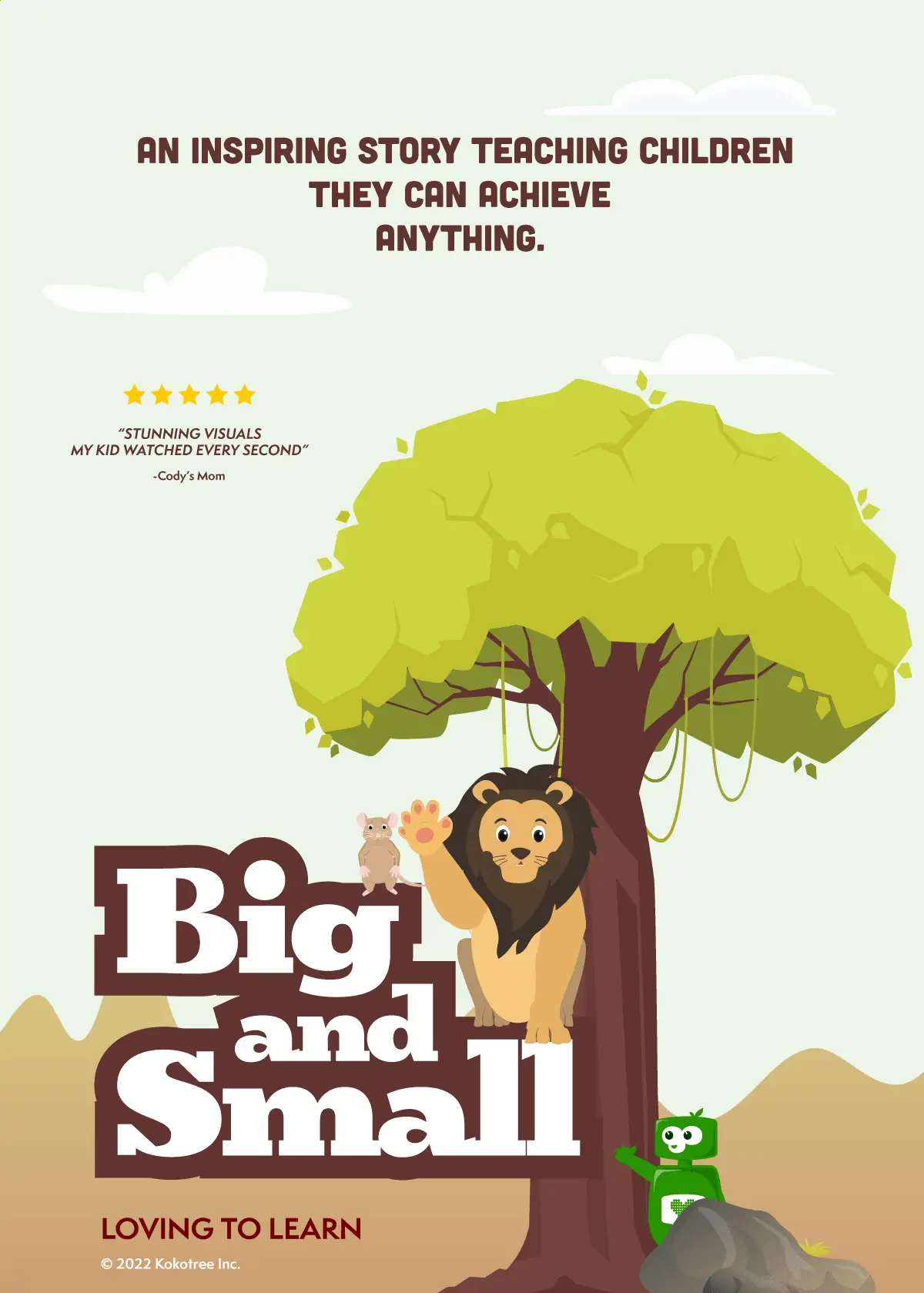
Your child explores the jungle with Elizabeth, comparing sizes of plants, rocks, trees, and animals before enjoying a heartwarming story about an unlikely friendship. They'll walk away pointing out "big" and "small" everything!
7.5 minutes
Ages 1-6
Skill: Size comparison and relative measurement
Your kid watches friendly animals compare sizes in the jungle. You get 7 minutes to drink coffee while it's hot.
Elizabeth the teacher guides children through a colorful jungle scene, pointing out big and small plants, rocks, trees, and animals. Then comes story time—Looka the Lion learns that his tiny friend Shoomy the Mouse can do big things, teaching kids that size isn't everything.
What your child learns:
This video builds foundational math skills by teaching relative size comparison through real-world examples. Children learn to observe, compare, and describe objects using size vocabulary—skills they'll use in everything from sorting toys to understanding measurement.
- Identifies big vs. small objects in their environment
- Compares two objects to determine which is bigger or smaller
- Uses size vocabulary ("big," "small," "bigger than") correctly
- Understands that size is relative (baby deer is small compared to mamma deer)
- Connects size concepts to living things (animals, plants, trees)
They'll use these skills when:
- Choosing between the big cup or small cup at snack time
- Sorting toys by size during cleanup
- Picking out "the biggest cookie" (you knew this was coming)
- Describing pets and animals at the park or zoo
The Story (what keeps them watching)
Looka the Lion is the proud king of the jungle who thinks he's too big and important to befriend tiny Shoomy the Mouse. "I'm so big, and you are so small. We could never be friends!" But when a hunter's net traps Looka, guess who comes to the rescue? Little Shoomy nibbles through the ropes with his sharp teeth and saves the day! Looka learns that small friends can do big things, and the two become best buddies. It's the classic tale of the Lion and the Mouse—with adorable Kokotree characters your child will love.
How We Teach It (the clever part)
- First 2 minutes: Elizabeth introduces "big" and "small" with on-screen text labels, then immediately shows real examples—plants, rocks, and trees in the jungle. Words appear above objects as she names them.
- Minutes 2-4: The concept deepens with animal comparisons (baby deer vs. mamma deer, baby buffalo vs. mamma buffalo), helping kids understand relative size in living things.
- Final 3.5 minutes: Story time reinforces the concept through narrative. Looka is "big and strong," Shoomy is "small." The contrast drives the plot and makes the vocabulary stick.
Teaching trick: Every time Elizabeth says "big" or "small," the word appears on screen above the object. This multi-sensory approach (hearing + seeing + visual highlight) helps the vocabulary click faster.
After Watching: Quick Wins to Reinforce Learning
- Mealtime activity: "Can you find the biggest piece of fruit on your plate? Now the smallest?" (Practices visual comparison with familiar objects—works with any food!)
- Car/travel activity: "I spy something BIG outside the window!" Take turns finding big and small things. (Extends observation skills to new environments)
- Bedtime activity: "Let's line up your stuffed animals from smallest to biggest." (Introduces ordering by size—a natural next step)
- Anytime activity: "Are you bigger or smaller than the couch? What about the cat?" (Builds understanding that size is relative to what you're comparing)
When Kids Get Stuck. And How to Help.
- "My child says everything is 'big'—they don't seem to get 'small.'" Totally normal! Try holding two objects and asking "Which one is bigger?" instead of labeling. Comparison questions are easier than vocabulary recall at first.
- "They can compare two things but get confused with three or more." That's actually a more advanced skill! Stick with two-object comparisons for now. The video focuses on pairs for exactly this reason.
- "My toddler just points and says 'big big big!' at random things." They're practicing! Enthusiastic labeling means the concept is clicking. Gently model correct usage: "Yes! That truck IS big. And this car is small."
What Your Child Will Learn
Prerequisites and Building Blocks
This video is perfect for beginners—no prior skills needed! Children should be able to focus on a screen for several minutes and understand basic instructions. "Big & Small" serves as a foundational concept that prepares kids for more advanced math skills like measurement, ordering, and sorting. It naturally leads into videos about "bigger/smaller," "tall/short," and eventually numerical comparisons.
Cognitive Development and Teaching Methodology
At ages 1-6, children are concrete thinkers who learn best through visual examples and repetition. This video uses the "label and show" method—saying a word while highlighting the object—which activates both auditory and visual processing simultaneously. The jungle setting provides high-contrast examples (tiny mouse vs. huge lion), making abstract concepts tangible. Story-based learning at the end engages emotional memory, helping vocabulary stick.
Alignment with Educational Standards
Size comparison aligns with early math standards across educational frameworks, including NAEYC's "comparing and ordering" benchmarks and Common Core's kindergarten measurement standards (K.MD.A.2: directly compare two objects). Preschool teachers expect children to use comparative language and sort objects by size. This video builds the vocabulary and observation skills needed for kindergarten readiness assessments.
Extended Learning Opportunities
Pair this video with size-sorting activities using household objects (spoons, blocks, shoes). Try the Kokotree "Big & Small" matching game in the app. Create a "size hunt" around your home—find five big things and five small things. For extended learning, introduce "medium" as a third category once big/small is mastered. Drawing activities ("draw a big circle and a small circle") reinforce the concept kinesthetically.
Transcript Highlights
- "Look at these beautiful plants. I can see a small plant and a big plant." (Direct labeling with visual support)
- "By looking at their bodies, you can tell that mamma deer is bigger than her baby. The mamma deer is big. And the baby deer is small." (Introduces comparative language)
- "I'm a big lion, and you are a small mouse. What makes you think we could be friends?" (Uses story conflict to reinforce vocabulary)
- "No matter how big or how small you are, you can do anything you set your mind to." (Connects size concept to positive messaging)
Character Development and Story Arc
Looka the Lion begins as proud and dismissive, judging Shoomy by his small size. Through the story, children watch Looka learn that size doesn't determine ability or worth. Shoomy models persistence and kindness—offering friendship despite rejection, then helping without hesitation. This demonstrates growth mindset (small doesn't mean incapable) and problem-solving (using his unique strength—sharp teeth—to solve a big problem).
Mathematical Foundations of Size Comparison
Size comparison is one of the earliest mathematical concepts children encounter, forming the foundation for measurement, ordering, and eventually numerical reasoning. When children compare "big" and "small," they're engaging in pre-measurement thinking—understanding that objects have attributes that can be observed and described.
This video teaches relative comparison, a crucial concept. The baby deer isn't objectively "small"—it's small compared to the mamma deer. This relative thinking prepares children for understanding that measurement depends on context and reference points. A "big" block might be "small" compared to a chair.
The progression from objects (rocks, plants) to living things (deer, buffalo, lion, mouse) is intentional. Research shows children understand size concepts more easily with familiar, meaningful objects. Animals are particularly effective because children naturally notice size differences between babies and adults.
The story segment reinforces what educators call "attribute recognition"—identifying that size is a characteristic of objects that can be compared. When Looka says "I'm so big, and you are so small," he's modeling the comparison language children need to develop. The dramatic contrast (lion vs. mouse) makes the concept unmistakable.
This video also plants seeds for future learning: ordering (smallest to biggest), seriation (arranging by size), and eventually standard measurement units. Children who master big/small comparison are better prepared for kindergarten math benchmarks involving direct comparison of objects.