
What's Standing Lines About?
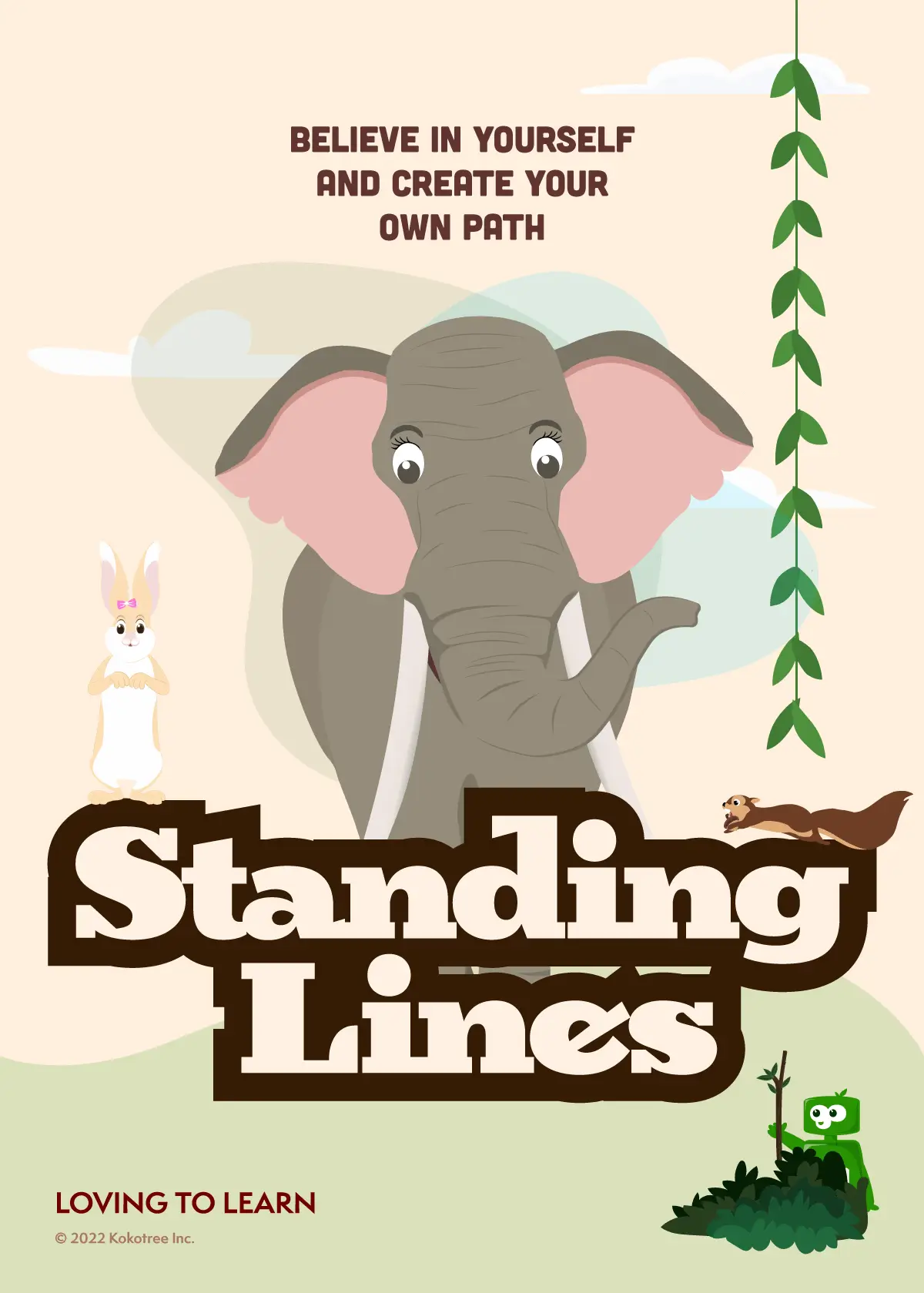
Your little one joins Elizabeth the elephant on a jungle exploration to discover standing lines hiding everywhere—from sticks on the ground to vines in trees! By the end, they'll confidently recognize and draw vertical lines, building the foundation for writing letters like L, T, and numbers like 1.
4 minutes
Ages 2-4
Skill: Pre-writing & Line Recognition
Your kid watches Elizabeth find standing lines in the jungle. You get 4 minutes to drink your coffee while it's hot.
Elizabeth walks through a colorful jungle, pointing out vertical lines in nature—a stick on the ground, a vine hanging from a tree, even a little mouse climbing up! The screen highlights each standing line so kids can clearly see the pattern. Then Elizabeth guides children through drawing their own standing lines using dots in the sky and dots by their toes.
What your child learns:
This video introduces vertical line recognition and drawing—essential pre-writing skills that prepare little hands for forming letters and numbers. Through rhymes and repetition, children learn that standing lines go "up and down" and can be found everywhere in nature.
- Recognizing vertical (standing) lines in real-world objects
- Understanding directional concepts: up and down
- Drawing lines using the dot-to-dot method
- Following multi-step visual instructions
- Connecting abstract shapes to concrete examples
They'll use these skills when:
- Noticing the tall lines on doors, fences, and building edges during walks
- Starting to write letters like I, L, T, E, F, H, and numbers like 1 and 4
- Drawing trees, houses, and people with proper proportions
- Following instructions in preschool art and writing activities
The Story (what keeps them watching)
Elizabeth the elephant invites kids into her lush jungle home for a special lesson. With catchy rhymes like "A standing line goes up and down, standing lines are all around!" she transforms a simple concept into a treasure hunt. Kids spot standing lines in a stick, then watch a tiny mouse scamper up a vine—leaving a line trail behind! The real magic happens when Elizabeth teaches the dot-to-dot technique: one dot in the sky where birds fly, one dot down by your toe, then connect! She even shows how pointing one finger to the sky creates an instant standing line. Clever!
How We Teach It (the clever part)
First 1.5 minutes: Elizabeth introduces the concept with a memorable rhyme and shows basic examples of standing lines in the jungle—a stick and a vine—highlighting each one visually so kids can clearly identify the pattern.
Minutes 1.5-3: The teaching gets hands-on! Elizabeth demonstrates the dot-to-dot drawing method twice, then invites children to follow along. She adds a kinesthetic element by having kids raise their hand, make a fist, and point a finger to the sky—their finger becomes a standing line!
Final minute: Elizabeth reinforces learning by repeating the opening rhyme while showing all the standing lines discovered, creating a satisfying full-circle moment that cements the concept.
Teaching trick: The video uses body-based learning—kids point their finger to the sky and discover they've made a standing line with their own hand! This kinesthetic connection helps the abstract concept click instantly.
After Watching: Quick Wins to Reinforce Learning
Mealtime activity: "Can you find standing lines on your plate?" Point to carrot sticks, celery, french fries, or even the edge of a sandwich. Kids practice spotting vertical lines in everyday foods.
Car/travel activity: "Let's count standing lines outside the window!" Look for telephone poles, tree trunks, fence posts, and tall buildings. This turns any drive into a learning game.
Bedtime activity: "Draw a standing line on my back with your finger!" Take turns drawing lines on each other's backs or palms. This reinforces the up-and-down motion without any supplies needed.
Anytime activity: "Show me a standing line with your body!" Have your child stand up tall and straight like a standing line, or point their finger to the ceiling. Great for wiggly moments when they need to move.
When Kids Get Stuck. And How to Help.
"My child draws the line sideways instead of up and down." Totally normal! Use the video's trick: point to the sky, point to your toes, then connect. Physical anchors (sky = up, toes = down) help more than verbal instructions alone.
"They can't find standing lines in real life yet." Start with super obvious examples like door frames or your own pointed finger. Once they "get it" with easy ones, they'll start spotting standing lines everywhere—you won't be able to stop them!
"The concept seems too simple—is this really helping?" Absolutely! Standing lines are the building blocks for 60% of uppercase letters. Mastering this one line type now means smoother handwriting development later. Simple doesn't mean unimportant.
What Your Child Will Learn
Prerequisites and Building Blocks
This video is ideal for children just beginning their pre-writing journey. No prior skills are required—it's designed as a true starting point. Standing lines are typically the first stroke children learn before progressing to sleeping lines (horizontal), slanted lines, and eventually curves. This video fits perfectly at the beginning of the Budding Sprouts program, establishing foundational visual discrimination and fine motor concepts that will support all future letter and number formation.
Cognitive Development and Teaching Methodology
The teaching approach leverages multiple evidence-based strategies perfect for toddlers and preschoolers. Rhyming text supports phonological memory and makes concepts "sticky." Visual highlighting isolates the target shape from complex backgrounds, reducing cognitive load. The kinesthetic finger-pointing activity engages bodily-kinesthetic learners and creates muscle memory. Repetition of the core rhyme three times follows the "rule of three" for retention, while the dot-to-dot method scaffolds the drawing process into manageable steps.
Alignment with Educational Standards
Standing line recognition and drawing aligns with kindergarten readiness standards across educational frameworks. It addresses fine motor development benchmarks and pre-writing indicators found in early learning guidelines. Teachers expect incoming kindergarteners to demonstrate basic stroke formation—standing lines, sleeping lines, and circles—before formal letter instruction begins. This video directly prepares children for manuscript handwriting programs like Handwriting Without Tears, which introduces vertical lines first.
Extended Learning Opportunities
Pair this video with standing line tracing worksheets available in the Kokotree app. Extend learning with playdough activities—roll "snakes" and stand them upright to make 3D standing lines. Use finger paint to practice the sky-to-toe drawing motion on paper. The app's "Line Hunt" game reinforces recognition skills. For outdoor extension, collect sticks and arrange them vertically, or use sidewalk chalk to draw giant standing lines children can walk along.
Transcript Highlights
- Core concept introduction: "A standing line goes up and down. Standing lines are all around. Standing lines are here and there. Standing lines are everywhere."
- Real-world connection: "Here's a stick on the ground. The little stick goes up and down. The little stick is very fine. The little stick's a standing line."
- Drawing instruction: "You start with a dot, in the sky. Up in the air where birds fly. We add a dot down below. Right down here, right by your toe."
- Kinesthetic learning moment: "Point your finger to the sky. And now you have a standing line! Your finger is a standing line!"
Character Development and Story Arc
Elizabeth the elephant models enthusiastic, patient teaching throughout the video. She demonstrates curiosity by exploring the jungle specifically to find examples, showing children that learning happens through observation. Her encouraging phrases—"Wow! You're doing great!" and "I have an idea!"—model positive self-talk and growth mindset. Elizabeth breaks down the drawing process into tiny steps, demonstrating that complex skills become manageable when approached systematically. Her calm, friendly demeanor creates a safe learning environment.
Pre-Writing Development: Why Standing Lines Come First
Standing lines (vertical strokes) are universally taught as the first pre-writing stroke because they align with natural developmental progression. Toddlers develop gross motor control in a top-to-bottom pattern, making downward strokes more intuitive than horizontal or diagonal movements. The shoulder and elbow joints naturally support vertical motion before the wrist develops the lateral stability needed for horizontal lines.
In terms of letter formation, standing lines appear in 15 of 26 uppercase letters (B, D, E, F, H, I, K, L, M, N, P, R, T, Y) and the numerals 1, 4, and 7. Mastering this single stroke gives children a significant head start on handwriting.
The video's dot-to-dot method is pedagogically sound because it provides clear start and end points, reducing the cognitive demand of spatial planning. Research shows that children learn directional strokes more effectively when given visual anchors. By associating "up" with the sky and "down" with toes, Elizabeth creates memorable reference points that children can recall independently.
The kinesthetic finger-pointing activity adds crucial proprioceptive feedback—children feel their arm extend upward, creating a body-based memory of "standing line" that reinforces visual learning. This multi-sensory approach ensures the concept transfers from screen to paper to real-world recognition, building the perceptual foundation children need for reading and writing success.