
What's Circle And The Color Yellow About?
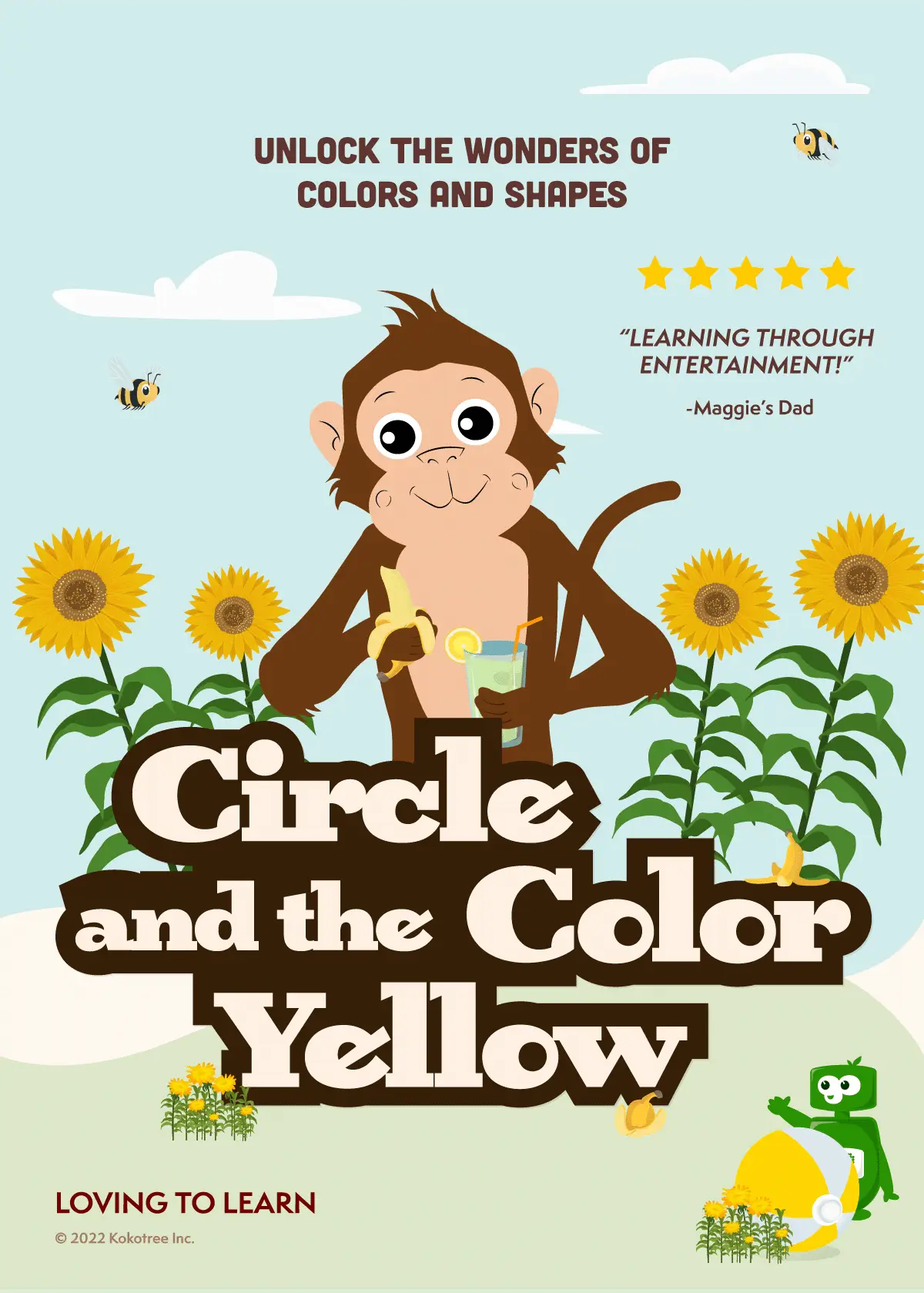
Your little one joins Meera the Tiger and her adorable animal students on a jungle walk to discover circles everywhere—from ponds to sunflowers—and explore the cheerful color yellow. They'll finish watching ready to spot circles and yellow objects all around your home!
9 minutes
Ages 1-4
Skill: Shape and color recognition
Your kid watches friendly animals hunt for circles in nature. You get 9 minutes to enjoy your coffee while it's still warm.
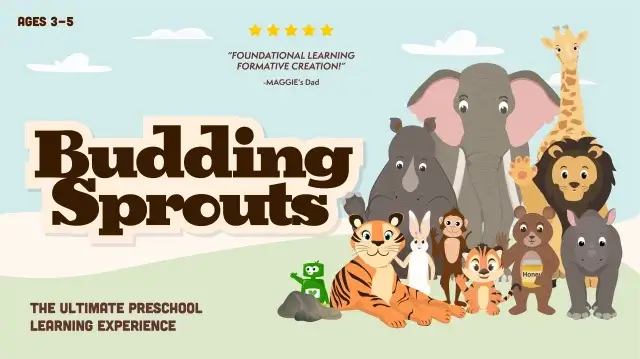
Meera the Tiger gathers her class of curious animal friends—Tiki Tiger, Ruby Rabbit, Maddy Monkey, Bobby Bear, and Gina Giraffe—in a sunny jungle clearing. They learn about circles through playful rhymes, then take a walk to a beautiful pond surrounded by sunflowers, lemons, and buzzing bumblebees. A catchy song ties together all the yellow things they discover!
What your child learns:
This video introduces two foundational concepts that toddlers encounter daily: the circle shape and the color yellow. Through rhymes, real-world examples, and interactive moments, children build visual recognition skills they'll use everywhere.
- Identifying circles in everyday objects (wheels, balls, the sun)
- Recognizing the color yellow in nature and food
- Understanding that circles have no beginning or end
- Connecting shapes to real-world items (pond, log cross-section, sunflower centers)
- Making circles with their own hands
They'll use these skills when:
- Picking out the round crackers at snack time
- Pointing to yellow cars during a walk
- Sorting toys by shape during playtime
- Describing what they see in picture books with friends
The Story (what keeps them watching)
Meera the Tiger welcomes her students for a special lesson about circles and yellow. The kids are instantly curious—Tiki shares that his mom talks about circles, while Maddy gets caught sneaking bananas (classic Maddy!). After learning that circles are round with no beginning or end, the whole class goes on a jungle walk. They discover a circular pond, spot circles in fallen logs and sunflowers, and Gina Giraffe notices how the bright yellow sun matches her beautiful fur! A cheerful song about yellow bumblebees, bananas, and baby chicks wraps up this sunny adventure.
How We Teach It (the clever part)
- First 3 minutes: Meera introduces circles through memorable rhymes ("This is a circle, a shape that's round. It has no end or beginning found.") while showing simple animations of circles growing and shrinking.
- Minutes 3-6: Interactive learning kicks in! Kids make circles with their hands, Ruby shows her hula hoop, and the class takes a nature walk to find circles in the real world—ponds, logs, and sunflower centers.
- Final 3 minutes: A catchy song connects yellow to familiar objects (bumblebees, bananas, sunshine), reinforcing color recognition through melody and repetition.
Teaching trick: The video pairs each new concept with something kids already know—circles are "like Bobby's face" and "like Ruby's hula hoop." This anchoring technique helps little brains file new information with existing knowledge.
After Watching: Quick Wins to Reinforce Learning
- Mealtime activity: "Can you find something circle-shaped on your plate?" Point to round foods like orange slices, pancakes, or the rim of their cup. Bonus points for finding yellow foods too!
- Car/travel activity: "Let's count how many circles we see!" Wheels, traffic lights, and signs are everywhere. See who spots the most yellow cars.
- Bedtime activity: "What yellow things did we see today?" Recall the day's yellow discoveries together—maybe their rubber duck, a banana at lunch, or the sunshine through the window.
- Anytime activity: "Can you make a circle with your hands like Maddy?" Practice the thumbs-and-fingers circle from the video, then hunt for circles around the room together.
When Kids Get Stuck. And How to Help.
- "My child calls ovals circles too." Totally normal at this age! Their brain is grouping "roundish" things together, which shows learning is happening. Gently point out that circles are perfectly round "like a ball" while ovals are stretched "like an egg."
- "They only remember yellow, not circles (or vice versa)." Learning two concepts at once is a lot! Rewatch and pause on just the circle OR yellow sections. Mastering one at a time builds confidence for tackling both.
- "My toddler won't sit through the whole video." Nine minutes is long for little ones! Watch in chunks—the circle section, then the yellow section later. Short, repeated viewings actually strengthen memory better than one long session.
What Your Child Will Learn
Prerequisites and Building Blocks
This video is designed for early learners with no prior shape or color knowledge required. It's perfect as a first introduction to geometric shapes and primary colors. Children who have watched other Budding Sprouts videos will recognize Meera and the animal friends, creating comfortable familiarity. This lesson lays groundwork for future learning about other shapes (squares, triangles) and colors (red, blue), establishing the pattern-recognition skills essential for mathematical thinking.
Cognitive Development and Teaching Methodology
The video employs multi-sensory learning strategies ideal for toddlers and preschoolers. Rhyming text activates phonological processing while supporting memory retention. Visual demonstrations of circles (drawn, growing, real-world) address visual learners, while the interactive "make a circle with your hands" moment engages kinesthetic learners. The song section uses melodic learning to cement color associations. Repetition throughout—hearing "circle" and "yellow" dozens of times—aligns with how young brains build neural pathways.
Alignment with Educational Standards
This video addresses foundational geometry standards for pre-K, specifically identifying and describing circles. It also covers color recognition benchmarks expected before kindergarten entry. The content aligns with Head Start Early Learning Outcomes Framework domains for Mathematics (geometry and spatial sense) and Scientific Reasoning (observation skills). Teachers expect incoming kindergartners to identify basic shapes and primary colors—this video directly prepares children for those assessments.
Extended Learning Opportunities
Pair this video with circle tracing worksheets to develop fine motor skills alongside shape recognition. The Kokotree app includes shape-sorting games that reinforce circle identification. Extend learning with a "yellow scavenger hunt" around your home or a nature walk to find circles outdoors. Create simple art projects using circular objects as stamps (toilet paper rolls, cup bottoms) with yellow paint to combine both concepts in hands-on exploration.
Transcript Highlights
- Teaching circles through rhyme: "This is a circle, a shape that's round. It has no end or beginning found."
- Real-world connection: "A circle has no beginning or end, just like your hula hoop. You can go 'round and 'round in circles."
- Interactive learning moment: "Can you make a circle with your hands? Give it a try, just like this."
- Color association through song: "Yellow is the color of the bumblebee. And the canary on the tree. Yellow is the color of lemonade. And the banana that Maddy ate."
Character Development and Story Arc
The animal characters model ideal learning behaviors throughout. Tiki Tiger demonstrates that connecting new knowledge to home life ("My mom talks about circles") deepens understanding. Bobby Bear shows thoughtful observation by noticing his face is round. Maddy Monkey's banana-eating moment provides gentle humor about staying focused, then shows recovery by enthusiastically participating in the hand-circle activity. Gina Giraffe models making personal connections to learning ("I love yellow because it reminds me of sunshine"). These behaviors teach children how engaged learners act.
Shape Recognition and Color Learning: A Developmental Deep Dive
Circles are typically the first shape children master, and for good reason—they appear constantly in a child's world. From plates to balls to wheels, circles are everywhere, making them the perfect entry point for geometric thinking. This video capitalizes on that familiarity by showing circles in contexts toddlers already know: the sun, bouncing balls, car wheels, and even their own faces.
The pairing of circles with yellow is pedagogically intentional. Yellow is one of the first colors children can reliably distinguish, as it activates strong responses in developing visual systems. The bright, warm quality of yellow also creates positive emotional associations, making learning feel cheerful and rewarding.
The video's approach—moving from abstract (animated circles) to concrete (real-world circles in nature)—follows the concrete-representational-abstract (CRA) teaching sequence recommended by early childhood researchers. Children first see what a circle IS, then find circles in familiar objects, building the classification skills that underpin all future mathematical thinking.
The interactive hand-circle activity is particularly valuable. When children physically create a shape, they engage proprioceptive learning—their muscles "remember" the roundness. This body-based learning creates stronger memory traces than passive viewing alone. The song section uses a familiar melody structure, reducing cognitive load so children can focus on the new content (yellow objects) rather than struggling with an unfamiliar tune.
By video's end, children have encountered circles and yellow through visual, auditory, kinesthetic, and musical pathways—a comprehensive approach that ensures the concepts stick regardless of individual learning preferences.