
What's Counting 1 to 10 About?
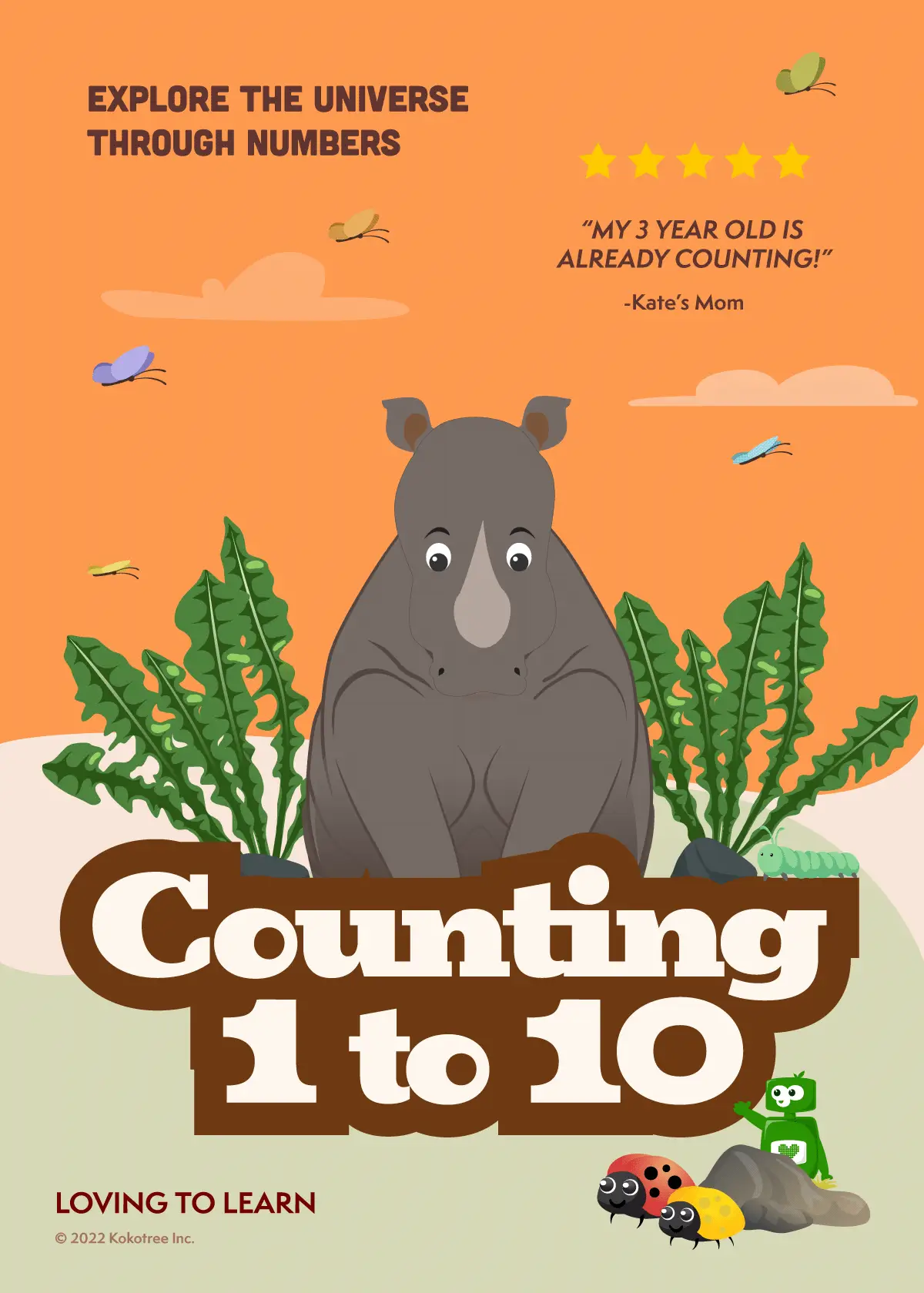
Your little one joins Rocko the Rhino for their very first math adventure, learning to count from one to ten with confidence. By the end, they'll be counting everything in sight!
4 minutes
Ages 1-6
Skill: Number recognition and counting sequence
Your kid watches a friendly rhino count numbers in the jungle. You get 4 minutes to sip that coffee while it's still warm.
Rocko the Rhino welcomes your child to a colorful jungle setting where numbers appear on screen one by one. Each number is spoken clearly, displayed visually, and repeated multiple times with built-in pauses for your child to practice saying them back.
What your child learns:
This video builds the foundation of all math skills—counting! Through repetition and active participation, children memorize the counting sequence and begin recognizing written numerals.
- Recognizes written numbers 1 through 10
- Says number names in the correct order
- Practices verbal repetition for memory building
- Develops confidence speaking numbers out loud
- Understands counting as a predictable sequence
They'll use these skills when:
- Counting crackers on their snack plate at lunch
- Pressing elevator buttons and announcing the floor
- Counting steps while walking up the stairs
- Telling you how many toys they want to bring to the park
The Story (what keeps them watching)
Rocko the Rhino is the friendliest math teacher in the jungle! He invites your child to sit close and learn something special—counting from one to ten. Rocko counts through the numbers multiple times, first demonstrating, then encouraging your child to repeat after him. The gentle pacing and warm encouragement ("You're doing great!" "You're doing fantastic!") keeps little learners engaged. By the end, Rocko celebrates their progress and reminds them to practice every day. It's simple, repetitive, and exactly what young brains need.
How We Teach It (the clever part)
- First 1 minute: Rocko introduces himself as a math teacher and counts 1-10 while numbers appear on screen, letting children absorb the sequence visually and audibly.
- Minutes 1-3: The counting repeats with built-in pauses, prompting children to say each number out loud. This active participation cements the learning.
- Final minute: Rocko celebrates their effort, reinforces that counting is fun, and encourages daily practice to build the habit.
Teaching trick: Numbers are grouped into chunks of three (1-2-3, 4-5-6, 7-8-9-10), making the sequence easier for young minds to remember—just like learning a phone number!
After Watching: Quick Wins to Reinforce Learning
- Mealtime activity: "Let's count your peas! One, two, three..." (Reinforces counting with real objects they can touch and eat)
- Car/travel activity: "Can you count to ten before we get to the stop sign?" (Practices the sequence from memory without visual cues)
- Bedtime activity: "Let's count your stuffed animals on the bed together." (Connects counting to beloved objects, making it personal)
- Anytime activity: "How many fingers am I holding up?" (Builds number recognition and counting in a playful guessing game)
When Kids Get Stuck. And How to Help.
- "My child always skips the same number." - Totally normal! The numbers 4-5-6 and 7-8-9 often blur together. Slow down and tap your finger for each number to create a physical rhythm they can follow.
- "They can say the numbers but don't seem to understand what they mean." - At this stage, memorizing the sequence comes first—understanding quantity comes later. Think of it like learning the alphabet before reading words.
- "My child loses interest before the video ends." - Start with just the first counting round and build up. Repetition works best in short bursts throughout the day rather than one long session.
What Your Child Will Learn
Prerequisites and Building Blocks
This video is designed as a true starting point—no prior counting knowledge required. Children benefit from basic attention skills and familiarity with listening to instructions. "Counting 1 to 10" serves as the foundation for all future math content in the Budding Sprouts program, preparing learners for counting objects, understanding quantity, and eventually simple addition. It pairs well with shape and color recognition videos that also build visual discrimination skills.
Cognitive Development and Teaching Methodology
The video leverages spaced repetition, a proven memory technique where information is repeated at intervals to strengthen recall. Chunking numbers into groups of three reduces cognitive load for developing minds. The call-and-response format activates verbal processing and motor memory simultaneously. Visual number display paired with audio creates multi-sensory learning pathways, accommodating visual, auditory, and kinesthetic learners through watching, listening, and speaking.
Alignment with Educational Standards
This video addresses Common Core Math Standard K.CC.A.1 (count to 100 by ones) at its foundational level. It supports Head Start Early Learning Outcomes in Mathematics, specifically "Child knows number names and the count sequence." Kindergarten readiness assessments typically expect children to count to 10 independently—this video builds exactly that skill through research-backed repetition methods.
Extended Learning Opportunities
Pair this video with Kokotree's counting worksheets featuring numbers 1-10 for tracing practice. Follow up with "Counting Objects" videos that connect number words to quantities. The Kokotree app includes interactive counting games where children tap objects while counting. Extend learning with household activities: counting toys during cleanup, steps while walking, or items during grocery shopping.
Transcript Highlights
- "I'm Rocko the Rhino, your math teacher. And I love talking about numbers. Welcome to your first math class." (Establishes warm, welcoming learning environment)
- "Now, you might know some of these already, and that's great. Just follow along." (Validates prior knowledge and reduces pressure)
- "This time, repeat after me." (Shifts from passive watching to active participation)
- "Make sure you practice this every day. See you next time!" (Encourages habit formation and continuity)
Character Development and Story Arc
Rocko the Rhino models the role of an encouraging, patient teacher. His warm greeting ("Hi. How ya doin? Come on in.") creates immediate rapport with young viewers. Throughout the video, Rocko demonstrates enthusiasm for learning ("Counting is so much fun!") and offers specific praise ("You're doing great!" "You're doing fantastic!"). This positive reinforcement models growth mindset—celebrating effort and progress rather than perfection.
The Mathematics of Early Counting: Building Number Sense
Counting from 1 to 10 may seem simple, but it represents one of the most critical mathematical milestones in early childhood. This process, called "rote counting," establishes the stable order principle—understanding that number words always come in the same sequence. Children must memorize this sequence before they can apply it to counting objects (one-to-one correspondence) or understanding that the last number represents the total (cardinality).
The video's structure reflects how young brains learn best. First exposure is passive—children watch and listen as Rocko counts. Second exposure reinforces through repetition. Third and subsequent exposures shift to active recall, where children must retrieve and produce the number names themselves. This progression from recognition to recall mirrors how memory consolidates information from short-term to long-term storage.
Chunking numbers into groups (1-2-3, 4-5-6, 7-8-9-10) reduces working memory demands. Young children can typically hold 3-4 items in working memory, making these groupings developmentally appropriate. The visual display of numerals alongside spoken words builds the crucial connection between number symbols and their names—a skill called "numeral identification" that predicts later math achievement.
Daily practice, as Rocko encourages, leverages the spacing effect: distributed practice over time produces stronger, more durable learning than massed practice in a single session.