
What's Counting Backwards 10 to 1 About?
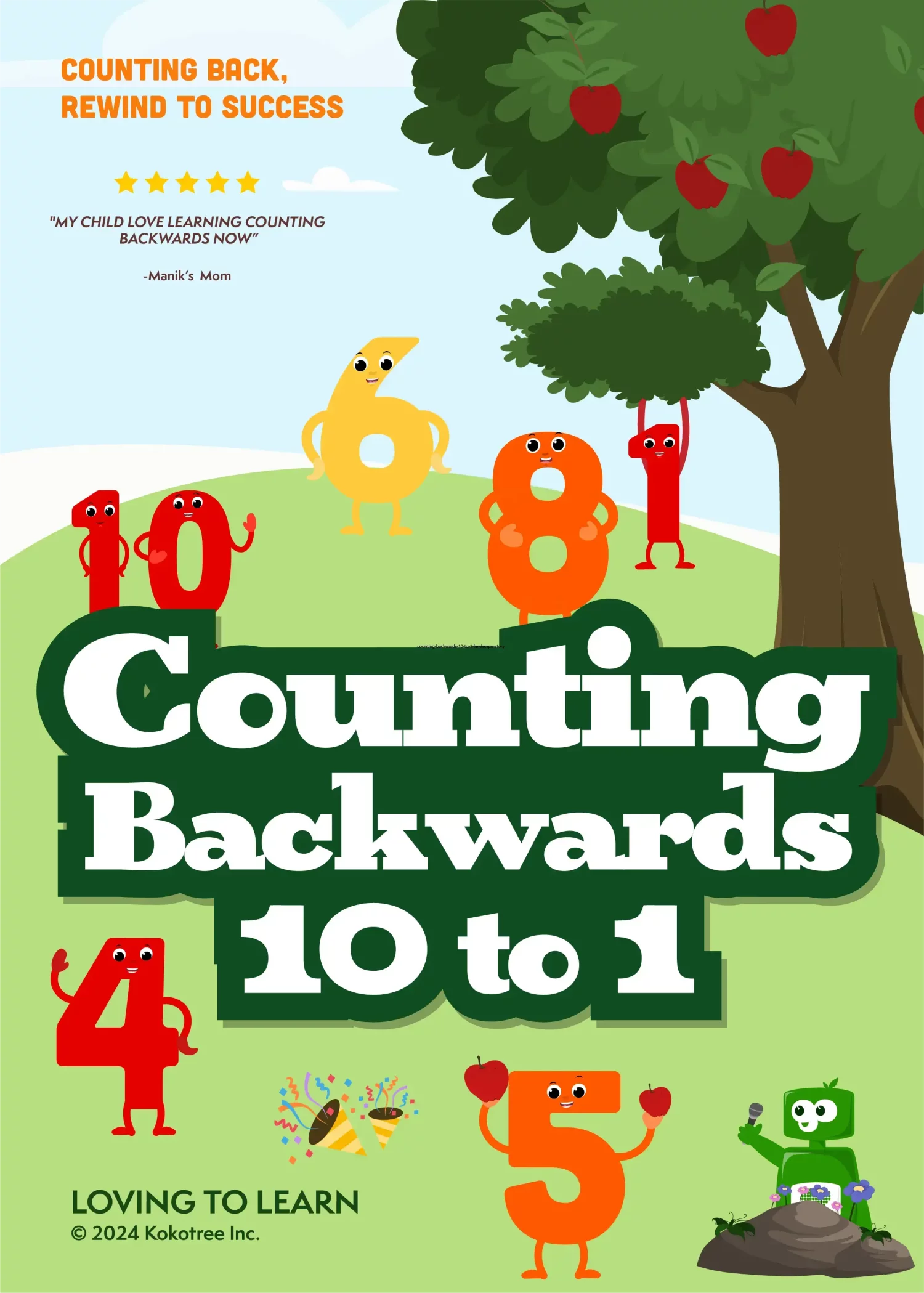
Your little one joins the Kokotree Class under the apple tree at night for a cozy counting adventure! They'll practice counting backwards from 10 to 1 using real objects—and walk away ready to countdown anything from snacks to bedtime.
6 minutes
Ages 3-5
Skill: Reverse number sequencing (10 to 1)
Your kid watches friendly animals pick apples and count backwards. You get 6 minutes to finish that cup of coffee.
The Kokotree Class gathers around an apple tree with 10 apples on a branch. As each character picks an apple (mostly for hungry Bobby Bear!), everyone counts down together. Then a caterpillar appears, and kids count its 10 body segments forwards AND backwards. Finally, they practice using their own fingers to count down.
What your child learns:
This video builds reverse counting fluency through repetition with different objects. Your child sees the same 10-to-1 sequence three different ways, which helps the pattern stick in their memory.
- Counting backwards from 10 to 1 with confidence
- Understanding that numbers decrease in reverse order
- One-to-one correspondence (matching counting words to objects)
- Using fingers as a counting tool
- Recognizing that counting works with ANY set of objects
They'll use these skills when:
- Counting down to blast off during rocket ship play
- Waiting for cookies to cool ("10 more seconds!")
- Playing hide and seek with friends
- Understanding "5 more minutes until bedtime"
The Story (what keeps them watching)
It's nighttime at the apple tree, and the Kokotree Class wants one more lesson before bed. Mr. Rocko spots 10 apples on a branch—perfect for counting practice! Each animal takes turns picking apples while everyone counts backwards together. Bobby Bear eats almost ALL of them (he really loves apples!). When the apples are gone, a curious caterpillar appears with exactly 10 body segments to count. The video ends with kids learning they can count backwards anytime using just their fingers. No apples or caterpillars required!
How We Teach It (the clever part)
- First 2 minutes: Mr. Rocko introduces the 10 labeled apples and explains the backwards counting game. Kids see numbers visually attached to objects.
- Minutes 2-4: The class picks apples one by one, counting down with each removal. Bobby Bear's apple-eating adds humor and keeps attention high.
- Final 2 minutes: Learning transfers to new objects (caterpillar segments, then fingers), proving that backwards counting works everywhere.
Teaching trick: The video uses three completely different objects (apples, caterpillar tummies, fingers) to teach the same sequence. This "varied repetition" helps kids understand that 10-9-8-7-6-5-4-3-2-1 isn't just about apples—it's a pattern that works with anything!
After Watching: Quick Wins to Reinforce Learning
- Mealtime countdown: "Let's count your grapes backwards before you eat them! Start with how many you have." (Practices connecting quantity to reverse sequence)
- Car ride blast-off: "Let's do a rocket countdown! 10, 9, 8..." then make a blast-off sound together. (Reinforces the sequence through play)
- Bedtime fingers: "Show me 10 fingers. Now let's count backwards and put one down each time." (Mirrors exactly what they saw in the video)
- Stair stepping: Count backwards as you walk down stairs together. "10 steps to go, 9 steps to go..." (Adds movement to reinforce decreasing numbers)
When Kids Get Stuck. And How to Help.
- "My child keeps mixing up the order after 7." Totally normal! The middle numbers (7, 6, 5, 4) are the trickiest. Practice just 7-6-5-4 separately, then add the beginning and end back in.
- "They can only do it with the video, not on their own." That's actually the first step! Try counting backwards together during the video, then pause it and see if they can finish. Gradual release builds confidence.
- "Backwards counting seems harder than regular counting." It absolutely is! Forward counting follows the order kids learned first. Backwards counting requires holding the sequence in memory AND reversing it. Give it time—this video is designed for repeat viewing.
What Your Child Will Learn
Prerequisites and Building Blocks
Children watching this video should already count forward from 1 to 10 with confidence and understand that numbers represent quantities. This video builds on the "Counting Backwards 15 to 10" episode, extending reverse counting skills to complete the full countdown sequence. It fits into the number sense progression by strengthening backward fluency, which prepares children for subtraction concepts. Mastering 10-to-1 counting also supports future learning in measurement (counting down units) and time awareness.
Cognitive Development and Teaching Methodology
This video leverages the concrete-representational-abstract (CRA) teaching progression ideal for ages 3-5. Children first see concrete objects (apples being removed), then a semi-concrete representation (caterpillar segments), and finally abstract finger counting. The varied repetition approach—same sequence, different objects—builds transfer skills. Visual labeling of numbers supports visual learners, while the call-and-response counting engages auditory processors. The physical finger activity at the end addresses kinesthetic learners who need movement to anchor learning.
Alignment with Educational Standards
This video addresses Common Core Math Standard K.CC.A.1 (count to 100 by ones) by building the reverse fluency that strengthens overall number sense. It supports kindergarten readiness indicators for "demonstrates understanding of number sequence" and "counts backwards from 10." Head Start Early Learning Outcomes Framework Goal P-MATH 2 (verbal counting) is directly addressed. Many state Pre-K standards include backward counting from 10 as a benchmark skill, making this video excellent preparation for formal schooling.
Extended Learning Opportunities
Pair this video with Kokotree's printable "Countdown Caterpillar" worksheet where children color segments while counting backwards. The app's "Number Blast" game reinforces reverse sequencing through interactive rocket launches. Extend learning with a homemade countdown calendar for special events, or create a paper chain with 10 links to remove daily. For advanced learners, try counting backwards from 20 or counting backwards by 2s. Physical activities like jumping backwards while counting add gross motor integration.
Transcript Highlights
- Setting up the learning goal: "Let's count backwards from ten to one. Each time we take an apple down, we'll count which number it was. Ready?"
- Transferring to new context: "Let's count how many little tummies the caterpillar has, shall we?" followed by "And now it's crawling backwards. So let's count his tummies backwards too!"
- Teaching the finger strategy: "You can count down from ten by using your hands. Hold up your fingers. And then count down. And put your fingers down one by one as you count."
- Positive reinforcement: "Wonderful! You all did such a good job counting down from ten, class!"
Character Development and Story Arc
Mr. Rocko models excellent teaching behaviors—he responds to Ruby's request for "just one more lesson" with flexibility, showing children that curiosity is valued. Bobby Bear's enthusiastic apple-eating provides comic relief while demonstrating that learning can be joyful (and delicious!). When Bobby offers his last apple to someone else, he models sharing and self-awareness. The ensemble participation shows collaborative learning, with each character taking turns picking apples. Maddy's request to count "one more time" when the caterpillar leaves demonstrates persistence and love of learning.
The Mathematics of Backward Counting: Building Number Sense
Backward counting (also called "counting back") is significantly more cognitively demanding than forward counting because it requires children to hold the number sequence in working memory while simultaneously reversing it. This skill is foundational for subtraction—when children later solve "8 - 3," they'll use backward counting strategies (8, 7, 6, 5... the answer is 5).
The video strategically uses one-to-one correspondence throughout. Each apple removed matches exactly one number word, reinforcing cardinality (the last number counted represents the total). When the class counts the caterpillar's segments forward first, then backward, they experience that the quantity (10) remains constant regardless of counting direction—an early conservation of number concept.
Using fingers as the final counting tool is pedagogically brilliant. Fingers are always available, making this a portable math strategy. Research shows that finger counting activates the somatosensory cortex, creating stronger neural pathways for number concepts. Children who use fingers while learning to count often develop stronger number sense than those who don't.
The varied contexts (apples, caterpillar, fingers) prevent children from thinking backward counting only works with one type of object. This abstraction—understanding that mathematical principles apply universally—is a crucial developmental milestone. By age 5-6, children should count backward from 10 fluently, and this video provides the scaffolded practice to achieve that benchmark through engaging, repeated exposure.