
What's Inside and Outside About?
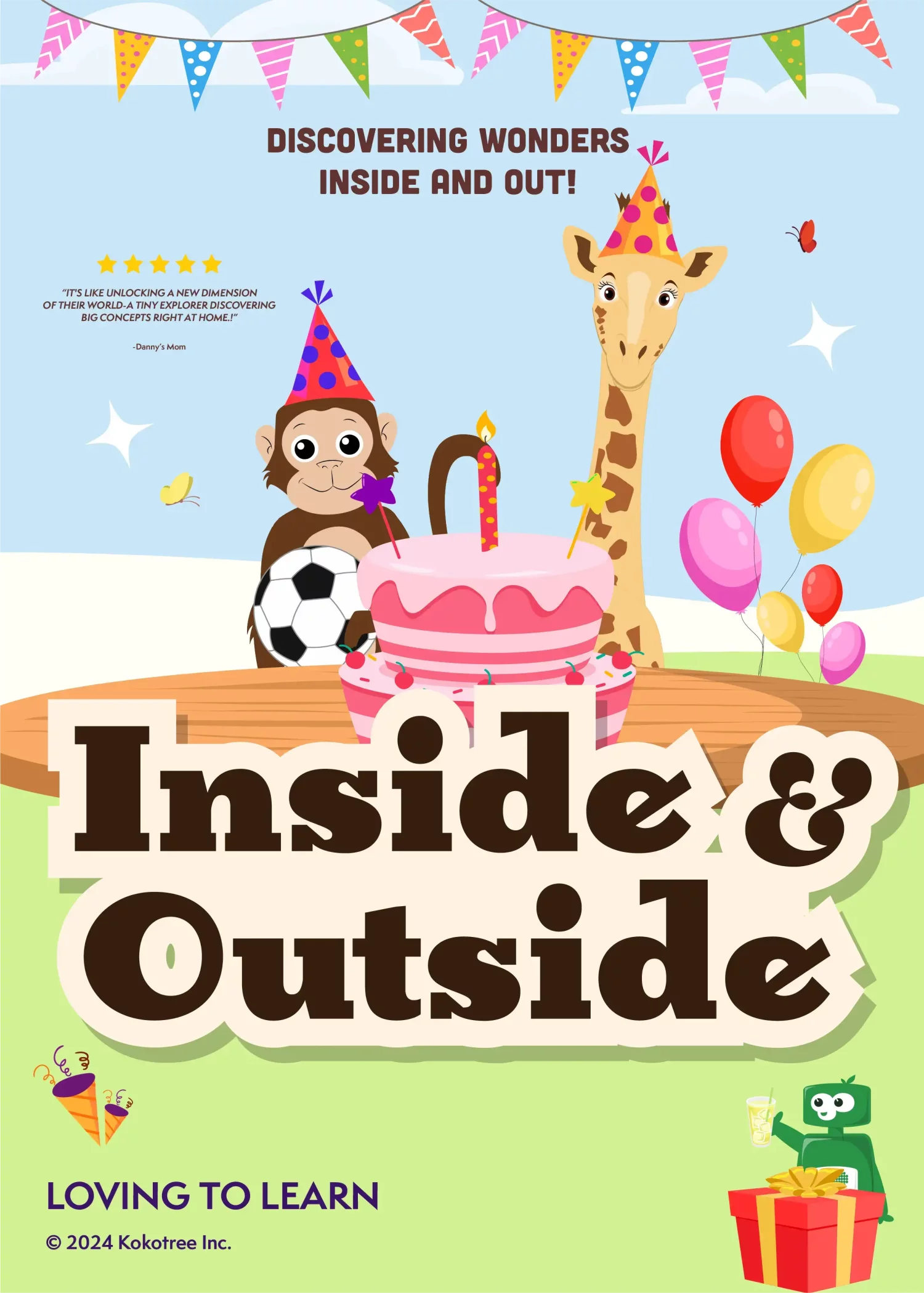
Your little one joins Miss Elizabeth and friends for a birthday celebration that turns into a playful lesson on spatial awareness! After watching, your child will confidently point out what's inside the toy box and what's outside the window.
7 minutes
Ages 1-6
Skill: Understanding spatial relationships (inside vs. outside)
Your kid watches friendly animals play hide-and-seek while learning positions. You get 7 minutes to [drink your coffee while it's still warm].
Miss Elizabeth takes the Kokotree Class outside on Gina Giraffe's birthday for hands-on learning fun. The kids jump in and out of hoopla rings, then play an exciting game of hide-and-seek where they discover who's inside the treehouse, inside a basket, and inside the classroom.
What your child learns:
This video introduces foundational spatial concepts through active play and storytelling. Your child will understand the difference between being inside something (like a circle or room) and outside of it—a skill that builds vocabulary and prepares them for math concepts.
- Distinguishing between "inside" and "outside" positions
- Following simple directional instructions ("jump inside," "jump outside")
- Observing and describing where objects and people are located
- Connecting spatial words to real-world situations
- Building listening skills through game-based learning
They'll use these skills when:
- Putting toys inside the toy bin at cleanup time
- Understanding "come inside" or "let's go outside" from caregivers
- Playing games that involve positions (hide-and-seek, obstacle courses)
- Describing where things are to friends ("the ball is inside the box")
The Story (what keeps them watching)
It's Gina Giraffe's birthday, and Miss Elizabeth has a special outdoor surprise! The class gathers around a big chalk circle where Gina steps inside, then outside—making the concept click instantly. Next comes hoopla ring jumping that gets everyone moving, followed by the ultimate test: hide-and-seek! Miss Elizabeth hunts for her students, finding Maddy hanging outside the treehouse, Tiki and Bobby Bear hiding inside it, Ruby tucked inside a basket, and Ronnie's horn poking outside the bushes. The birthday girl? She's clever—hiding inside the classroom!
How We Teach It (the clever part)
- First 2 minutes: Miss Elizabeth introduces the concept using a simple chalk circle. Gina physically moves inside and outside while the class watches, creating a clear visual demonstration.
- Minutes 2-4: Active participation begins! Every child gets a hoopla ring and practices jumping inside and outside on command, turning the concept into muscle memory.
- Final 3 minutes: Hide-and-seek reinforces learning naturally. Miss Elizabeth narrates each discovery using "inside" and "outside" repeatedly—"You're inside the treehouse!" "Your horn is outside the bushes!"
Teaching trick: By having body parts (ears, tails, horns) stick "outside" while the animal hides "inside," the video creates memorable visual contrasts that make the concept impossible to forget.
After Watching: Quick Wins to Reinforce Learning
- Mealtime activity: "Is your spoon inside the bowl or outside the bowl?" Point to different items and ask your child to identify their position. Great for building vocabulary during snack time!
- Car/travel activity: "I spy something inside the car... I spy something outside the car!" Take turns finding objects in each position. Perfect for keeping little minds busy on the go.
- Bedtime activity: "Is teddy inside the bed or outside the bed?" As you tuck in stuffed animals, narrate their positions. Reinforces learning while creating cozy routines.
- Anytime activity: Grab a laundry basket and play "inside/outside jump!" Call out positions and have your child hop in and out—just like the hoopla ring game in the video.
When Kids Get Stuck. And How to Help.
- "My child keeps mixing up inside and outside." Totally normal! These spatial concepts take time to stick. Use a cardboard box and physically place toys inside, then outside, narrating each action. Repetition with real objects helps it click.
- "She understands during the video but forgets right after." That's how little brains work—they need lots of practice! Point out inside/outside throughout your day: "We're going inside the store now." Casual repetition builds lasting understanding.
- "This seems too simple for my child." Great news—they're ready to level up! Add "on top of," "under," and "beside" to your vocabulary. This video builds the foundation for more complex spatial concepts coming soon.
What Your Child Will Learn
Prerequisites and Building Blocks
This video works best when children can follow simple one-step instructions and have basic circle recognition. It builds naturally on earlier shape videos and prepares children for more complex spatial relationships like "between," "above," and "below." The inside/outside concept serves as a gateway to positional vocabulary that supports both early literacy (following written directions) and mathematical thinking (geometry foundations). No prior Kokotree videos are required, but children who've watched the Shapes series will recognize the circle immediately.
Cognitive Development and Teaching Methodology
The three-phase teaching approach (demonstration → active practice → contextual application) aligns perfectly with how 1-6 year olds learn spatial concepts. Young children need to physically experience positions before abstractly understanding them—hence the hoopla ring jumping. The hide-and-seek game leverages children's natural love of play while providing repeated exposure to target vocabulary in meaningful contexts. Visual, auditory, and kinesthetic learners are all engaged through watching demonstrations, hearing repeated verbal cues, and moving their bodies.
Alignment with Educational Standards
This video addresses foundational geometry standards found in early childhood frameworks worldwide, specifically understanding spatial relationships and positional vocabulary. Kindergarten readiness checklists consistently include "uses position words correctly" as a key indicator. The content aligns with preschool math benchmarks requiring children to describe relative positions of objects using appropriate vocabulary. Teachers expect incoming kindergarteners to follow two-step positional directions—this video builds that exact skill through the "jump inside/jump outside" sequences.
Extended Learning Opportunities
Pair this video with printable worksheets featuring animals in boxes (circle which are inside!). The Kokotree app's "Position Play" game reinforces these concepts interactively. Extend learning with household activities: sorting toys into containers, playing "hot and cold" with hidden objects, or creating obstacle courses with inside/outside stations. Reading books about houses, caves, or containers naturally reinforces the vocabulary. For advanced learners, introduce the related concepts of "enter" and "exit" during daily transitions.
Transcript Highlights
- "Now you are inside the circle." / "See? Now Gina is outside of the circle." — Clear, simple demonstration with immediate contrast
- "Jump inside the ring! Jump outside the ring!" — Rhythmic repetition that builds muscle memory and vocabulary simultaneously
- "I see your ears outside the basket. Which means you must be inside the basket." — Logical reasoning modeled for children, connecting visual evidence to spatial conclusions
- "Right now we're outside the classroom. But soon we'll be inside the classroom with Gina." — Future-tense application showing the concept in transition
Character Development and Story Arc
The characters model enthusiastic participation and collaborative learning beautifully. Gina Giraffe shows confidence by volunteering first, while Ruby Rabbit demonstrates observational skills by noting Gina is "in the center." The self-aware humor—Gina joking about hiding her long neck, Ronnie about his big horn, Maddy about her long tail—models growth mindset by acknowledging challenges while still trying. Bobby Bear's surprise at not being spotted shows that learning can include delightful unexpected moments. Miss Elizabeth models patient, encouraging teaching throughout.
Spatial Reasoning Deep Dive: The Foundation of Mathematical Thinking
Spatial reasoning—the ability to understand and remember the spatial relations among objects—is one of the strongest predictors of later STEM success. Research consistently shows that children who develop strong spatial vocabulary early demonstrate advantages in mathematics, science, and engineering throughout their education.
The inside/outside distinction represents one of the first "topological" spatial concepts children master. Unlike metric concepts (measuring exact distances), topological concepts focus on relationships: containment, proximity, and boundaries. When a child understands that being "inside" means being enclosed by a boundary while "outside" means being beyond that boundary, they're grasping fundamental geometric principles.
This video strategically uses multiple boundary types—a chalk circle, hoopla rings, a treehouse, a basket, bushes, and a classroom—to help children generalize the concept. This variety prevents children from associating "inside" only with specific containers and builds flexible spatial thinking.
The physical movement component (jumping in and out of rings) activates the vestibular and proprioceptive systems, creating embodied cognition. When children physically experience crossing a boundary, the concept becomes encoded not just in language centers but in motor memory. This multi-modal encoding creates stronger, more durable learning.
The hide-and-seek segment adds inferential reasoning: seeing ears "outside" the basket leads to the conclusion that the body must be "inside." This logical extension prepares children for mathematical reasoning where known information leads to conclusions about unknown information—a foundational skill for problem-solving across all STEAM disciplines.