
What's Letter F About?
Your little one joins a classroom birthday celebration where every gift starts with the letter F! They'll master the "fuh" sound, identify F-words in a fun story, and learn to write both uppercase and lowercase F.
10 minutes
Ages 3-6
Skill: Letter recognition, phonics, and handwriting
Your kid watches animal friends celebrate with F-themed presents. You get 10 minutes to enjoy your coffee while it's still warm.
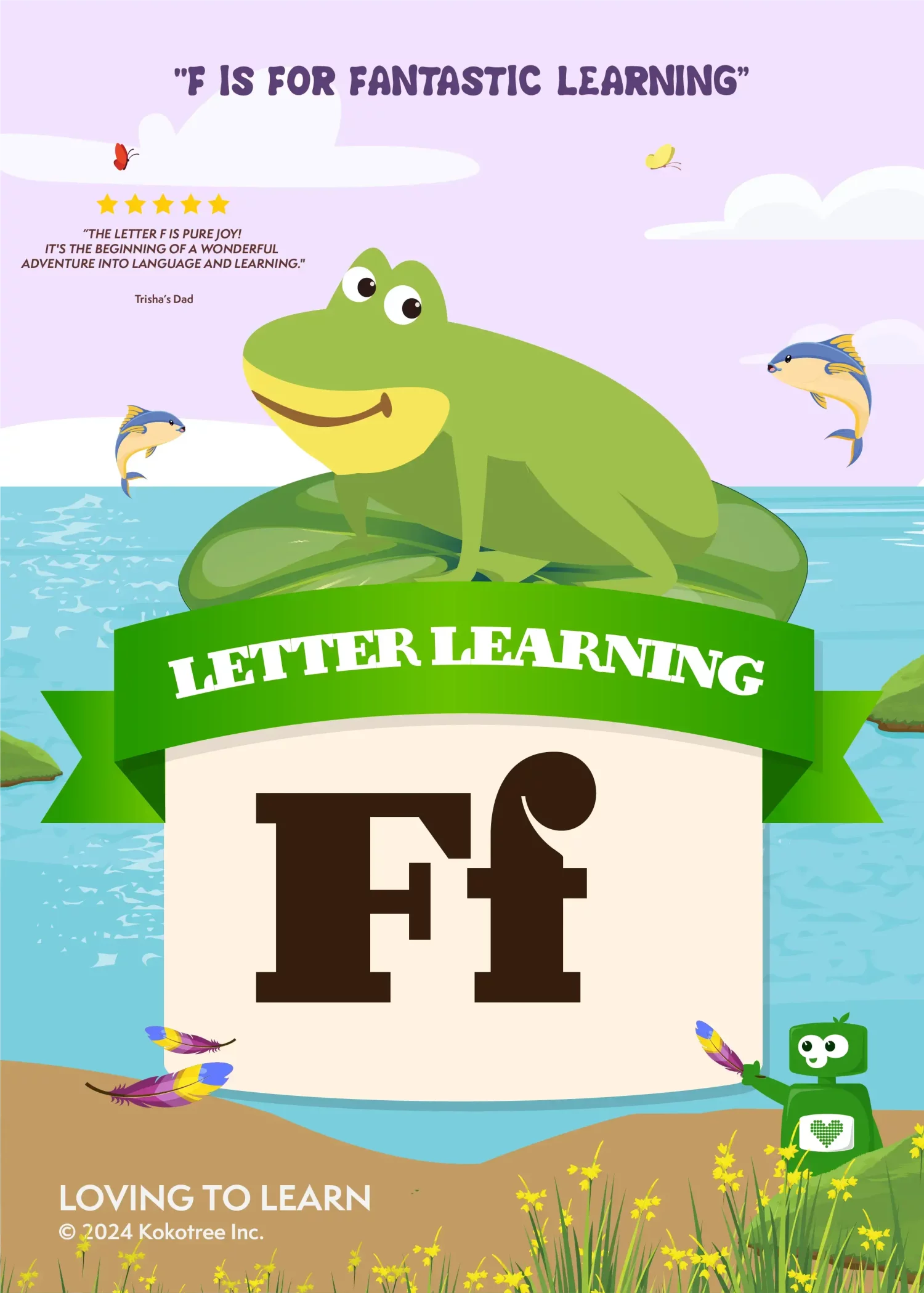
The Kokotree Class surprises Miss Meera with birthday gifts—a flower, flute, feather, frisbee, flag, fan, and even a friendly frog! Then they dive into an adventure story about fish and frogs at a freshwater lake, packed with F-words to spot.
What your child learns:
This video builds strong phonics foundations by connecting the letter F to its "fuh" sound through repetition and storytelling. Children practice identifying the sound at the beginning of words and get step-by-step handwriting instruction.
- Recognizes the letter F by sight (uppercase and lowercase)
- Produces the "fuh" sound confidently
- Identifies words that start with F (flower, frog, five, family)
- Writes uppercase F using standing and sleeping lines
- Writes lowercase f with proper curve formation
They'll use these skills when:
- Spotting the letter F on food packages at the grocery store
- Pointing out words that start with F in their favorite picture books
- Writing their name if it contains the letter F
- Playing "I Spy" games looking for F-objects around the house
The Story (what keeps them watching)
It's Miss Meera's birthday and her students have a surprise—gifts that all start with F! After naming each present (flower, flute, feather, frisbee, flag, fan, and a ribbiting frog), Miss Meera tells a story about Freddy the Frog and his fish friends Flipper and Fanta. When fishermen threaten the lake, Freddy's frog family saves the day by throwing farkleberries! Kids stay hooked spotting all the "fuh" sounds while learning that true friendship means helping others.
How We Teach It (the clever part)
- First 3 minutes: The "fuh" sound is introduced naturally through birthday gifts—each item (fan, feather, frisbee) gets the "fuh, fuh" treatment, making the sound memorable and fun.
- Minutes 3-7: An engaging story reinforces F-words in context. Kids hear "frog," "fish," "forest," "five," "friends," and "family" woven into an exciting adventure.
- Final 3 minutes: Handwriting instruction breaks down letter formation into simple steps (standing lines, sleeping lines), with two demonstrations of each letter.
Teaching trick: Miss Meera uses the "fuh, fuh, [word]" pattern before every F-word, training little ears to isolate and recognize the initial sound—so "fuh, fuh, flower" becomes automatic.
After Watching: Quick Wins to Reinforce Learning
- Mealtime activity: "Can you find something on your plate that starts with F?" (Fork! Fish sticks! French fries! They'll practice connecting the sound to real objects.)
- Car/travel activity: "Let's count how many things we see that start with the 'fuh' sound!" (Flags, flowers, fences—turns any drive into phonics practice.)
- Bedtime activity: "Use your finger to draw the letter F on my back—I'll guess if it's uppercase or lowercase!" (Reinforces letter formation without paper.)
- Anytime activity: "Can you walk like a frog and say three F-words?" (Combines movement with phonics for active learners.)
When Kids Get Stuck. And How to Help.
- "My child says 'fuh' but can't think of F-words on their own." - Totally normal! Start by giving choices: "Does 'fish' start with F or 'dog'?" This builds confidence before asking them to generate words independently.
- "The lowercase f seems harder than uppercase." - It is! The curve takes more fine motor control. Practice making "candy cane" shapes in the air first, then move to finger-tracing in sand or shaving cream.
- "My child mixes up F and other letters." - Very common, especially with similar-looking letters. Focus on the "fuh" sound first—once they hear it reliably, the visual recognition follows. Try exaggerating the sound together: "Fffff-rog!"
What Your Child Will Learn
Prerequisites and Building Blocks
Children benefit most from this video if they understand that letters represent sounds and have some exposure to the alphabet. This lesson builds on foundational letter awareness and prepares children for blending sounds into words. It pairs well with other Kokotree letter videos, particularly those covering similar formation patterns (like E and T, which also use standing and sleeping lines). This video strengthens the phonemic awareness needed for early reading success.
Cognitive Development and Teaching Methodology
The video leverages the "hook and repeat" method ideal for preschoolers—introducing the "fuh" sound through exciting context (birthday gifts!), then reinforcing it through narrative storytelling. This approach works because 3-6 year olds learn best through emotional engagement and repetition. Visual learners see the objects, auditory learners hear the repeated sound pattern, and kinesthetic learners can trace letters along with Miss Meera's instructions.
Alignment with Educational Standards
This video addresses key kindergarten readiness indicators including letter-sound correspondence (CCSS.ELA-LITERACY.RF.K.3), letter formation, and phonemic awareness. Teachers expect incoming kindergarteners to recognize most letters and associate them with sounds. The handwriting instruction aligns with proper stroke sequence emphasized in early writing curricula, using directional language (topline, baseline, midline) that children will encounter in school.
Extended Learning Opportunities
Pair this video with Kokotree's letter tracing activities and F-word matching games in the app. Print out letter F worksheets for additional handwriting practice. Create a "Letter F Treasure Hunt" around your home—find objects starting with F and sort them into a special box. Read picture books featuring frogs, fish, or farms to reinforce F-word recognition in new contexts.
Transcript Highlights
- Sound introduction: "All the gifts you got begin with the letter F and the sound of the letter F is 'fuh'."
- Repetition pattern: "Fuh, fuh, fan. Fuh, fuh, feather. Fuh, fuh, frisbee."
- Handwriting instruction: "Draw a standing line from topline to the base. Now go back to the topline and draw a small sleeping line to the right. Then go down to the midline and draw a short sleeping line to the right."
- Student engagement: "Freddy the Frog freed his friends from the fishermen."
Character Development and Story Arc
Miss Meera models enthusiastic learning and genuine appreciation for her students' efforts, showing children that learning is a joyful, shared experience. The story-within-the-story features Freddy the Frog demonstrating courage and loyalty—he warns his friends despite their dismissal, then returns to help them anyway. This models persistence and kindness. Ronnie Rhino's alliteration at the end shows how paying attention leads to creative accomplishments, reinforcing growth mindset.
Phonics and Letter Formation Deep Dive
The letter F presents unique learning opportunities in early literacy development. Phonetically, F is a voiceless labiodental fricative—meaning children create the sound by placing their top teeth on their lower lip and pushing air through. This is one of the easier consonant sounds for young children to produce and distinguish, making F an excellent early phonics focus.
The video's approach of pairing the sound with concrete objects (flower, frog, frisbee) leverages the concrete operational thinking stage typical of preschoolers. Children at this age learn abstract concepts (like letter-sound relationships) best when connected to tangible items they can visualize and potentially touch.
Handwriting instruction in this video follows developmentally appropriate practices by breaking letter formation into discrete steps using consistent directional vocabulary. "Standing line" and "sleeping line" are child-friendly terms that help young writers understand vertical and horizontal strokes. The uppercase F requires three strokes with two direction changes, while lowercase f introduces the more challenging curved stroke that prepares children for letters like j, g, and y.
The story component serves a dual purpose: maintaining engagement while providing contextualized repetition. Research shows children need 10-15 meaningful exposures to a letter-sound correspondence before it becomes automatic. This video provides well over 20 F-word exposures in a narrative that children want to follow, making the repetition feel natural rather than drill-like. The alliteration activity at the end ("Freddy the Frog freed his friends from the fishermen") introduces phonological awareness at a higher level, preparing children for more advanced reading skills.