
What's Counting Backwards 15 to 10 About?
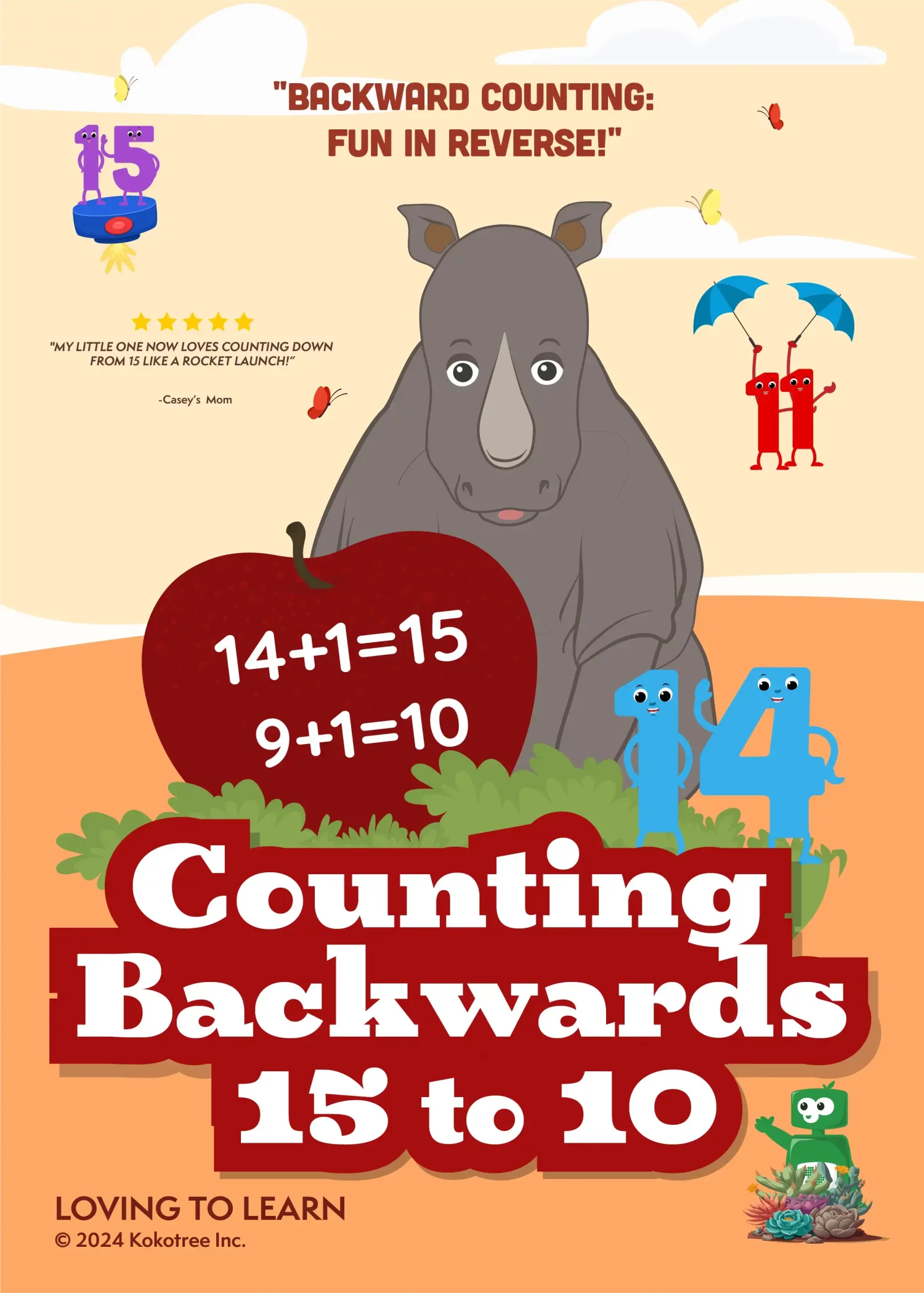
Your little learner joins Rocko and friends under a magical apple tree where counting gets turned upside down—in the best way! They'll discover that numbers can go backwards too, building essential math foundations through a fun, snack-filled adventure.
7 minutes
Ages 3-5
Skill: Reverse number sequencing (15-10)
Your kid watches animals pluck apples while counting backwards together. You get 7 minutes to enjoy your coffee while it's still warm.
Rocko the wise owl gathers the Kokotree class under their favorite apple tree for a special math lesson. One by one, each animal friend plucks an apple from a branch with fifteen apples, and together they discover what happens when you count in reverse—from fifteen all the way down to ten!
What your child learns:
This video transforms an abstract math concept into something kids can see, touch, and understand. By watching apples disappear one at a time, children grasp that subtraction and backward counting are connected—numbers get smaller when we take things away.
- Counting backwards from 15 to 10 with confidence
- Understanding that removing one item means one less number
- Recognizing the relationship between subtraction and reverse counting
- Building number sense through visual representation
- Practicing patience and turn-taking during group activities
They'll use these skills when:
- Counting down the days until a special event on a calendar
- Pressing elevator buttons and watching floors decrease
- Playing hide-and-seek and counting "10, 9, 8..." before seeking
- Sharing snacks and figuring out how many are left after each friend takes one
The Story (what keeps them watching)
Rocko invites the Kokotree class back to their beloved apple tree—the same one where they first learned to count! After a quick review counting up to fifteen apples, Rocko introduces a new challenge: what happens when we count the OTHER way? One by one, Gina bites an apple, Bobby eagerly gobbles his (and Tiki's!), Ronnie uses his horn, and Ruby makes a spectacular toss. With each apple plucked, the class counts down together, turning subtraction into a tasty game that ends with everyone smiling—especially apple-loving Bobby!
How We Teach It (the clever part)
- First 2 minutes: Rocko reviews forward counting 1-15 using apples on the branch, activating prior knowledge and building confidence before introducing the new concept.
- Minutes 2-5: Each animal takes turns plucking one apple while the class identifies how many remain. This hands-on demonstration makes abstract subtraction concrete and visual.
- Final 2 minutes: The whole class practices counting backwards 15-10 together, reinforcing the sequence through repetition and celebrating their new skill.
Teaching trick: By having different animal friends each remove ONE apple at a time, Rocko isolates the concept of "one less" so children can clearly see and understand the pattern before practicing the full backward sequence.
After Watching: Quick Wins to Reinforce Learning
- Snack time countdown: Put 15 crackers or grapes on a plate and say "Let's count backwards like Rocko's class!" Each time your child eats one, count down together. (Practices one-to-one correspondence while snacking)
- Stair stepping: Count backwards from 15 (or 10) as you walk down stairs together. "Fifteen, fourteen, thirteen..." (Connects numbers to physical movement)
- Bedtime countdown: "Let's do 15 countdown kisses!" Give kisses while counting backwards to ten. (Makes reverse counting cozy and memorable)
- Block tower: Stack 15 blocks, then remove one at a time while counting backwards. Let your child predict "How many will be left?" (Builds prediction skills and number sense)
When Kids Get Stuck. And How to Help.
- "My child keeps switching back to counting forward." - Totally normal! Forward counting is deeply ingrained. Try using hand motions—point down as you count backwards to create a physical cue that this is "going down" counting.
- "They can't remember what comes before a number." - This is harder than it sounds! Start with just 5-1 until that's solid, then expand. Singing countdown songs (like rocket launches) helps lock in the sequence.
- "15 to 10 seems like a lot of numbers." - It is! Break it into smaller chunks: practice 12-10 first, then add 15-13. The video can be rewatched focusing on just the final countdown scene for extra practice.
What Your Child Will Learn
Prerequisites and Building Blocks
Children should be comfortable counting forward from 1-15 before tackling this video—and the lesson thoughtfully reviews this skill first! This video builds directly on Kokotree's earlier counting videos where the class learned numbers 1-10 and then 11-15. It serves as a bridge between basic counting and formal subtraction, introducing the foundational concept that numbers can decrease as well as increase. This reverse sequencing skill prepares children for countdown activities and subtraction equations they'll encounter in kindergarten.
Cognitive Development and Teaching Methodology
At ages 3-5, children learn best through concrete, visual examples—which is exactly why Rocko uses real apples being physically removed rather than abstract number drills. The video applies scaffolded learning: reviewing known content (forward counting), introducing new vocabulary ("backward," "reverse"), then demonstrating through action. Multiple learning styles are engaged: visual learners see apples disappear, auditory learners hear the counting sequence, and kinesthetic learners can mimic the plucking motion at home.
Alignment with Educational Standards
This video addresses Common Core Math Standard K.CC.A.1 (count to 100 by ones) and its prerequisite skill of understanding number sequence in both directions. Kindergarten readiness assessments frequently include backward counting from 10 or 20. The one-to-one correspondence demonstrated (one apple removed = one number down) aligns with K.CC.B.4, connecting counting to cardinality. Teachers expect incoming kindergarteners to count backwards from at least 10 with confidence.
Extended Learning Opportunities
Pair this video with Kokotree's printable "Apple Tree Countdown" worksheet where children cross off apples while practicing the 15-10 sequence. The app's "Number Land" counting games reinforce these skills through interactive play. Extend learning with real apple counting during snack time, or use any stackable objects (blocks, cups, books) to recreate the plucking activity. For advanced learners, challenge them to continue the countdown from 10 to 1!
Transcript Highlights
- Introducing the concept: "Today we are going to learn about backward counting. Any guesses on what the term 'backward' counting suggests?" - Rocko invites prediction before teaching.
- Making it concrete: "There were fifteen apples but Gina took one. So how many apples are left on the tree?" - Direct connection between action and number change.
- Reinforcing the pattern: "Did you notice that we counted backwards from fifteen to fourteen to thirteen to twelve to eleven to ten?" - Explicit naming of the sequence helps cement learning.
- Building confidence: "Let's attempt it once again... Nicely done. Do you feel a little more comfortable now?" - Encouraging repetition and self-assessment.
Character Development and Story Arc
Each animal character models positive learning behaviors throughout the lesson. Bobby demonstrates enthusiasm (even excessive enthusiasm for apples!), showing that excitement about learning is wonderful. Tiki models generosity by sharing his apple, and the class responds with kindness rather than judgment when he admits he doesn't like apples. Maddy's initial comment that "math is okay" but "not as fun as swinging" shows authentic child perspective—and by the end, everyone is engaged and smiling, modeling how new challenges become enjoyable with practice.
The Mathematics of Backward Counting: Building Number Sense
Backward counting is far more cognitively demanding than forward counting, and understanding why helps parents appreciate this milestone. When children count forward, they're reciting a memorized sequence—similar to singing the alphabet. Backward counting requires working memory to hold the sequence while mentally reversing it, plus understanding of numerical magnitude (knowing that 13 is "less than" 14).
This video brilliantly uses the "one less" principle as its foundation. Rather than asking children to memorize a backward sequence in isolation, Rocko connects each number change to a concrete action: one apple removed equals one number down. This builds true number sense—the intuitive understanding that numbers represent quantities, not just words in a sequence.
The choice to focus on 15-10 (rather than 10-1) is pedagogically strategic. Children this age often have 10-1 partially memorized from songs and games, but 15-10 requires applying the backward counting PRINCIPLE rather than relying on rote memory. When children can count backwards through the "teens," they demonstrate genuine understanding of how our number system works.
The visual representation of apples on a branch provides what educators call a "number line model"—children can literally see the quantity decreasing. Rocko also connects backward counting to the addition equations shown earlier (10+1=11, etc.), planting seeds for understanding that addition and subtraction are inverse operations. This foundational concept will serve children throughout their mathematical education, from basic subtraction facts through algebra and beyond.